


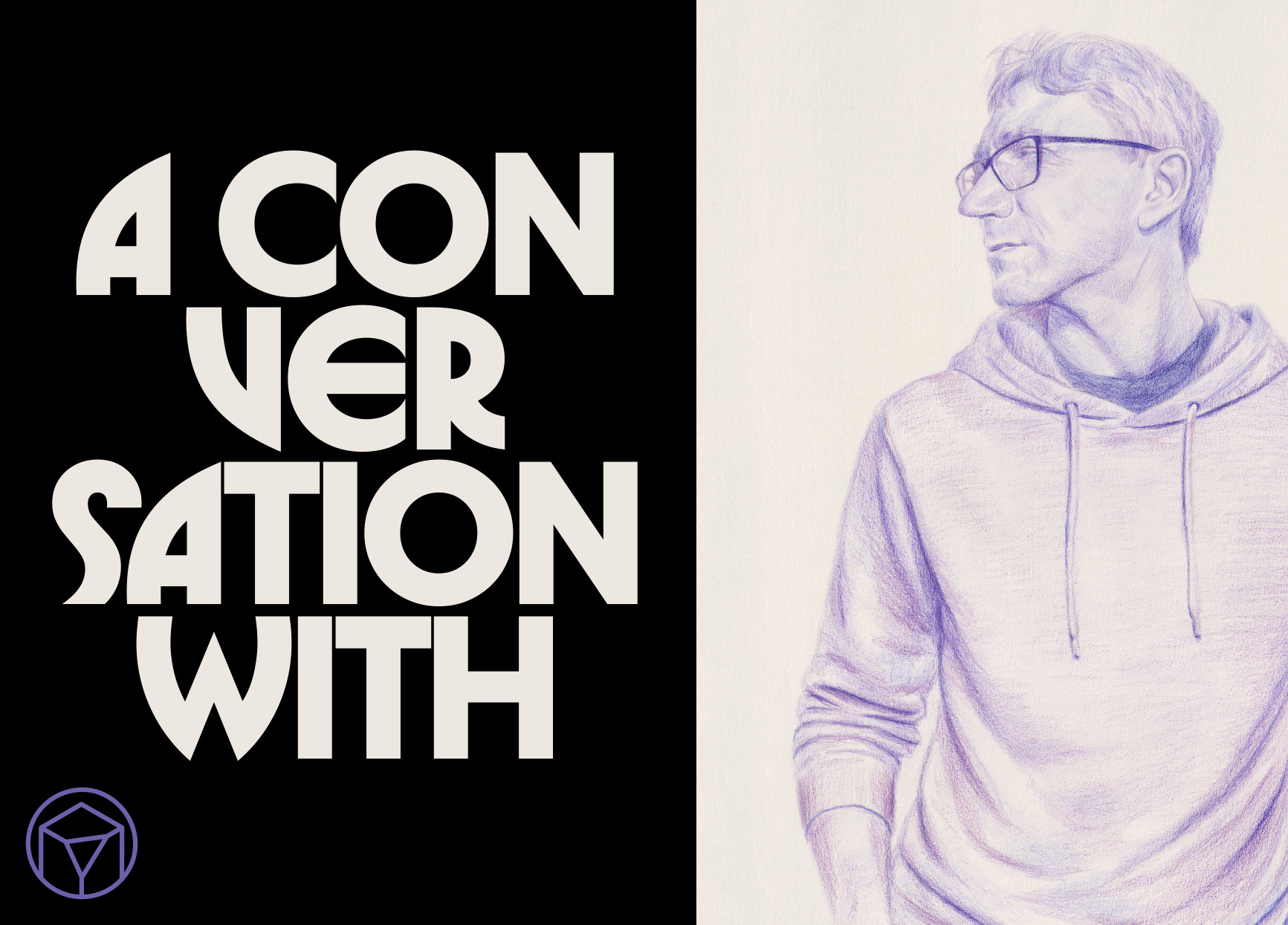
Stuart Turton is the author of intricate, finely wrought novels like The Seven Deaths of Evelyn Hardcastle, which examines ideas of destiny, determinism and forgiveness through the lens of a mystery that invokes both Agatha Christie and Bill & Ted. His most recent book is The Last Murder at the End of the World.
This interview appears in volume 001 of Chisel in truncated form.
Christian Donlan: Your books feel like they come from an obsessive place. Is that the kind of person you are?
Stuart Turton: I would describe myself as not a very obsessive person. That’s not a thing I do. I get into a project, and then generally I leave it behind. But I’ve been thinking about this, and it turns out my Roman Empire is time. I’m always thinking about time. I’ve studied time for books. I studied it as a narrative [element], but also, when I went to university, I did an English philosophy degree, and lots of my modules were about time.
So this is time in all its incarnations?
ST: It’s the mechanics of it, the semantics of it, all of time. But I’ve started to realize that everyone’s fascinated by time. Everybody thinks about it in different ways, right? I’m 46 now, so everyone I know is nostalgic. That’s time. Everyone’s worrying about the future. Worrying about the future is time.
But my specific thing is: I have entered a sniper’s alley. At 46, people around me are just dying. The older generation, I’m losing them. My dad has got dementia. He’s in the final year of his life, probably. My mum was telling me that his niece had come in and sat with him the other day. My dad never got on with this niece for all these different reasons. But this time with her, he was so fond and so caring. And when she left, my dad started to cry, and he said to my mum, “Has your mum gone?” Because he thought his niece was my mum’s mum. So my dad’s living [in] this peculiar place with his dementia where people from his past can wander in. They’re just there, and they sit with the people in the present, and his brain has gotten rid of that distinction completely.
[Time] ties into everything. I’m always thinking about nonlinear time. And it’s not just a sniper’s alley. I have two children, a two-and-a-half-year-old, and I have a seven-year-old, and they are fucking gorgeous. They are brilliant little girls. I absolutely adore them. And I was sat reading a story to my seven-year-old the other day, and had the most selfish thought in the world: I don’t want this version of her to go away. I don’t want that version of her to go away. She will be 8, 9, 10, 11, 12, and the relationship will shift and alter. But I fucking love this version of it. This one right here I adore. And I was like: if somebody gave me the power tomorrow, I would freeze it here. That’s how selfish and monstrous I can become. I would hold it at this age and just have it at this age forever. It got me to the thought of: I can’t allow myself to believe that this version of her evaporates, that this moment goes. I can’t give myself that belief.
Do you have your own personal understanding of time?
ST: If you’re interested in time, it quickly becomes apparent what kind of person you are. When I look at the science, the concepts of time I want are the ones that give me most comfort. It’s like believing in the afterlife. So the idea that my family doesn’t evaporate [when they’re gone], that they’re shuffled to the back of some dark cupboard, and I just can’t see them, but they continue to exist, I find that very comforting.
And there is a philosophical examination of that. There’s a philosophical, scientific explanation of what that is. It’s all that sort of stuff. It’s that connection. It’s that interjunction between what I want and what brings me comfort, but also me being mechanically interested in the movement of time.
I’m also in the sniper’s alley at the moment. My mum has Alzheimer’s. I’ve found that I’m curious as to what life is like for her. Because she seems to live in this endless present, but there must be breaks that I don’t witness. There must be breaks where the present begins again and everything else is jettisoned.
ST: We go back to the mechanical underpinnings of time, right? And as awful as these things are, that is like presentism, right? It is that idea that there is no past and there’s no future, there’s only this immediate moment and everything else is a story we tell ourselves. And when you see people with dementia, like your parents, my dad, it’s fascinating to see that almost in action. My dad has become an experiment for a philosophical tract.
It sounds like you’re into this philosophy and the science, but also the practical element of: we exist, and we’re trapped within this thing.
ST: Yeah, well, I am a practical person. I’m not theoretical. For me, all of my thinking often comes through writing. So I don’t understand [something] until I’ve written [about what] I don’t understand. And that’s almost what the novels are. The novels are me attempting to get to grips with things that are bothering me.
And this is what my journalism was for years. You go away and talk to a bunch of people who are much fucking smarter than you, and then you’ve got to condense all that information so that people of your intelligence can understand it. It’s this process of filtration.
I still do that now. I will go away and read these books. If you read Einstein’s Dreams [by Alan Lightman], I’ve just got finished with that, and I was like: this feels like a man attempting to do the same thing. It felt, for me, that [the book] was a man attempting to reconcile, read all the learning, all the understanding, and then turn it into this other thing where he could understand and reflect back to him what he was trying to get to.
So it is that. I love the theoretical side of it, but I need to understand it in practice. I need to see it. [When you consider] the quantum stuff and about the geography of light and time, my first understanding of it was genuinely when I wrote a paper on it for university. And I remember thinking about the growing-block theory of time as well: the past and the present are static and the future’s moving. And I had this idea of it as a very big, dark cupboard. You’re just at the doors to the cupboard. And everything in your life is moving. You’re pushing things to the back of the cupboard all the time. And once I had that, I had the entire theory. I got it. But I need that. I need to write it down, and I need to visualize it and then go into the world and see it. And until then it’s a sort of mess in my head. I can’t put it together the way I want.
When did you first start to realize that there was this thing called time that we were all moving through, or stuck within?
ST: I remember very clearly having this moment. I would have been young. My dad used to come home from work, and then we would watch the A-Team. This was our little tradition. I remember sitting down with my dad, and I was in the crook of his arm, and then my sister was on the other side of him, and my dad had a can of Guinness. And I remember, as a kid, thinking: “this won’t happen again.” And I don’t know what caused the thought. I remember being incredibly mournful about it. I knew it. I knew this ephemeral thing, this moment, would go out from underneath me and I wouldn’t go back to it. It’s the old, “you can’t step in the same river twice” thing. I could have cried I was so sad, even though I knew the A-Team would be on next week and my dad would come home next week. Even so, I knew that this version of it, this specific time? This was never coming back.
Were you the kind of kid who had these epiphanies a lot?
ST: I was always preoccupied by stuff that no one [else] seemed to be particularly preoccupied by. But moments like that, when I’d be looking at the world and there was something about seeing it through a kid’s lens? It’s like too much emotion and you’re trying to pull it into too small a vessel.
How did you deal with it as a child? Because that’s a lot.
ST: I don’t remember. I truly don’t. I remember the epiphany. I remember the moment of it. My dad was never a very emotional guy. My dad was a working-class manual laborer. He built walls for a living, right? That’s what he did, and that was the way he viewed the world. It was only much later on I realized that there’s a really sensitive soul there, right? But he was only like 22 when he had us really, which ... I’m 46 and I’ve got two kids. My dad’s kids were fully grown up by the time he was 46. It’s easy as a child to look at your parents’ flaws. And then to put them in context: my dad was 30. He was working a couple of jobs to try and pay for this family, and interest rates were sky-high, and it was just his life. His entire childhood, his 20s, had vanished underneath him because he had these kids.
My mum said this the other night. She was down, and she was talking about [life] in the ’80s. It was like: is your kid alive at the end of the day? Yes. That was it. That’s all you had to do as a parent. Keep them alive till the end.
That’s what parenting was, and then all of a sudden, we got very sort of touchy-feely. My mum loves the grandkids, and she plays with them. But she was like, the way we parent [is a sort of:] “my time is your time” sort of thing. Whereas my mum was: “No, no, my time was my time, and you were expected to get on with your own things over here.” And I remember that very vividly.
And it’s a societal expectation of how we parent now, how much interaction we give our kids. And it all comes down to the idea of time, these two things existing completely parallel like that. And again, this idea, for me, it feels – and it generally does – that the moment that my mum was talking about is here. I can almost feel like you can touch it. That moment of life existed, and it [still] exists somewhere. I need it to exist somewhere. I need the idea that it’s just there out of reach of the back of the dark cupboard.


Fascinating read