



Ever since my son was born, each day feels like I’m being drawn and quartered, because for the past 12 months I’ve been caught between the meat hooks of time. I look at my son and I’m filled with excitement for all that is to come in his life – the games we’ll play, the trips we’ll go on, the conversations we’ll have, the jokes we’ll make, the boy and then young man he will be. I see the son he already is and will continue to become. I see the father he is shaping me into. But I’m also filled with the pangs of passing time, for every first is gone as soon as it arrives. His first smile and laugh, the first clap of his hands, his first steps. Time’s robbery is that I do not get to relive those. People will tell you that the passage of time is bittersweet, but on certain nights when I’m putting my son to bed, it mostly feels bitter.
Alan Lightman, an MIT astrophysicist and author, wrote a novella in 1994 that I’ve been returning to a lot this year. Einstein’s Dreams imagines the young Einstein working in the patent office in Bern while he dreams through the different permutations of time under his then-developing theory of relativity. Lightman takes us into snapshots of these different worlds, where past, present and future do not behave in the same way as in our universe. What Italo Calvino’s Invisible Cities did for descriptions of place, Einstein’s Dreams does for time. We are immersed into the dreamscape of worlds similar to our own, but which a few minor changes render so fantastically different.
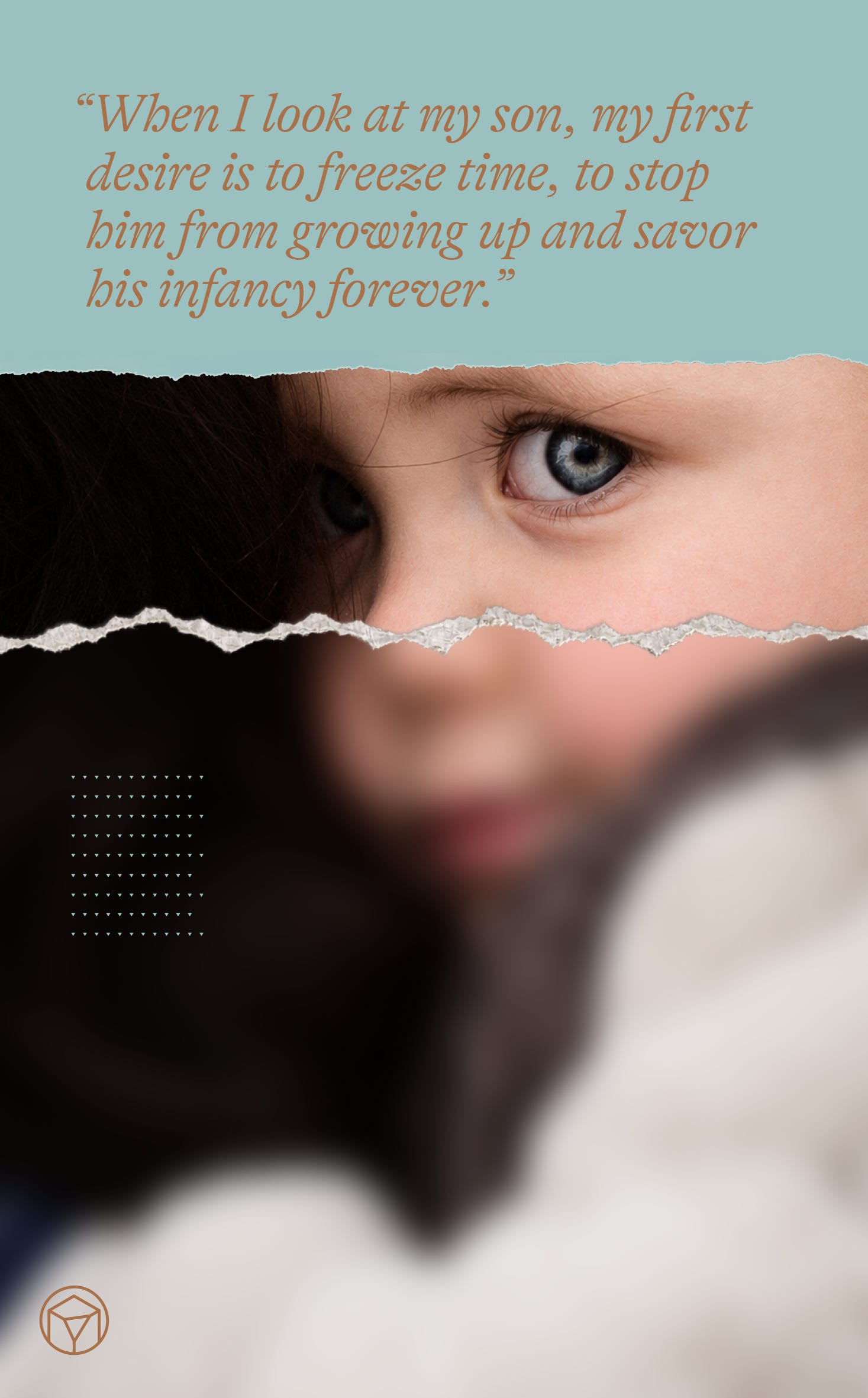
When I look at my son, my first desire is to freeze time, to stop him from growing up and savor his infancy forever. Lightman gives us such a world: a universe where there is an epicenter to time, a place where time does in fact stand still, where “raindrops hang motionless in air … pendulums of clocks float mid-swing.” He imagines people making pilgrimages to this place, imagining that “as a traveler approaches … he moves more and more slowly. His heartbeats grow farther apart, his breathing slackens, his temperature drops, his thoughts diminish, until he reaches dead center and stops.” What kind of person would make a pilgrimage to the center of time? Lightman identifies two categories: lovers, and parents with children.
For the lovers it’s quite simple, they want to share a charged moment of passion for eternity. But for parents, the motivation is more complicated. Lightman describes it like this:
“[A]t the place where time stands still, one sees parents clutching their children in a frozen embrace that will never let go. The beautiful young daughter with blue eyes and blond hair will never stop smiling the smile she smiles now, will never lose this soft pink glow on her cheeks, will never grow wrinkled or tired, will never get injured, will never unlearn what her parents have taught her, will never think thoughts that her parents don’t know, will never know evil, will never tell her parents that she does not love them, will never leave her room with a view of the ocean, will never stop touching her parents as she does now.”
This passage stops me in my tracks. What seems like a natural desire – to freeze your child before they get too old, so they can never be hurt and never do wrong – is revealed to be horrific. The child is a butterfly pinned under glass, for the parents are motivated more by fear than love. A natural fear, maybe, but the desire to stop a child’s growth is ultimately grotesque. It is anti-love and anti-life.
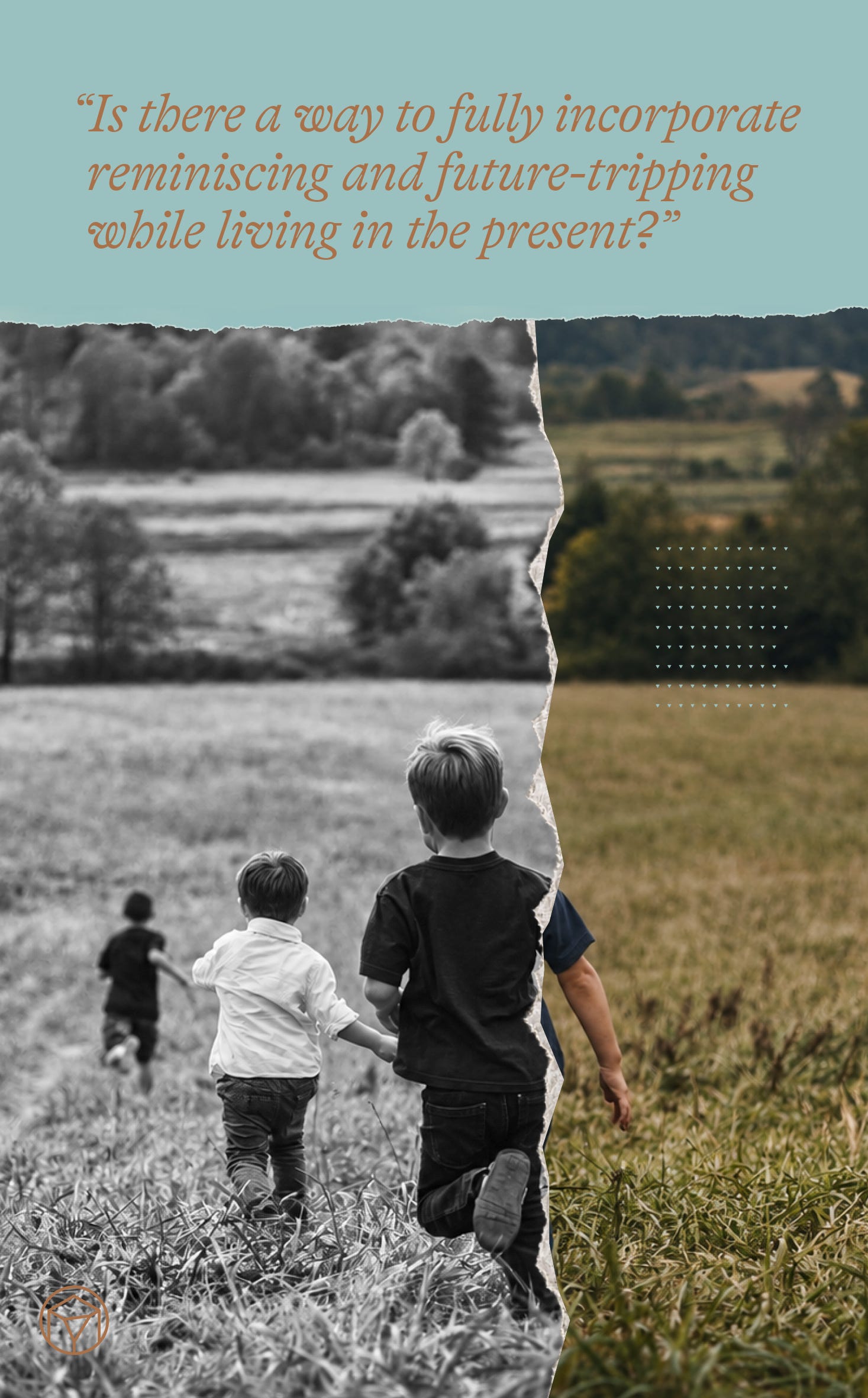
Lightman offers two opposing reactions to the concept of freezing yourself in time, from two different camps of people in this imagined world. The first camp is against the concept, stating that while life may be a journey of suffering, there is a nobility in the suffering and “without time there is no life.” The second camp are proponents of the practice, preferring an eternity of contentment “even if that eternity were fixed and frozen.” But I’m wondering if there is a third way, because neither of Lightman’s alternatives feel adequate. Is there a way to fully incorporate reminiscing and future-tripping while living in the present?

Whenever I’m feeling melancholy about the swift passage of time, some rational part of my brain sternly instructs that I need to snap out of it and “live in the moment.” We’re told we shouldn’t focus on the future or the past, only the here and now, but this internal voice strikes me as schoolmarmish and unhelpful. The present barely exists. Every moment is swiftly pulled into the past never to be repeated, and my fantasies of the future can stretch on forever. The past and future are both infinite, whereas the present is miniscule. Why would I want to restrict myself to the narrowest sliver of time?
In one section of Einstein’s Dreams, Lightman describes a world with only the now and therefore without memory, where “each night is the first night, each morning is the first morning, each kiss and touch are the first.” This is a world of the constant present. In order for people to know who they are, they must carry a Book of Life, which is filled with the history of their life, for without this Book a person becomes “a snapshot, a two-dimensional image, a ghost.” Lightman seems to be saying that to live solely ‘in the moment” is dangerous. It renders you insubstantial. But becoming too wedded to your memories can be dangerous as well. In a different section of the book, Lightman describes a patchwork town made up of streets and houses stuck at various points in the past. Individuals hang on to some era of their lives and then remain fastened there, unable to see beyond their defining moment, literally living within the architecture of their childhood homes or first marriages or other glory days. Which sounds fine enough, but Lightman accurately depicts it as a tragedy, for no one in this world is happy. They are utterly lonely, for “a life in the past cannot be shared … each person who gets stuck in time gets stuck alone.” The only thing more hellish than having no memories is being trapped in them.
And what about the future? Lightman does depict a universe where there is no such thing as a future. Time is “a line that terminates at the present, both in reality and in the mind.” Nobody can imagine the future, it’s no more possible than seeing colors outside the visible spectrum. In response to this uncertainty, people “cling to the present as if hanging from a cliff,” terrified for any moment to end because “each laugh is the last laugh” and “each parting of friends is a death.” This confirms that I don’t wish for a world without a future. Looking forward to tomorrow is just as important as enjoying the days that have been. I am looking forward to walking into my son’s bedroom tomorrow morning and picking him up from his crib and watching his face light up all over again. His chubby face another day older, his wispy golden hair another millimeter longer, his mind another day more developed. My love for him another day deeper.
In yet another of Lightman’s micro-universes, cause and effect exist, but are so erratic that sometimes events get jumbled and you can’t be sure what action caused which outcome. This chaotic randomness seems exciting, as it appears to offer freedom: You can’t be sure the past is affecting the present nor if your present is affecting the future, so there is no need to dwell on the past or weigh your present actions in terms of future consequences. Rather, each act can only be judged on its own, regardless of what happens before or after. One gets the distinct impression this is a world Lightman would enjoy living in, a world where families comfort a dying uncle not because of an inheritance that may be left to them in the future, but solely because the uncle is loved at that moment. Idealistically, Lightman imagines this is “a world of impulse … a world of sincerity … a world in which every word spoken speaks just to that moment, every glance given has only one meaning, each touch has no past or no future, each kiss is a kiss of immediacy.” And I can’t deny there is something gripping about a life so spliced into moments. But it would be, as Lightman admits, a life of islands, unmoored in the sea of time. In such a world there would be no texture to any relationship, because the best and deepest relationships are built like any structure, one shared moment resting on top of another, each interaction setting a foundation for the next. I don’t think I would want to bring my son into such an unstable world, where we could never build anything substantial between us.
Increasingly, I find myself wanting to integrate all aspects of time when I’m with the people that I love. I want to hear the notes of their past, present and future played together in one harmonious chord. And I don’t want to constantly reprimand myself for dwelling in the past or imagining the future. One image that keeps coming to me is the layers of geology, rocks of different eras stacked atop each other. Epochs and ages that are vastly different meet in the same pile of sediment, thanks to the compression of time and gravity. When viewed vertically, down the rock layers, we see a superpositioning of time, but these different eras are happening simultaneously when scanned horizontally. And this is what I sense within me, within all of us. My whole life, past present and future, is held inside of me, and it’s all happening simultaneously. Lightman’s image of a “center of time” with concentric circles around it reminds me of the rings of a tree. I want to experience time as a tree does, integrating all the rings, all the years, into one experience.
To use another metaphor: If time is indeed a trinity of past, present and future, then I want to experience all three aspects simultaneously. I don’t want to focus on one aspect of time to the exclusion of the others, unbalancing the triangle. Lightman describes a world where time is a “quality” instead of a quantity. So events are recorded by “the color of the sky, the tone of the boatman’s call on the Aare, the feeling of happiness or fear when a person comes into a room.” And thus an event like the birth of a child is not a fixed point in time, pinned by days, hours, minutes. Instead, events “glide through the space of the imagination, materialized by a look, a desire.” The specific shade and slant of a sunset piercing your kitchen window is the same as when you first fell in love. The smell of ripe bananas is when your child first smiled at you. The impulse to sprint across a field of wet grass is the day you graduated from high school. The taste of your tears is the night your grandmother died.
Time as both a quality and as something measurable that stretches out in three dimensions – this is the relationship with time I’m trying to achieve. I want to look at my son and see him as a newborn, an infant, a toddler, a boy, a teenager, a young man. I want to feel the way I did when he was born, when he first fell asleep on my chest, when he first wrapped his pudgy arms around my neck. And I want to be his father through each of those stages: before, during and after each moment has occurred. I don’t want the present to blot out the eternally shining future or the infinitely shimmering past. I want them all happening around me and through me, simultaneously. Call me greedy, but when it comes to my son I want Einstein and Lightman’s experience of time – relative but constant, subjective but eternal, expansive but deeply personal.

