


Marcel Duchamp married Lydie Sarazin-Levassor in June 1927. Their marriage would quickly end, with Sarazin-Levassor leaving Duchamp due to infidelity. It was not another woman who had stolen Duchamp’s heart; as far we know, he was entirely faithful by the conventional meaning of the word. We can assume that he was, in matters of sex, entirely within the bounds of his wedding vows. The problem was that his heart belonged to another from the start – not to another woman, nor to art, as you might expect, but to chess. Duchamp was so obsessed with the game that he spent his honeymoon neglecting his new bride, instead preferring to study chess problems. In a fit of jealousy, Sarazin-Levassor glued the pieces to the board while Duchamp slept.
Some have speculated that Marcel and Lydie’s marriage was one of convenience, and perhaps it was doomed from the start. They divorced within months.
Duchamp is now remembered for his contributions to art. Any survey of art history will include some mention of his Fountain and other readymades. He is a provocateur, a Dadaist, a visionary – or, for those more traditionally minded among us, a hack who exposed the shallowness of the art world. But when I think of Duchamp, I think of him hunched over the board. I think of him as a fellow chess obsessive.
His obsession paid dividends. He became a successful theorist of the game, a chess journalist and a Grandmaster. But it came at a cost: Duchamp all but abandoned his art career to devote himself to chess. Yet Duchamp did not quite see it this way – his love of chess and his love of art were one and the same. “I have come to the personal conclusion that while all artists are not chess players, all chess players are artists,” he told the New York State Chess Association in 1952.
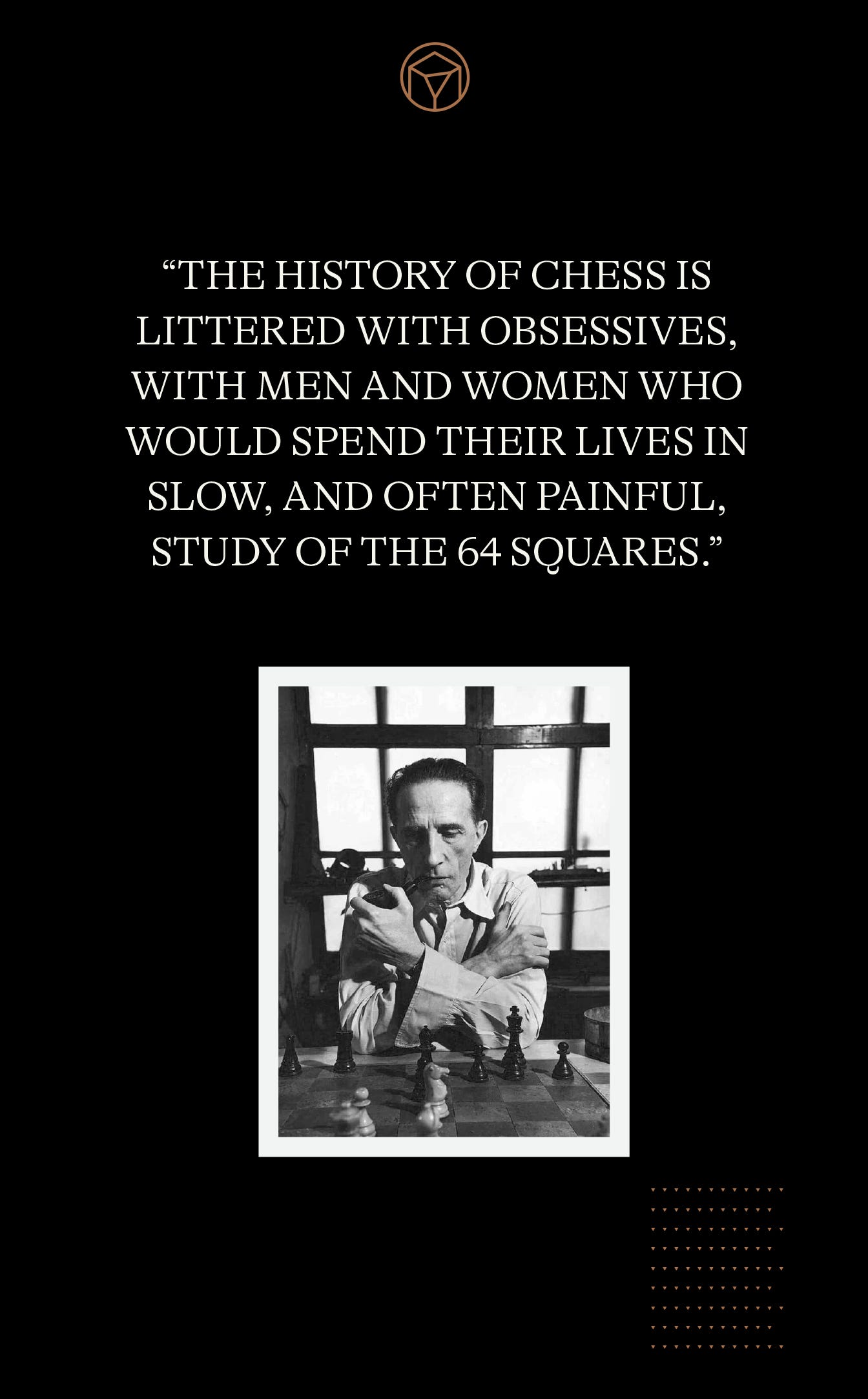
The history of chess is littered with obsessives, with men and women who would spend their lives in slow, and often painful, study of the 64 squares. This raises a question: What about chess draws us to it? Why do so many choose to give their lives to the game?

I cannot remember a time when I did not know how to play chess. That is part of the game’s appeal. A child of 4 can learn how to move the pieces, and many can have a grasp of basic tactics and strategies by age 6. Certain children take to the game immediately and within a few years are regularly beating their teachers. I was not one of those children. I loved board games as a child, and my favorite game was Risk: I wanted to play war games, and I spent hours thinking of ways to best my father. I did not know at the time that chess was an ancient war game, nor did I see its mystical depths.
That came later, when I was well into adulthood. I was in my 30s, in fact. I had found a job in tech, and I soon discovered that many people at large tech companies spend a lot of their time trying to look busy. They furiously opened and maintained tickets, sent out endless emails with near-identical project updates, and did whatever they could to justify continued employment. It is easy enough to fool everyone because many of the people you’re trying to fool are trying to fool you, too. With the right volume and cadence of emails and Slack messages, you can get by for a time. But I needed something to do with my time, and so I took to chess.
It started on my phone. I would play games online, but what I really loved were puzzles. Increasingly complex positions were presented to me, labeled with something like “White to play and win.” Soon, I found chess books, and my wife gave me a small magnetic chess set I could fit in my backpack. While at the office, I would find a corner cubicle, or sometimes even a bathroom stall, and I would try my best to solve increasingly complex puzzles. I would spend hours a day looking at the board.
Chess is remarkably simple in its presentation yet infamously deep. The way a novice plays – frequently hanging pieces, failing to spot opportunities to exploit, seemingly moving pieces at random – is so distinct from the way a Grandmaster plays that it seems as if they are playing by another set of rules, moving pieces in ways a beginner cannot comprehend. But it is always the same game: 64 squares, 16 pieces on each side, placed in the same arrangement again and again. The difference is found in a Grandmaster’s ability to see the board.
A good riddle uses simple language to present a puzzle, or maybe a paradox, and when you first hear the riddle, it should seem impossible to solve. But once you have solved a riddle, the answer is obvious. So long as you remember the first time you encountered it, you will never be puzzled by it again. You can see it for what it is. A good chess puzzle is exactly the same. At first, it should seem impossible: Every possible move can be countered, and the situation can seem hopeless. Once you solve it, you see the position truly, and you see that the game could have gone no other way. The language of the riddle did not change, and neither did the position on the board. The difference is entirely within you.
This is most starkly on display when you play someone much better than you. Eventually, the better player will make an inscrutable move, a move that to the lesser player seems like a blunder. If you are not careful, you will think to yourself, How can they not see it? You’ll take the piece, hopeful for a moment that you have gained the advantage. Perhaps I can win, you’ll think. And then the response comes, and the position becomes clear to you – you can see now that you have lost.
Improving at chess is simple but never easy. The first lesson that a new player must learn is to use their time. This may seem obvious, but many middling players struggle to follow this advice. They want to reserve their time for when a position becomes complicated, perhaps thinking that they will need it in the endgame. They make their moves quickly, and they frequently blunder. Slowing down is not enough, however. You do not simply let the clock run down and magically become better. You use your time to look at the board. A chess coach – a Grandmaster, in fact – once told me that when he taught children to play chess, he told them to sit on their hands. They must learn to consider the position, to avoid making the obvious move (or, more appropriately, the obvious mistake). Sitting on their hands, they had no choice but to look, and only look, at the board.
The more time spent looking at the board, the more you can see. The complexities of the game unfold before you. A new possibility emerges in your imagination, and you begin to explore it. You are overtaken by a sense of wonder. That feeling – that experience of discovery – is what draws us to the game.
It is not known if Nietzsche ever played chess; there is no mention of it in his work, nor any by his biographers. Yet a passage in Twilight of the Idols is some of the best advice for a player who wishes to become better. Late in that book, Nietzsche identifies three tasks that require an educator, and the first one is learning to see. By default, you assume that “you have to react, you follow every impulse,” he says. You must learn “not to react immediately to a stimulus, but instead to take control of the inhibiting, excluding instincts.” These instincts allow you to postpone judgment, to avoid easy (and often wrong) categorization, and to “take stock of an individual case from all sides.” In an odd turn of phrase – for Nietzsche, at least – he calls this “the first preliminary schooling of spirituality.”
It is an odd turn of phrase because we do not associate Nietzsche with any sort of spirituality. We think he is an anti-spiritualist because he is the prophet of the Death of God. But this reaction to Nietzsche stems from the exact problem that he is trying to diagnose. We read Nietzsche as the great critic of Christianity, of theism more generally, and, of course, of traditional morality, and so we try to categorize him as opposed to any sort of spirituality. We have moved too quickly. We have reacted to an immediate stimulus. We are not truly reading him, because we are not taking stock of the case from all sides. Just as he does with virtue and meaning, Nietzsche is providing a reinterpretation of spirituality in those pages.
Was this what Duchamp attempted to do with his readymades? By sticking a urinal in an art exhibit and signing it “R. Mutt,” Duchamp provoked us into thinking about what art is. We cannot look at a urinal and admire its beauty. We do not feel overwhelmed with a feeling of the Sublime. It does not draw us closer to nature, or to God, or to greatness, as we would like our art to do. Instead, it forces us to reconsider what art can be.
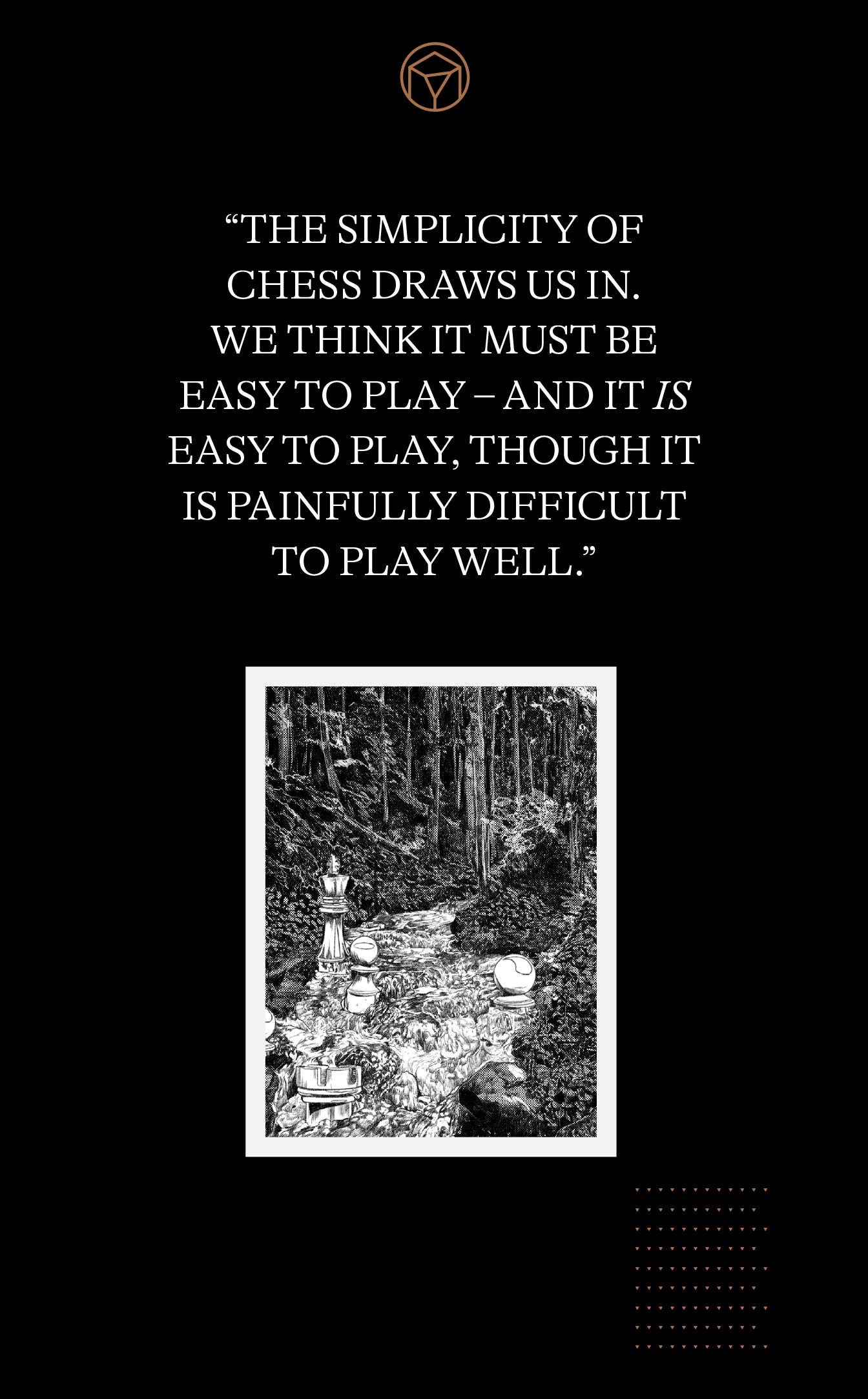
The 64 squares do much the same. The simplicity of chess draws us in. We think it must be easy to play – and it is easy to play, though it is painfully difficult to play well. As you slow down, as you begin to look at each game as an individual case, you see its complexity. You see that wooden pieces on a checkerboard can create a kind of geometric art. Players often describe positions as difficult or tricky, meaning it is hard to see where to go next; sometimes, though, they look at the board and call it beautiful.
Hikaru Nakamura, one of the leading Grandmasters in modern chess, has said that the game is more fun, more enjoyable, for players who have not yet achieved a FIDE title. At 1700 ELO or so, a player will still be learning, discovering new things on the board. Becoming even a Candidate Master – which calls for a minimum ELO of 2000 – requires significant time for memorization. Aided by their astonishing capacity for memorization, the top Grandmasters can calculate extraordinarily complex lines and variations; without this memorization, a lesser player cannot hope to compete; skill and intuition will never be enough. And according to Nakamura, the game becomes less enjoyable as it becomes a matter of rote memory.
Only one American has ever held the title of World Chess Champion: Bobby Fischer. Fischer famously hated opening theory, the term used for the collective accrued knowledge of various openings in the game. So much so, in fact, that he invented a new variant of chess, which he dubbed Fischer Random. (It is now more commonly called Chess960, a reference to the number of possible starting positions.) Fischer’s disillusionment with chess was similar to Nakamura’s observation: Opening theory had led to chess becoming a game of memorization rather than discovery. You did not need to really look at the board if you were sufficiently familiar with the standard openings.
In a 2009 documentary, which premiered a year after his death, Fischer was asked if he was a better player than the legendary Paul Morphy, a 19th-century American player who was arguably the best in the world while alive: “I’m better than Morphy … I don’t say that I have more talent than him, I know much more theory. It has nothing to do with his talent.” Instead, Fischer’s advantage was his position in history. This was precisely the problem with standard chess: “Chess is a search for truth … and the truth is chess is no good anymore.” Fischer had played chess at the highest levels, had defeated the best players in the world, and then he had looked at the game and found it lacking. The mystical character of chess that I have described disappeared as the study of chess took on a more scientific character. There was nothing left to discover.
So he pioneered and championed Fischer Random. It is impossible for even the best players to memorize the opening theory of this game because there are too many variations. The human mind simply cannot hold that much information in working memory. Instead, these players must approach each game as if it is entirely new. They are forced to look at the board, to see it as a unique case. I suspect that randomized chess, when it is played at the highest levels, recaptures that mystical quality. So long, of course, as you have learned to see.
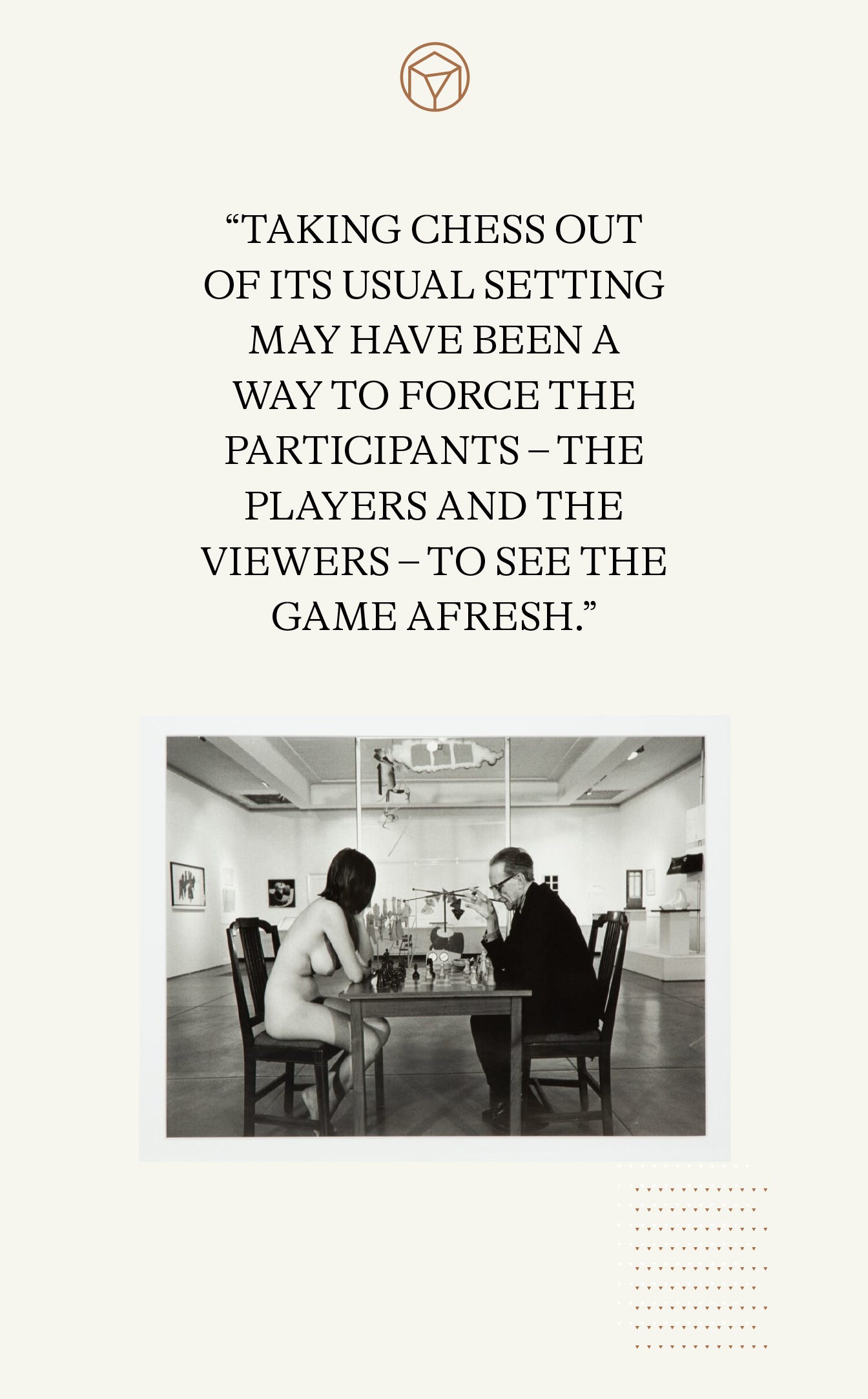
In the final decades of his life, Duchamp staged chess games in odd circumstances: life-size chess in fields, floating chess games in lakes, a game of chess with Eve Babitz that she played entirely in the nude. Taking chess out of its usual setting may have been a way to force the participants – the players and the viewers – to see the game afresh. When Duchamp displayed his readymades, ordinary objects were elevated – transformed – into art by their setting. This is art, he was saying, if you can only look at it in the right way. When Duchamp took chess out of studies and tournament halls, he revealed to the world what he had learned for himself: that what took place on the board was already art, but that we must learn to see it afresh. The game itself does not change, but Duchamp forces us to take stock of the game from all sides.
No variation in rules is required – we now can see the game in a new way.


Such an enjoyable read.