


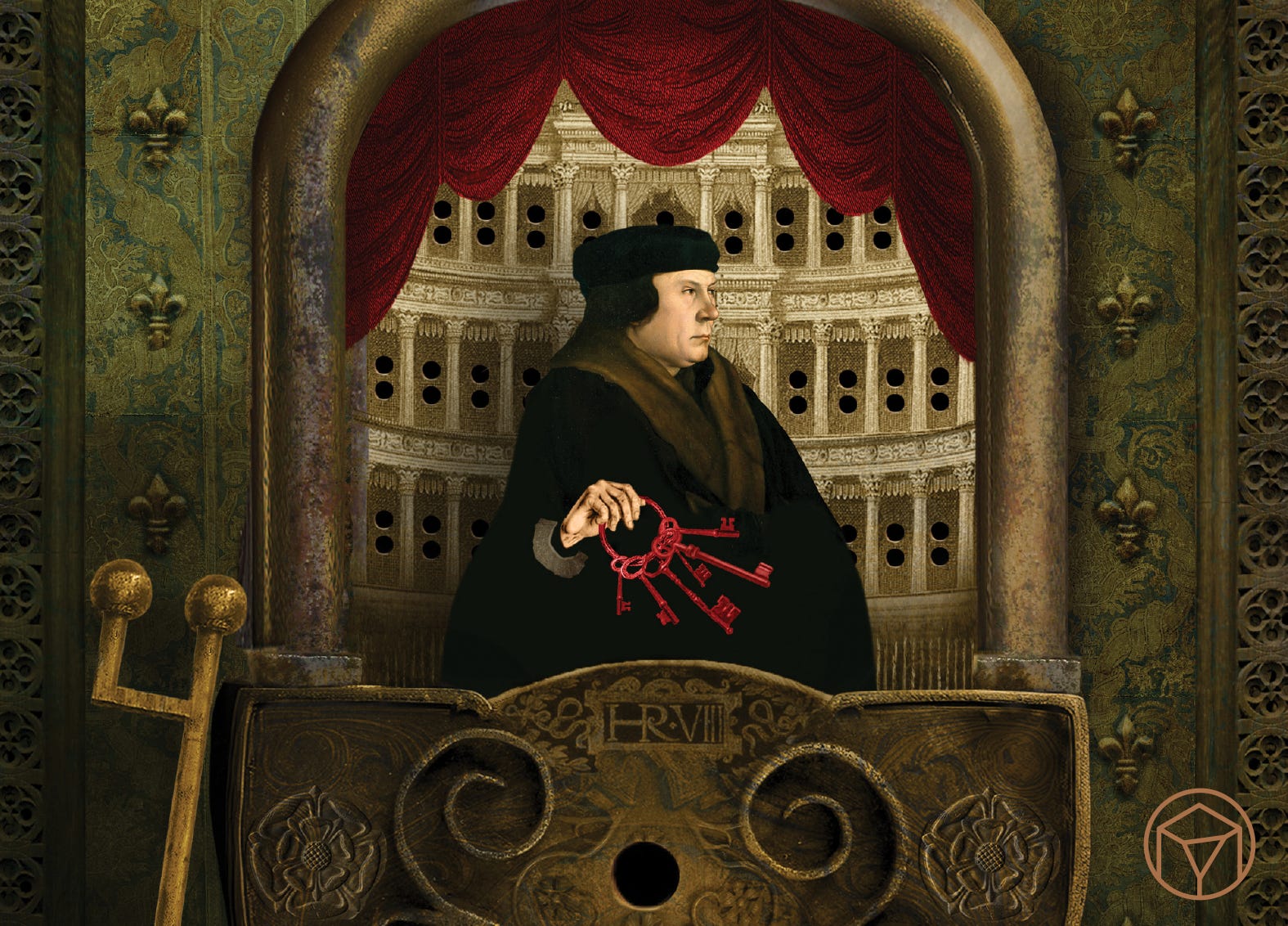
I am obsessed with a certain colon in Wolf Hall, the first of three books in the late novelist Hilary Mantel’s fictionalized life of the 16th-century English power broker Thomas Cromwell. It appears at the top of page 46 in my foxed and softened Picador paperback – the one with the bloodred cover, where the beady little eye of King Henry VIII peers out from the O in the title and the crescent-moon profile of Anne Boleyn makes the A like a cell in the Tower of London.
At this early stage, we have met Cromwell’s mentor, Cardinal Wolsey, one of my favorite literary personages, in all his glory. But now we are leaping ahead to glimpse his downfall, after his project to annul Henry’s marriage so he can wed Boleyn has failed. The dukes have come to Westminster to turn the cardinal out. They are taking away his treasure chests, his crimson robes, his gospels made of “slunk vellum from stillborn calves, reveined by the illuminator in tints of lapis and leaf-green.”
And they are taking his tapestries, “the scenes of secular pleasure: the sportive peasants splashing in ponds, the stags at bay, the hounds in cry, the spaniels held on leashes of silk and the mastiffs with their collars of spikes: the huntsman with their studded belts and knives, the ladies on horseback with jaunty caps,” and so on.
Now, that first colon is perfectly ordinary, but the second one blows my mind. You’re probably bracing yourself for a zesty defense, à la Mary Norris or John McPhee, of why it’s actually apt, or at least gives the passage a nuance unavailable by more standard means. No – in any reading I can see, it’s just plain wrong; in no way do the huntsmen and ladies constitute or exemplify the peasants and animals. It’s a random colon (not even semi!) stuck in the middle of a list, and honestly I still wonder if it’s a typo I’m reading too much into. It might bear mentioning that I edit lots of books, and thus I have an almost unseemly interest in punctuation.
It’s difficult to accidentally type a colon when you want a comma. The edition seems well edited, and Mantel’s writing was always highly controlled. I imagine it went like this: The line editor left a query – “Stick with comma?” – Mantel said she had the colon just where she wanted it and with good reason, and a note was left on the style sheet for the copy editor. The wonder of this colon doesn’t lie in its effect; the reader scans the passage as the flat series it is. It’s how boldly it represents the supreme bravado, the brazen but justified confidence, that made Mantel an all-time great stylist. The wrong colon is perfect because the book is perfect, because she willed it so, in prose so forceful and alive that it lenses grammar like gravity bending light.
There are many novels I struggled to get through because I didn’t like them enough. But Wolf Hall is the only one I had trouble finishing because I liked it too much.
I came to it idly, several years after its acclaimed publication in 2009. I’m an interested but picky historical fiction reader, often finding it too stagy or televisual, too knowing or strenuously relatable, the authors too awed by the material or eager to excite me. But the audiobook looked interesting when it came up on the Libby app, and I was about to take a road trip. Why not?
In one big way, audio is perfect for Wolf Hall, and that is narrator Simon Slater. He catches its bluff, dashing rhythms, its idiomatic derring-do, and crafts indelible voices. His Wolsey is gloriously plumped and plummy, Thomas More deliciously acidic and unctuous, Cromwell sharp and sardonic. When I finally got to the printed book, those were the voices, and they’re a big reason why I haven’t watched the BBC show. I just know that everyone will be too good-looking, leering around too significantly. Major adaptations never fail to drain something vital from books that I love, from The Lost City of Z to Gone Girl, where Gillian Flynn’s intense characters are played like they’re on ketamine. I couldn’t stand it if that happened to Wolf Hall.
But there are equally significant ways in which it’s an impossible audiobook, and for a long time, I treated it more like an album of music than a novel. I spent nearly two years listening to it, off and on, roving over some sections again and again, before I got the book and properly finished it, then on through the trilogy. Partly just wanting to bask in the cleverest scenes again, but partly because I kept losing track of the story, which melted around like shadows behind the bonfire-bright characters. This is the measure of an obsession: You can’t bear the thought of reaching the end without getting it all inside you, before whatever kind of time runs out.
I was insensible of that colon in audio form, of course, but turning to print, I realized it was part of a grand grammatical adventure in keeping us alert and off-balance. I had felt lost in the plot because the meaning, the flow, the transitions are finely woven in the text itself, which has its own peculiar rules. The POV is very slippery, an edgeless tide of third-person limited and free indirect discourse. We neither observe Cromwell across history nor inhabit his inner world, but instead we seem to ride on his shoulder, where his thoughts leak out a little. To me it’s like the reader is his conscience.
Mantel’s bespoke grammar isn’t just a caprice – it bends the whole world around Cromwell, whom she almost always calls “he,” antecedent be damned. This sows chaos in a book that is already rife with too-similar names. (“Half the world is called Thomas,” as she mentions – Cromwell, Wolsey, More – and there are way too many Marys and Annes.) This results in sentences like “but when More, a scholar revered through Europe, wakes up in Chelsea to the prospect of morning prayers in Latin, he wakes up to a creator who speaks the swift patois of the markets.” Only recently did I grasp that the pronoun means Cromwell, not More, which changes everything. After all this time, I still can’t read Wolf Hall by rote.
I won’t belabor the point by listing all the libertine colons, chancy commas and parkouring clauses, or the scenes that forsake clarity for richness and subtlety, seeming to fix us with an appraising look that says, well, you’ll figure it out, won’t you? There is a challenge to and trust in the reader that such novels often lack. The story teems with Tudors and Medicis, the Protestant Reformation and the Field of the Cloth of Gold, and all the beheadings you know so well, yet it’s how the style animates the characters that has worn my paperback into its sorry state.
Mantel was fearless in getting right up close to them. Cromwell is a genius of the daring bet, wily like Odysseus without the clownishness, a savvy lawyer who resembles “one of those squareshaped fighting dogs that low men tow about on ropes.” This according to the cardinal, feted for “his wit, his sense of wonder and of beauty, his instinct for decorum and pleasure, his finesse,” and damned in “a great unweaving of scarlet thread that might lead you back into a scarlet labyrinth, with a dying monster at its heart.”
How historical is all of this? As a reader of history, I’d want to know, but as a reader of fiction, I don’t mind being fooled. In fact, I insist on it. With her uncompromising style, Mantel demands we pay attention and help make meaning, as history too demands of us, indifferent but bearing some silent expectation.
It’s what Wolf Hall does wrong that makes it feel right – so vivid and unfolding, so near yet strange, so enticingly realistic, and all through one person’s inspired, idiosyncratic command of the same little symbols we all share.


I enjoyed this! My pet theory is that all great long novels have in them one glaring mistake.