


Last October, I sought the help of a professional gamer to coach me in Valorant, a teambased first-person shooter in which players are tasked with planting or defusing a bomb (or, better still, just killing all of their opponents). I have played – according to a back-of-the-envelope calculation – somewhere around 3,500 hours of Valorant in the past five years. That comes out to between 7% and 8% of those five years. The math looks worse if you count just waking hours, and desperately sad if you can conjure up the mental image of a grown man sitting at his desk, face several inches from the monitor, and imagine the cumulative strain of those hours on his posture. I’ve probably been subjected (or subjected my teammates) to thousands of hours of middling, uninspired gameplay.
At my peak, I was statistically one of the best Valorant players, if you accept charitable interpretations of all of those words. In late 2023, I vaulted ever-so-briefly into Immortal, the game’s second-highest skill bracket. I slipped from that vertiginous peak literally as quickly as possible, flunking out of the rank in two matches. Nevertheless, being an Immortal Emeritus notched me a spot around the top 2% of players by rank distribution, placing me among tens of thousands of players lording over the unwashed millions of lower-ranked scum. I once ran this boast – that Valorant might be the one thing I was statistically best at, percentile-wise, among all my skills – by a friend of mine. Even over Discord, I could sense he was frowning. “I think you’re probably a better journalist,” he offered, tactfully.
But in the months since that halcyon day, I had regressed and plateaued, bobbing around what I’d estimate to be the top 8% mark. For the sake of my self-esteem, I needed a professional assessment, a qualified somebody to tell me what I was doing wrong and how to fix it. I reached out to a distant acquaintance, a former pro gamer who offers training sessions for $70 a pop. He told me to record myself playing. We’d review the footage together, and he’d point out my mistakes and offer corrections.
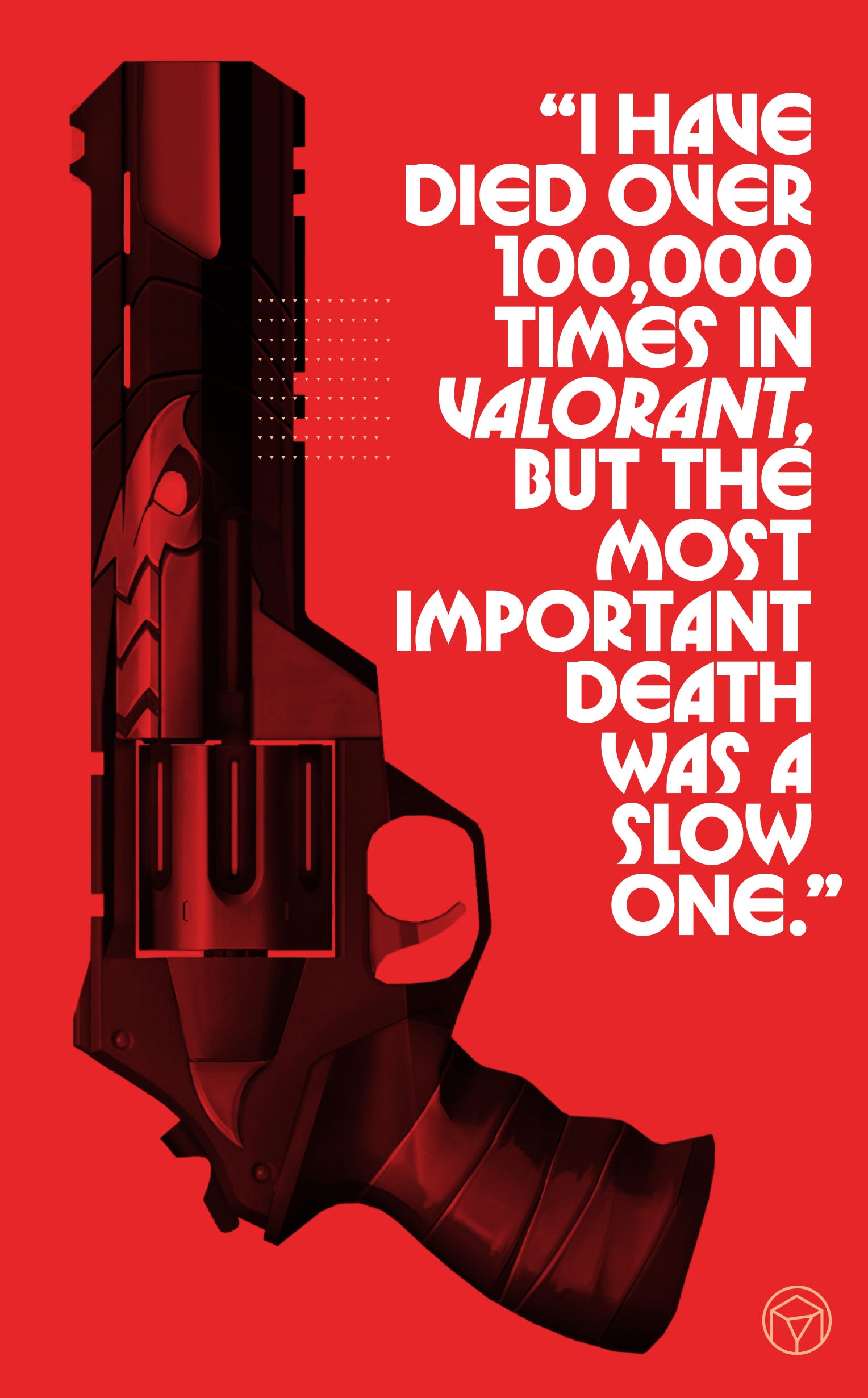
I’ve made a lot of mistakes playing Valorant. At its best, the game is the thinking man’s teamwork-oriented first-person shooter. When teams are evenly matched, Valorant takes on an orderly, algorithmic quality: attack and riposte, attack and riposte, as each team aims to be the first to win 13 rounds.
Few matches meet this ideal of play and counter-play. Often, rounds play out instead like a handful of abortive Rube Goldberg machines. On one side of the map, Player X swings a corner for no apparent reason and has his head blasted clean off by an opponent holding the angle. One domino falls askew, without toppling the others. Elsewhere, Player Z flubs a jump and accidentally falls off the map and dies. Meanwhile, some third player has read the timing of the round all wrong, and is miles away from the action as his team gets wiped out, a mistake he has made enough times to earn him the unflattering nickname the Snail among his friends. (Not that this has happened to me.)
And thus, at its worst, Valorant operates as a sort of psychoactive software meant to induce Falling Down (1993) style crashouts. Recently, I was temporarily banned from the game (for the first time ever, I should note) for bad-mouthing a teammate. OK, that’s not entirely truthful: I was temporarily banned for screaming at this teammate – a complete stranger – calling them a fat, disgusting beast, saying they probably typed with just their index fingers, and mimicking what I imagined they would sound like if they used voice comms by doing eight to 10 heavy breaths directly into my microphone. This profane rant kicked off when this teammate wandered away from the rest of the squad at a pivotal moment in the round without saying anything. (We won the round anyway.) I am 31 years old. The person I was yelling at was more likely than not a child.
I was desperate enough to keep playing that I urgently appealed my ban in a groveling email to Riot Games’ support team: “Dear sir or madam, yada yada yada, I want to express my profound regret over my actions. My juvenile playground taunts – nothing hateful! – were hardly constructive, I now realize. I’ve never been banned before and am generally a member in good standing of the Riot ecosystem. In light of my history of upstanding behavior, et cetera, et cetera, et cetera.” My suspension was, unsurprisingly, not overturned.
I have died over 100,000 times in Valorant, but the most important death was a slow one. In my first year or two playing, I was relentlessly positive, faithful to the idea that any situation and any game was winnable. I hadn’t played a first-person shooter in at least a decade, and I extended to other players the same grace I expected in return: We were all happy climbers, slowly but predictably improving. There was a time, in other words, when I would not have dreamed of joking that I was going to kill myself over the results of a match or round or duel.
Those reservations feel quaint now. Once I’d attained what could be considered a “good” rank in Valorant, a sort of status anxiety set in. Every victory was richly deserved. Losses, however, were personally wounding – a literal but also metaphorical stripping of rank that felt wildly unjust, a conspiracy by people dumber and less agentic than me meant to drag me down to their level. If only my teammates had listened. If only they had gotten more kills. If only they had played in a way that enabled me to get more kills. If only this or that teammate hadn’t made some snide, shitty remark, tilting me off the face of the earth. This map sucks. My teammates are all morons. This meta is horrible. The developers are braindead. The other team is playing so weird. Have I really played three-thousand-some-odd hours and somewhere along the way gotten worse?
I play video games with a consistent group, a pack of guys I fell in with more or less at random, all a few years younger than me. Some of them are … how to put this delicately … precariously employed. And yet, I log more hours than them online playing video games. I cherish their friendship, though my relationship with them has largely played out online; we are virtual strangers, in the sense that for all the hours we’ve spent yapping into each others’ ears, we’ve only met in person a handful of times. We have been, at times, viciously cruel to one another, but also extraordinarily generous and kind. I picked up a taste for Japanese menthols from them at the ripe old age of 29. I hope that they’ll attend my wedding.
A few years back, I began to notice that every morning, for the first several hours of the day, my eyes wouldn’t come to focus. The left eye always felt like it was going over a speed bump catching up to the motion of the right. I could feel it above the eye and under the brow. To fix my vision, I would lightly pinch the less-cooperative eyeball over the skin of my eyelid and jiggle it back and forth to try to shunt it into alignment. Sometimes, I’d dig around with a finger in the space under the top curve of the eye socket, hoping to jostle into place the wiring or whatever was going on back there. The condition made reading difficult, and the stuff of first-person shooting – rapid and precise alignment of crosshair on screen to target – nearly impossible.
Eventually, I saw a neuro-ophthalmologist. An MRI ordered by the doctor uncovered nothing at all, a non-finding that set me back roughly $3,000. If in that time – a year or so of increasingly bad vision, five months of waiting to see the doctor, a few months more to undergo the test and get the results – I even considered that the culprit might be the eyestrain resulting from those aforementioned hours-long gaming sessions, I didn’t take the thought too seriously. To step back from gaming would be to sever what already felt like a tenuous relationship, playing out almost entirely over the internet in the gauntlet of competitive Valorant.
But as the condition worsened, the gulf between what I believed to be my peak and my actual everyday performance widened, made all the worse by the kinds of jokes that are characteristic of a group of 20-somethings. I consider myself a cerebral player, preferring advantageous timings to direct one-on-one duels. But that bit of flattery doesn’t change the fact that I’m just not very good at Valorant’s core mechanic: shooting people. And I wasn’t getting any better. Every missed shot became freighted with meaning: I’m better than my friends can see, but I can’t prove it. To be appraised correctly is to be understood. To be misjudged is crazy-making. Every egregious whiff or misplay became fodder for a mid-coital intrusive thought.
I could feel myself reverting to boyhood, storming out of the proverbial playdate cursing my erstwhile friends after particularly infuriating games. I fell victim to those school-age anxieties – Do these guys even like me? – coming out the back of marathon double-digit-hour gaming sessions, at the end of which everyone is more or less nonverbal. I could feel my neural pathways atrophying with every inside joke repeated unthinkingly, landing to lesser and lesser effect as the night wore on. I grew hypersensitive to small and more than likely imagined changes in social gravity: who’s up, who’s down, who’s spending less time online, who can get people to come online just by getting into the Discord call and who can’t. I toyed with vows of silence, promising to myself on more than one occasion to quit Valorant indefinitely until my friends, on hands and knees, invited me back. And I was also the one to come begging after an unlucky string of matches: “Please, bro. Just one more game. It’ll be normal.”
I have broken that promise (“Just one more game”) hundreds of times, throwing good game after bad, queuing up for another without a passing thought. When I win and queue another, I’m pushing my luck. If I’ve lost, I continue out of despair. It’s a gamble: on myself, on the idea that I can manifest a better performance out of thin air. At a certain point, stupor sets in – the kind of slack-jawed stare that materializes 30 seconds into a short-form video you have no context for and have landed on accidentally, except it lasts all 30 minutes of a Valorant match.
In truth, I play Valorant because at any given moment it is the easiest thing to do. It’s easier than writing. It’s easier than working. It’s easier than chores or exercise or playing an instrument. It’s easier than reading. It’s easier than going to bed. I frequently choose Valorant over all of these things.
“Addiction” is a thorny word when it comes to video games. It calls to mind the anti-gaming panics of the ’90s and early 2000s, the anguished cries of millions of parents: My child is turning into a zombie! When “addictive” is used as a favorable adjective in marketing or press coverage, some critics smartly point out that it’s no trivial thing: Some of us have dealt with real addiction, they say. But I would struggle to choose a better word – compulsion, maybe? – to describe my on-itsface-quite-normal relationship to Valorant, which extracts the maximum of my time and energy for … what, exactly? The reward of a space in which to impress and/or yell at teens?
When COVID-19 hit, I thought I might seize the opportunity afforded to me by lockdown to write an album. Then Valorant came out. Thirty-five hundred hours later, with several thousand dollars invested into virtual in-game goods and a succession of absolutely necessary gaming accoutrements – a desk, fancy chair, mouse, mousepad, mouse bungee, custom keyboard, wrist rest, monitor, monitor stand, headphones and so on – I wouldn’t say that I’m any closer to completing my masterpiece.

As I was recording my gameplay for the coach, I could tell I wasn’t playing well. Still, it wasn’t anomalously bad, something so unexplainably awful that there’d be no point in review. I’d had plenty of games like this before. Not great, not terrible, just sort of nothing-ish. I could learn from this.
I came away from the session with a program – daily routines to train my aim and solidify good habits, and recommendations around in-game behavior to make me a more productive and useful teammate. Toward the end of 2025, I told myself I would commit to that program, with a few health-conscious modifications to dampen the gamer-ness of it all: Wake up early. Stretch. Train my aim following the regimen set by the coach. Warm up my movement in some Deathmatch lobbies. Play a few real games. Pause if they don’t go my way. Turn down invites to team up from friends who might drag me down. Aim train again before bed. Repeat. Slowly climb back to Immortal.
There was a gonzo journalism element to it: I subjected myself to X surprising thing for Y days in hopes of generating Z unusual result. I bought a single pack of Marlboro Reds to smoke if I started to get too silly in-game because I’d read somewhere that academics chew nicotine gum for its focus-sharpening qualities. The idea of maximizing the Oddity Quotient on the experiment for effect really tickled me: getting into powders and peptides or learning about the correct number of milligrams of caffeine to consume daily – things of that nature. I did not, ultimately, pursue those lines of inquiry.
Still, I was eager to get started. So much so that minutes before departing the house to drive to my parents’ house for the holidays, I turned to my fiancée and asked if I could get a quick dub in before we left. She made a face I hadn’t seen her make before. “That would be a little grotesque, no?” she said, after a pause.
The program started in earnest in January. I wish I could say I committed. I wish I could say the monastic tack took, that I summited the ranked pyramid and reached Immortal. In the span of a week and a half or so, I saw real improvement. I stuck with the agonizingly dull aim training – a series of high-speed clicking exercises whose usefulness as a test to detect concussions in professional athletes has been studied.
I can’t say exactly how or why the 3,500-hour fever broke. Maybe it was my friends drifting to other games, the embarrassment of neglected chores, or the sustained attention itself. But I keep coming back to something the coach said as we scrubbed through those 40-something minutes of unremarkable play. Earlier, as he and I reviewed the footage of one of my matches, he remarked, offhandedly, that there wasn’t much in the footage to critique. It wasn’t meant as a compliment.
“You’ve just got to get active,” he advised. There were a lot of stretches, he said, in which I wasn’t really doing much at all.


This is fantastic. I've thought a lot about how much time I've sunk (read: … cost fallacy) into video games. How many of them feel worth it? Not many—maybe a handful. And does playing usually involve running from, or at least deferring, some activity that better aligns with what I want my life to look and feel like? Yeah. All the honesty of this is articulated well in this essay. Thanks, y'all!
An essay that perfectly details my relationship with Valorant being published on Chisel Mag was not on my bingo card lol. Great read! Definitely not an easy game to break up with.
- a Recovering Valo Player with 1.2k hours of playtime (save me)