


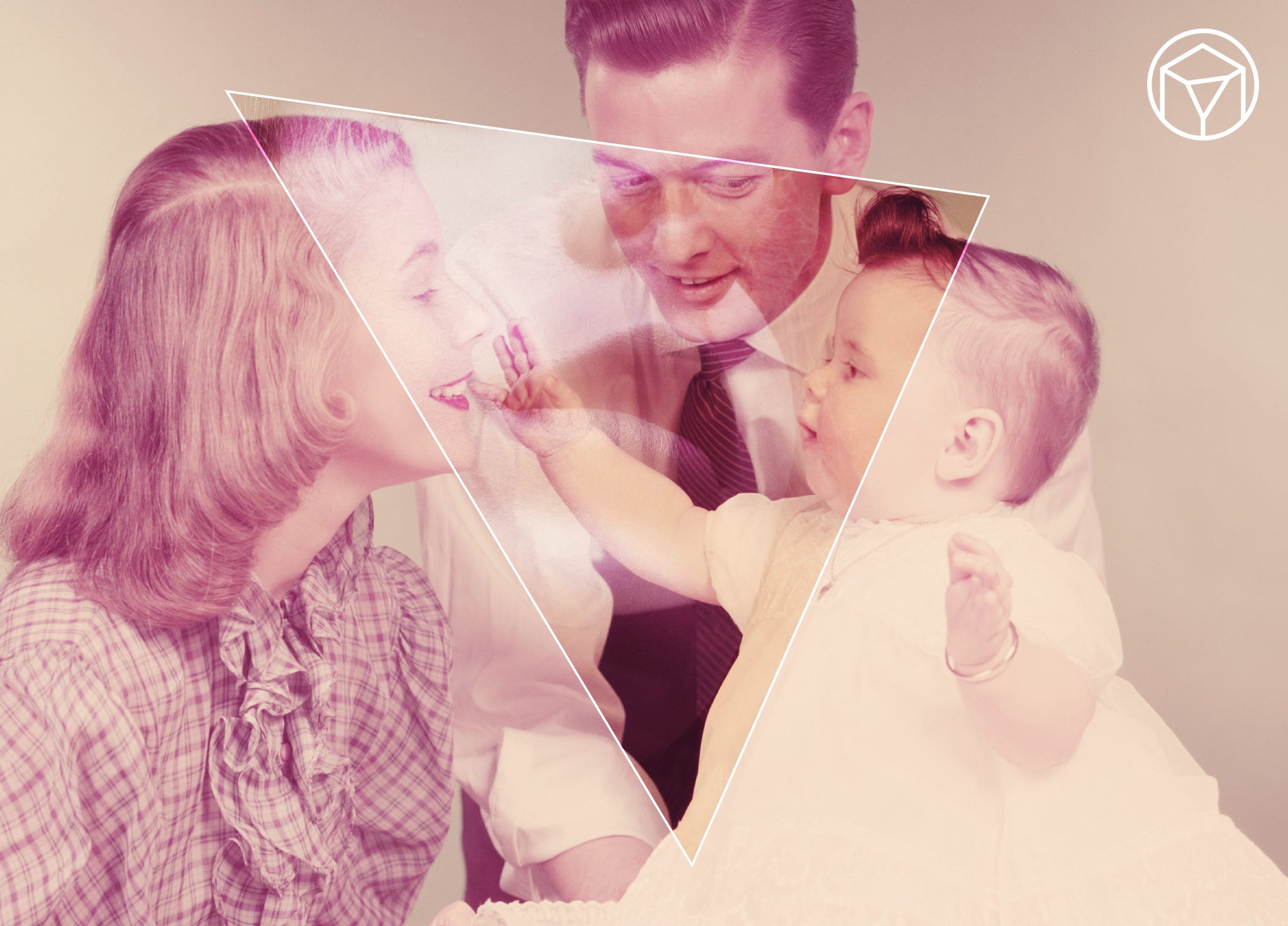
I am obsessed with my nine-year-old’s face. It is the face of my wife when she was the same age, melted down and mixed with my own nine-year-old face, then set to cool and solidify back into this new form: a brand new thing made from old parts.
He’s less impressed. His new habit is to hide behind his hand whenever I lift my phone to take his picture. There he is, swinging on our creaking swingset he’s had since he turned two, a kid in self-perpetuating flight, careless and free, before the onslaught of hormones emulsifies into apathy. All I want to do is capture this version of him, smooth and oil-free. So I lift my phone. Noticing, he takes his hands off the chain and throws them in front of his deep-brown eyes, his sculpted nose, his mother’s full lips, his father’s straight teeth, yowling like a feral cat.
I don’t know why he’s shielding himself from me. Perhaps he’s aware of his power. Perhaps he knows that to gape at his perfect face is to simply see too much. The boy is protecting me from myself, which is also (half) him.
Having children is a strange way to revisit past selves. The sequence of events is circuitous and madness-making: “My god he’s annoying,” we say, and then, “He’s doing that thing…!” then realizing, “...that thing I used to do,” before the final palindromic thought: “My god I was annoying.”
Our youngest is seven. He has the makings of my body, carved from details of chromosomal intimacy: The stubby legs, the stocky chest. Lately, if he doesn’t get his way, he shrieks until, rage extinguished, his lungs still full with air to expel, his scream dissolves into cackling. Frustration has been unmasked as unmodulated feeling: Now anger, now hilarity. I’d worry he was possessed or displaying traits of some personality disorder if I hadn’t cry-laughed the exact same way, forty years prior. How does such derangement travel across decades? This is an under-discussed aspect of parenting: How it’s a conversation with who you used to be. A chance to see who you, and your partner, once were.
My nine-year-old wants to marry a “babe” when he grows up. This is what he tells me one night before going to sleep. I say I got lucky, since I did just that. He says he’d marry mommy if they weren’t, you know, related. I explain how I told my older sister once, when I was five and she was fourteen, that when we grew up I’d be her King and she’d be my Queen. Because I loved her so much.
Back then my older sister had a four-poster bed. The top of each post was removable; the small yellow topper resembled a wooden microphone. I would take one off the top of the bed-frame and hold it to my mouth, asking her questions or making silly proclamations. I likely was holding this pretend mic when I told her of my commitment to jointly ruling our kingdom together.
My wife has told me she always wanted a poster bed. I imagine that when I was talking to my sister long ago, I was really talking to her, my spouse of nearly a decade and a half, who at that time would have been a three-year-old living outside Pittsburgh. She was the first grandchild, so she was pampered and treated well. Had she known a five-year-old boy outside of Detroit was proposing to her, indirectly and across time, she almost certainly would have said no. What did she need a kingdom for, anyway? She had a Cabbage Patch Doll and everything. (Years later, it would come out that the doll was generic, to save money and because the real ones were all sold-out, but in the moment this never registered with my future spouse and she cherished that doll as if it were the real thing. Which, I suppose, means it was.)
But that babydoll did not have her plump lips, nor my peerless chin. For that doll, we would have to meet and get to work on our factory line of one. And then two. They say pregnant women don’t remember the pain of delivery because then they wouldn’t have any more babies. The same should be said about all of us and our childhoods: We don’t remember what we were like back then.
So we find someone with whom to make another. We propagate. We fall in love with little versions of ourselves. Having children is a kind of preemptive narcissism followed by the harrowing surprise of reflective self-loathing. From then on, the old world pales.
I’m now looking at our eldest’s fourth-grade school photo and there we are: She and me, shrunken down and de-aged. The confluence is so obvious I can’t help but think his head, contrasted against that stark milky-blue backdrop, appears artificially generated. The mixture of two parental traits into one singular face is uncanny. I squint and look closely, hunting for tell-tale pixels; all I find is the tiny mole to the left of his jawline, the fine hairs set between left and right eyebrows that one day will thicken and he’ll want to pluck.
I stare at his photo, unhidden by modest hands; I stare at this Venn diagram of me and her, unable to dissect our disparate parts, marveling at the science fiction of it all.


Beautiful piece, @Jon Irwin 👏 Sincerity is underrepresented in online discourse, appreciate you bringing it to Chisel’s platform.