


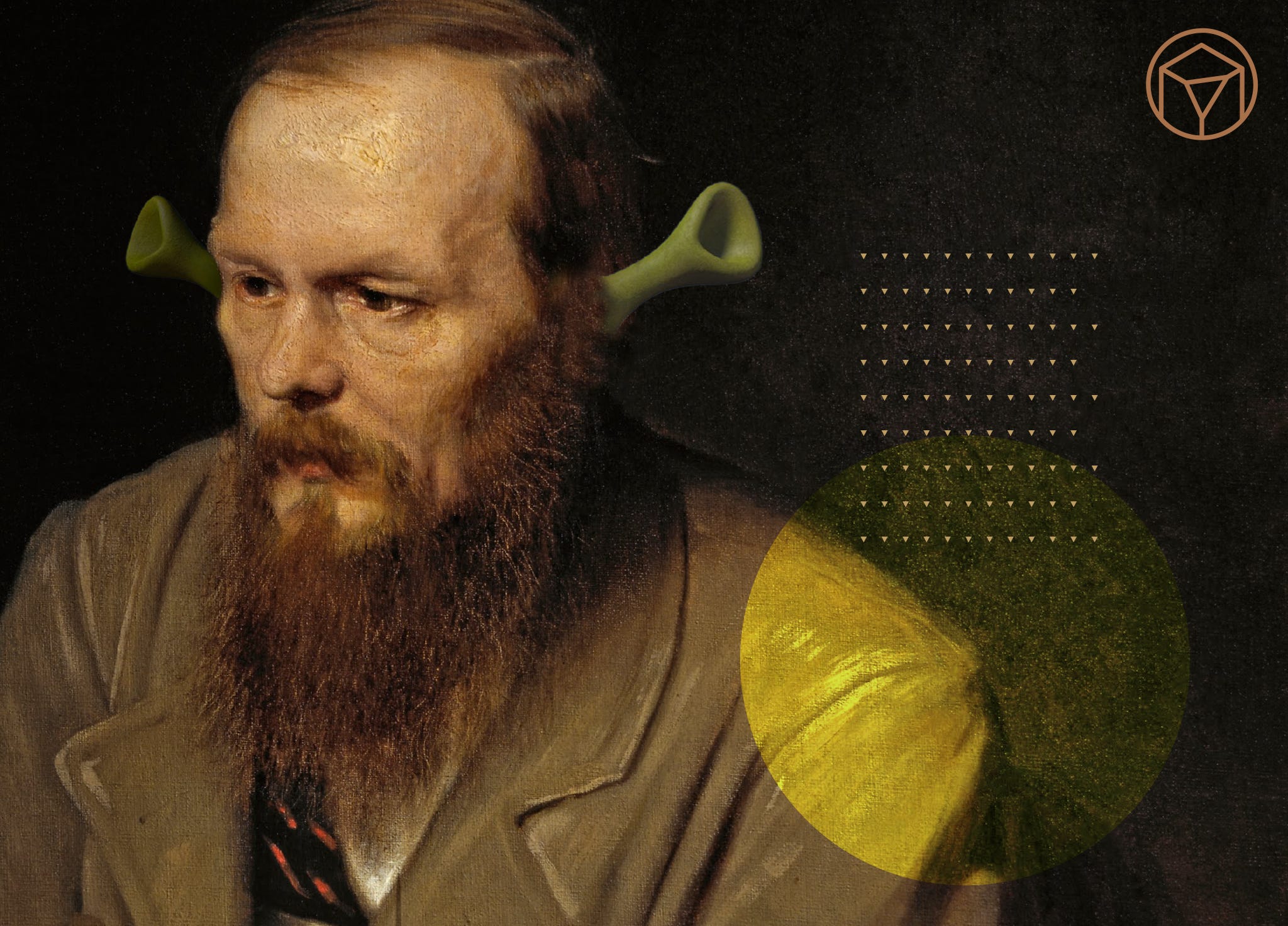
“I am a sick man ... I am a spiteful man. I am an unpleasant man. I think my liver is diseased. However, I don't know beans about my disease, and I am not sure what is bothering me … if I don’t treat it, it is out of spite. My liver is bad, well then – let it get even worse!”
So begins Fyodor Dostoevsky’s novella Notes from Underground, the confession of a retired bureaucrat, miserable and lonely, whose debilitating contempt for existence drives him into a spiral of self-loathing and alienation.
Shrek, too, is a tale about a lonely man, one who revels in his suffering because his inescapable conscience makes him aware of moral virtues and beauty (and his own lack thereof). He nurses his insecurity by living in a swamp (i.e., a bunker home) and he invents a cruel persona to make his pain of being a social pariah valid, but the mask imprisons him as much as it protects him. (“This is the part where you run away,” Shrek mocks the villagers who are out to hunt him. “And STAY OUT!”) So, he feels alienated even when he is given the chance of friendship. (“Listen, little donkey. Take a look at me. What am I? ... I’m an ogre! ... Doesn’t that bother you?”)
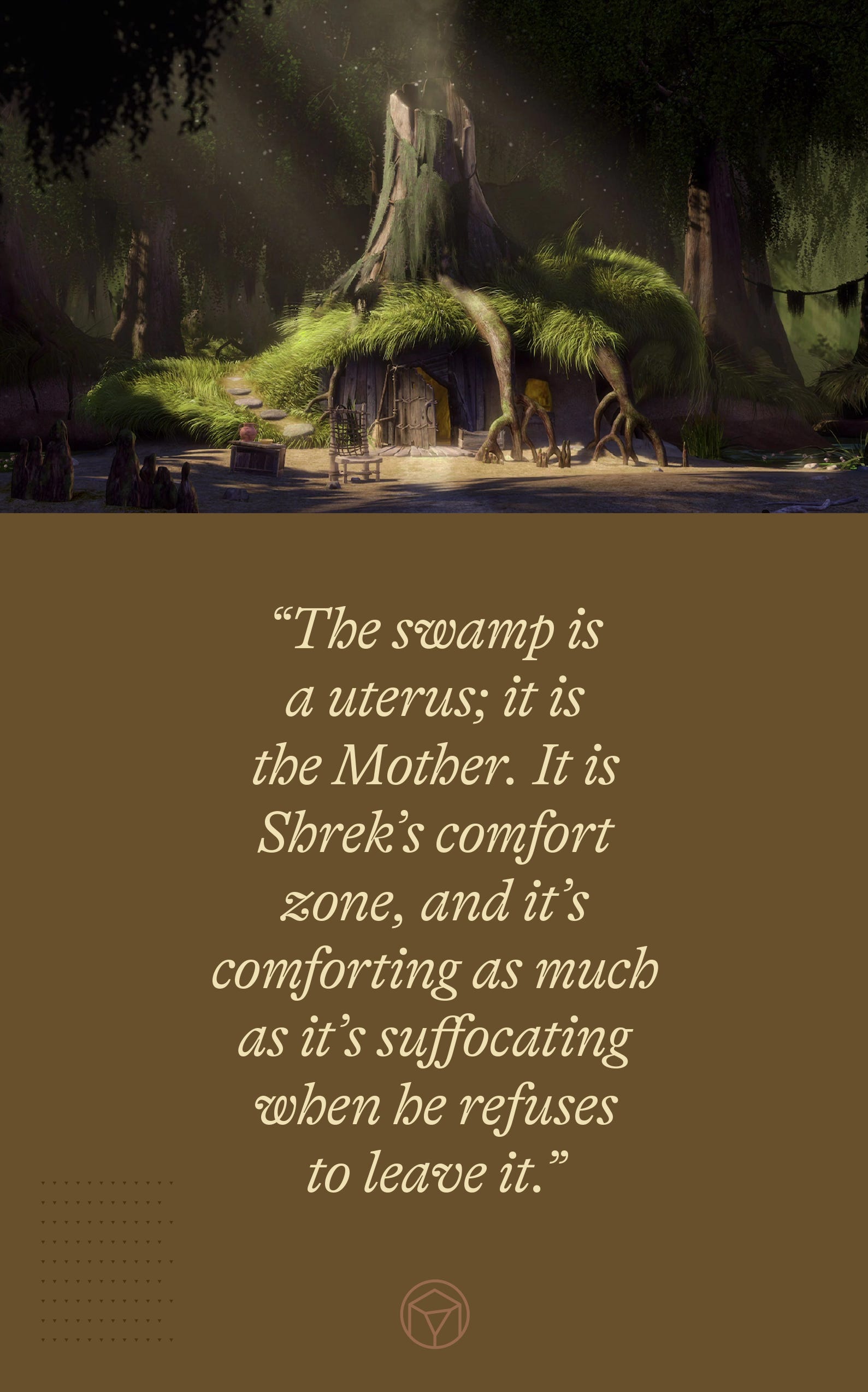
A swamp occupies the disreputable margin between the living and the rotting; it’s the back alley of the forest where nobody wants to go, smelly and stagnant because it’s so poorly oxygenated that nothing that ends up there fully decomposes. Symbolically, it’s the unconscious: the place where everything you don’t want to think about – fears, embarrassments – piles up without truly resolving. The swamp, like Dostoevsky’s crawl space, is a place of self-imposed exile: It’s a refusal to participate in the social order, and it is a corner to slouch in, somewhere to nurse your self-ordained right to be miserable.
“You’re so wrapped up in layers, onion boy, you’re afraid of your own feelings.”1 – Donkey
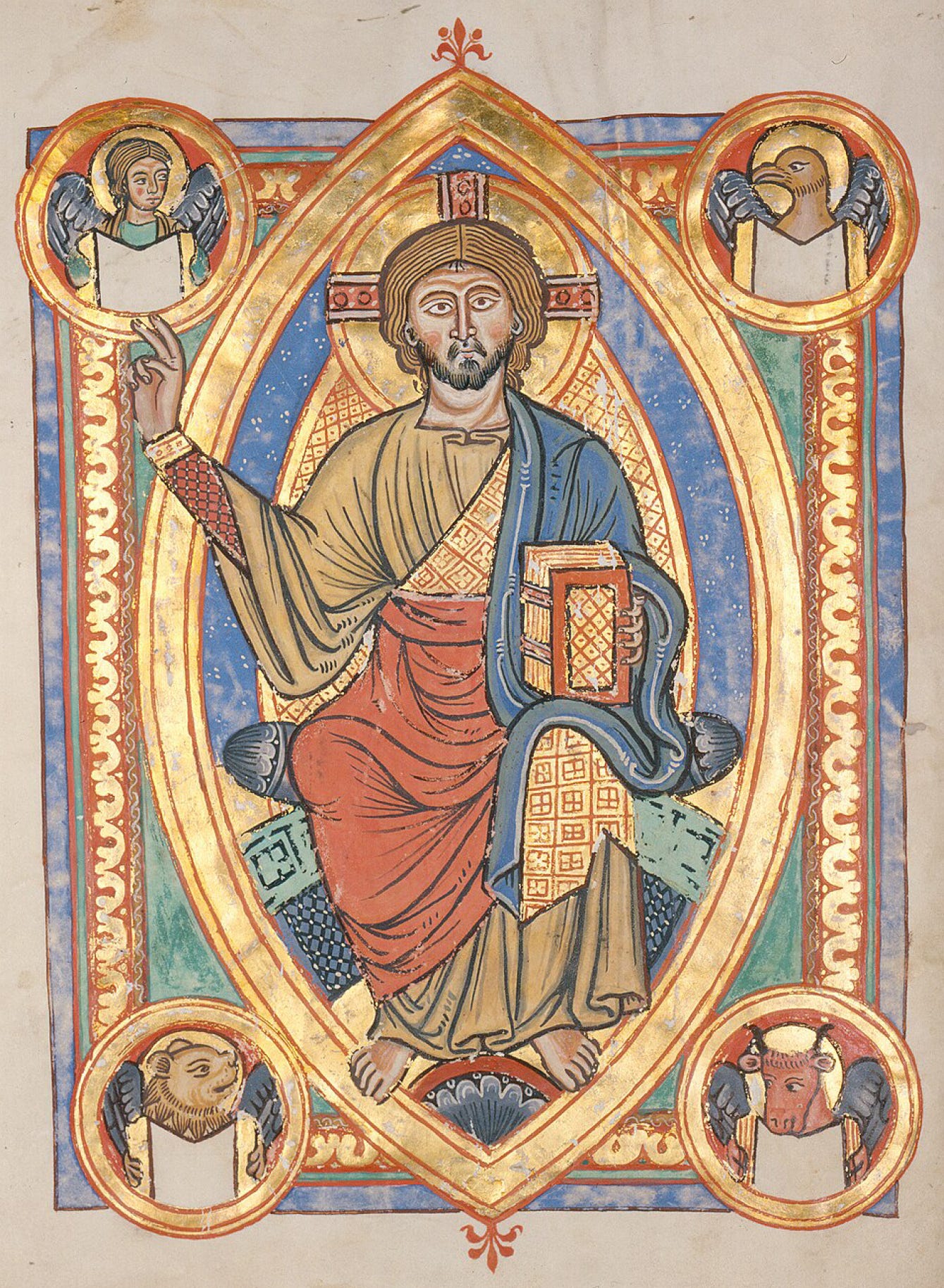
But the swamp has a second meaning: warm, wet and burrowed by nature into the shape of a nest, its yonic appearance suggests the feminine. The swamp is a uterus; it is the Mother. It is Shrek’s comfort zone, and it’s comforting as much as it’s suffocating when he refuses to leave it. The swamp is a mandorla, the almond-shaped motif commonly seen in Christian art when depicting the Virgin Mary, or the fatal wound in Christ’s side. It’s not a coincidence that the sacred wound is shaped like a vulva: It’s a place that gives birth, bringing forth a person from conception. It’s the act of creating life, of being and becoming.
On individuation
Birth: being expelled from an amniotic paradise is the first trauma any of us experiences (it’s no wonder babies cry). The umbilical cord is cut, and for the first time you are not merely different from your mother, you are a separate individual, you become an “I,” a first-person perspective.
And so, literal birth becomes the template for every subsequent crisis of selfhood: The ultimate goal of a person is to individuate, to separate from the identities and patterns that have formed you, and to gather the rejected, contradictory parts of yourself into a unified, distinct person that can meet the world without disguise. The act of becoming who you are is to leave the womb, again and again and again.
Spite is the philosophy of failed individuation: It’s recognizing that the ideal exists somewhere out there, and that you fall so far short of that ideal that you might as well stop trying altogether. As John Milton’s Satan says in Paradise Lost, it is better to rule in hell than serve in heaven. If you can’t have the happiness you see in others, at least you can be the architect of your own suffering. He’s happy to be alone, because if he isolates himself first, at least the isolation happens on his terms. Oh, Spite.
And when nobody wakes you up in the morning, and when nobody waits for you at night, and when you can do whatever you want. What do you call it, freedom or loneliness? – Charles Bukowski
I like my privacy. – Shrek
On love and the arrow
Then comes Fiona, who, at first, deepens Shrek’s crisis because she is everything he imagines himself excluded from: beauty, nobility, romance, the kingdom beyond the swamp – culture beyond nature, the world beyond home. Yet she copes with the same shame he believes makes him unlovable: She is princess and ogre, admirable and shameful, persona and shadow, each form experienced as the negation of the other. So, how does love change such mosaic personalities?
All love begins with a wound. Cupid’s arrow pierces the heart. The nails of crucifixion are driven through Christ’s body. DreamWorks’ Robin Hood shoots Shrek in the butt cheek. The verb that comes before love is always “fall”; we don’t climb in love or plan our way into it, we fall to it, as in, we surrender to it, we let it take over us.
The meeting of two personalities is like the contact of two chemical substances: If there is any reaction, both are transformed. – Carl Jung
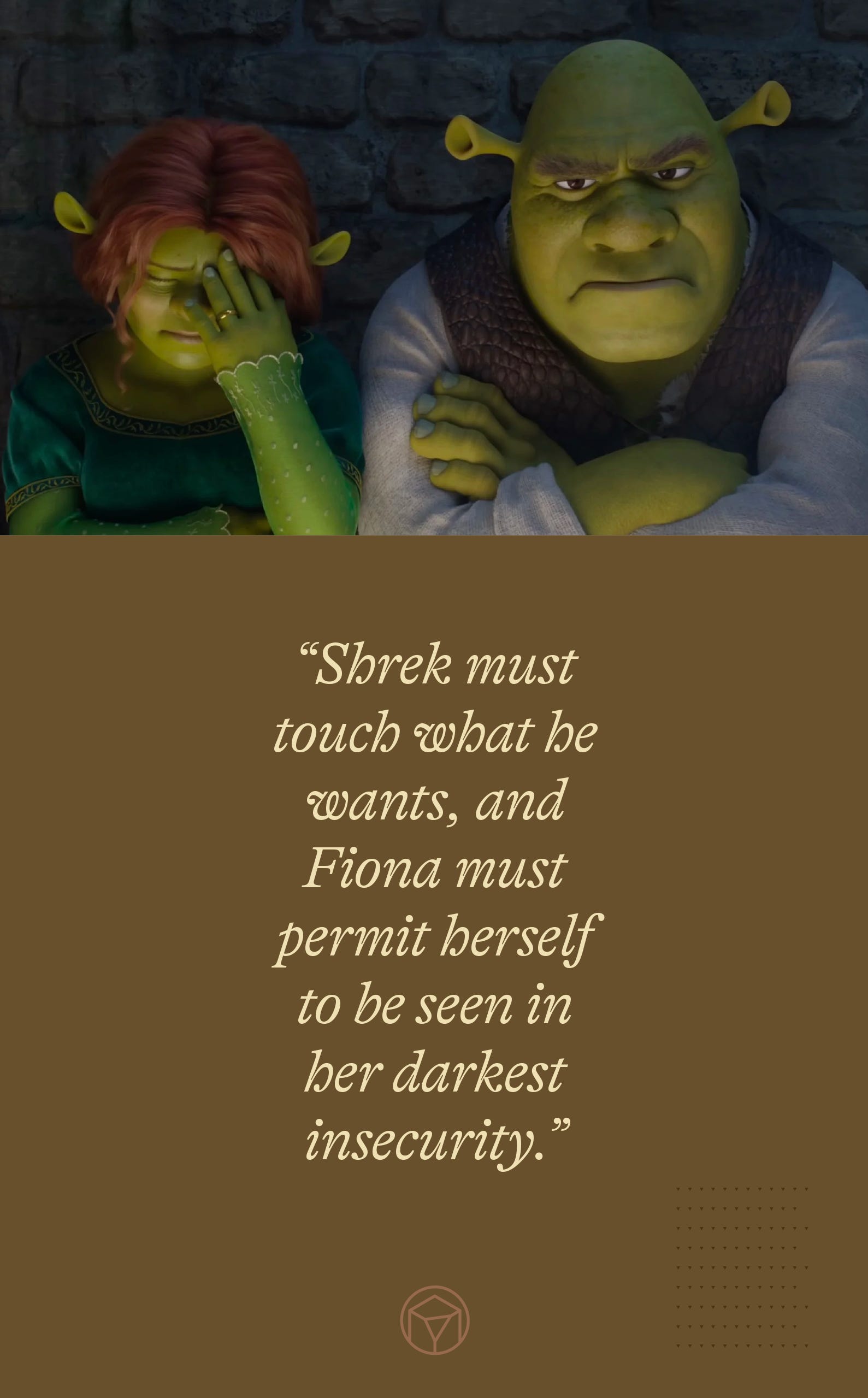
The scene where Fiona pulls the arrow out of Shrek is the initiation of their falling for each other, and they both face the risk that their truest selves will be seen and possibly found wanting at the mercy of the other. What’s to be done? After all, Shrek makes himself scary because how could she possibly want him? Fiona makes herself mean because how could he possibly accept her curse? But then, the stiff upper lip softens and the scary persona collapses. Shrek must touch what he wants, and Fiona must permit herself to be seen in her darkest insecurity. Unlike Dostoevsky’s poor narrator: Shrek encounters an Other who survives his contempt. This is the life-giving power of love: Another person’s desire becomes evidence against the story of unworthiness you tell about yourself.
A common misconception about Shrek is that it’s a children’s tale about how appearances don’t matter. But what it actually says is that appearances matter enormously – they shape how the world receives us – but, how we’ve been looked at by the world is not entirely who we are, and our only true grasp on our identity comes from confronting how we’ve been perceived and deciding which parts to accept, or change.
Shrek doesn’t “become himself” by discovering a pristine inner self hidden beneath the ogre (and Fiona doesn’t accept herself by erasing her ogre-self). He individuates by recognizing that the ogre, the lover, the exile, the friend, the brute and the knight in shining armor are all his, and that no single one of them has the power to impersonate the whole. Shrek isn’t about finding someone who “accepts you anyway,” but someone who, through loving you, reaches beyond your worldly performance until there’s no “anyway” left. That’s why Fiona’s curse says that “love’s true kiss” will make her take “love’s true form,” and love’s true form, turns out, is the body she thought was incapable of beauty and desire. The transformation integrates what fairy tales tend to split: Beauty is no longer the absence of monstrosity, and monstrosity is no longer excluded from love.
Nothing preserves a false self so well as a life without contradiction. Individuation is the story of stepping out of the enclosure, the Garden of Eden, the womb, the swamp. At the end of the movie, Shrek is still an ogre, uncured of his monstrosity. But, in the face of love, our green underground man with his mud baths and earwax candles embarks on the adventure because the world beyond the swamp has given him piercing encounters worth inhabiting, and it has made disguise and stagnation more painful than change.


Source: Shrek (2001) screenplay