


If we were to seek the image of the soul we could do worse than to look to the sky. Yesterday, leaving the supermarket, I was stopped in my tracks by a herd of squat gray clouds scudding across a deepening lilac; the underbellies of their dark, pensive masses flared red, and one star had risen prematurely above the throng in the beset blue of the evening. What it said to me I can express no better than by this description. My mum often sends me pictures of hastily captured sunsets, and I’d estimate that the most common text I’ve received from her besides the thank-yous for letting her know I’ve gotten home are the ones asking me if I’ve seen the moon.1
Up above us the theater of human experience is tossed in capricious and comprehensive analogy, and so evocative is its changeable display of our inner state that to ask which is the reflection and which the original seems foolish – the one expresses the other. More than this, civilization has grown under its tutelage; the sky has given to us not just light and darkness, rain and sunshine, food and water, but symbols, stories, instructions, warnings, ways of life … whether to the ancient Babylonians, the Chinese, the Australian aboriginals, or any other culture that has ever looked upwards.
The sky is the first fount of divination, in that divination requires the opening of a channel of communication between a conscious subject and an object, or composite object, so variable in nature as to present itself in an inexhaustible variety of forms. Theism aside, if the epithet “divine” can be applied to the human being it is because we are born into a world of things to be interpreted – in the interest of survival – not just as themselves but as signs of yet other things. We are born diviners, and the subject-object bond required for divination presupposes at least a potential and temporary oneness, an errant equals sign whose two distinct lines hover ephemerally together at heightened moments of attention.
Divination demands contemplation to the point of immersion, so it follows that the life of religious devotees is often given over to the extended and repeated consideration of sacred objects, and that many religions have declared the sky as the house of the divine, it being the mirror of the soul. The religion of materialism – under whose sway a majority of the developed world has unthinkingly come to live – also conforms to this glorification of the heavens, and for a brief moment in the industrial renaissance of the postwar 1950s and 60s, it began, in keeping with its theological grounding in matter, to see those divine dreamlands among the stars as a real promised land, one into which the body, being the materialist vessel, could rise.
The ensuing Space Race took us to the moon, but no further. Like most grand human operations, it had been motivated primarily by terrestrial competition, and it was as if, after the power play between the Soviets and the Americans was over, the subconscious of the human race had been brought to the edge of a void that we were woefully unequipped to comprehend. The dark chasm of space had teemed with possibility – was it not populated with stars? – but we had always, up until that point, gazed from the ground.
Setting foot on the moon is perhaps one of the two definitive moments of the 20th century, the other being the dropping of the nuclear bomb (and both really can be narrowed down to two molecular instants of impact). On the materialist plane of thought, what could be more significant, more worthy of mythology, more inaugural of a new epoch than these two things – the placing of the earth’s destruction in our hands, and the first footfall on another celestial body?
In the time since these events, our entire collective aspect has shifted, away from what might be called the heroic – not in a moral sense, but characterized by the tendency to venture outwards, and towards something more passive and insular. The most obvious inversion of the archetype of the hero is probably the hermit – the dweller and explorer of the self – but I think that we may have become more akin to frozen spectators, like the figure in Caspar David Friedrich’s Wanderer Above the Sea of Fog, sealed in the contemplation of a scene from which we are held forever separate. Not so much wanderers as wonderers. In Regarding the Pain of Others, Susan Sontag tells us that the first major world disaster of the 21st century, on September 11, 2001, “was described as ‘unreal,’ ‘surreal,’ ‘like a movie,’ in many of the first accounts of those who escaped from the towers or watched from nearby. (After four decades of big-budget Hollywood disaster films, ‘It felt like a movie’ seems to have displaced the way survivors of a catastrophe used to express the short-term unassimilability of what they had gone through: ‘It felt like a dream.’)”
Perhaps it is written into the nature of a materialist age of empire that a time comes when there are no more worlds to conquer, or the conquest is brought to an end, and what has been acquired must be considered – the shift into contemplation – before it slips away. The emperor becomes the museum keeper, and a jealous one too (just ask the countries still trying to get their possessions back from the British Museum). Materialism ages into vicariousness when you learn that you can’t have everything – but you can look as much as you like. If this is the age that we have moved into, then it explains the blurring in our time of the psychological boundary between contemplation and acquisition. Our lives are so abundant in images created by marketers, manufacturers of desire. Barriers begin to take on the aspect of shop windows, but the things behind them lose something of their sheen when the window is broken through.
Likewise, the possibilities of space seemed endless to the dreamers of the mid-20th century, but they were virtual, founded on fantasies, hypotheses and images seen through telescopes or TV screens. The cold reality of the moon landing revealed what we had always known: that space is inhospitable to human beings without the kind of extreme adaptation that would push us beyond humanity as we had known it. The astronauts came back singing the praises of the earth. The ground of the moon cannot be kissed, not without dying to pay the price, like the toll exacted by some fatal lunar lover in a fairy tale, one whose light shines alluringly from afar, but whose barrenness becomes evident up close. Once up there, we are out from under the dome beneath which our cultures have arisen. That is not to say that we couldn’t learn to flourish beyond the boundary of our atmosphere, with enough time and technology, but the fact remains that leaving the earth is a severe sacrifice – it demands a severance of the earthly umbilical cord, a becoming alien.
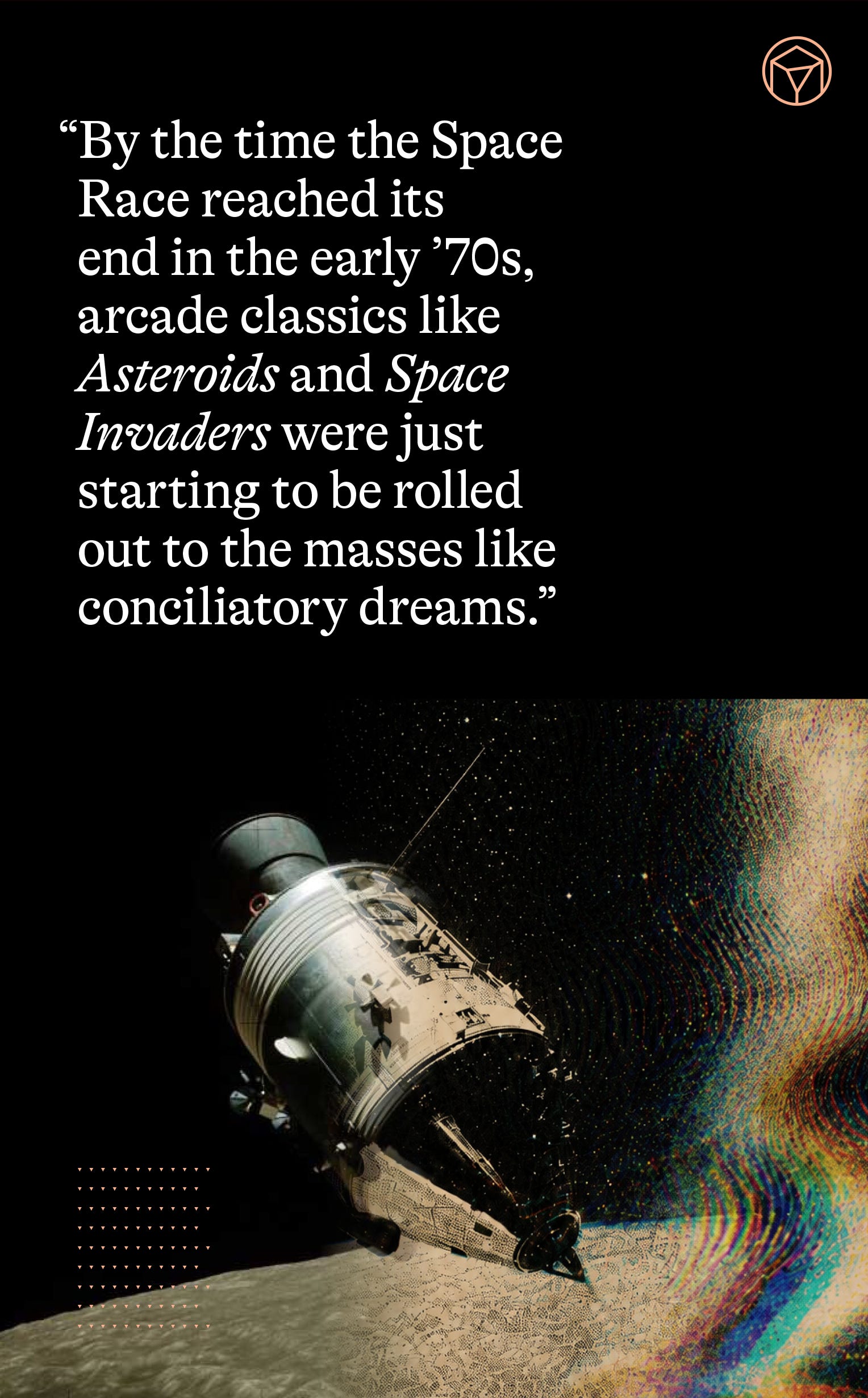
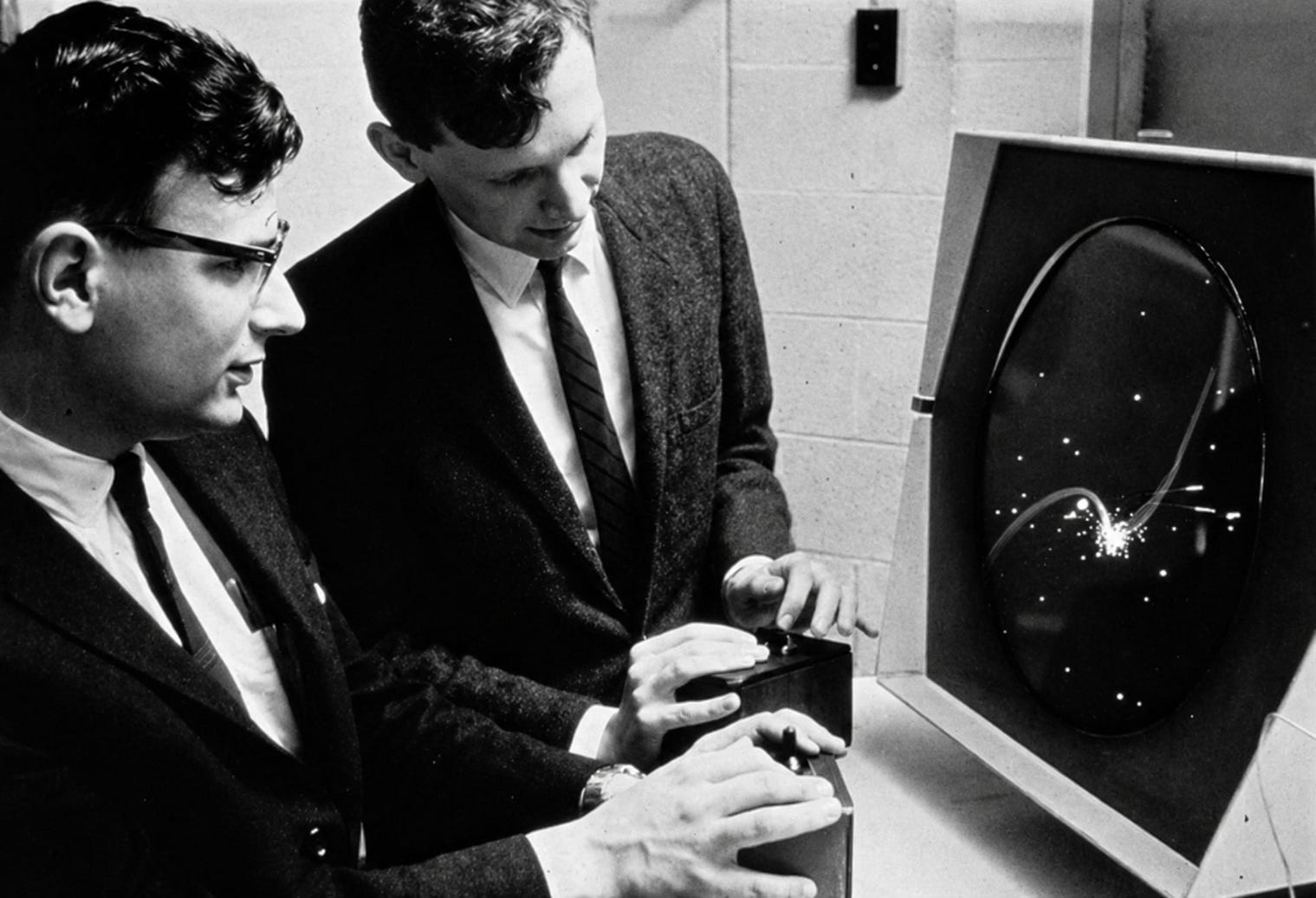
So instead, we turned our technological nous towards the proliferation of digital worlds. It was a small leap, as the very same technology that had been developed for space exploration had also already been put to use in generating the first interactive computerized environments. Steve Russell created one of the very first video games, Spacewar!, on the same DEC PDP-1 computer that was simultaneously being used for NASA’s Mariner program, and on the same Massachusetts campus where technology was being developed for the Apollo spacecraft. Many of the earliest video games were symbiotic with the cosmic zeitgeist, being explicitly narrativized around space travel, including the primitive Lunar Lander, and by the time the Space Race reached its end in the early ’70s, arcade classics like Asteroids and Space Invaders were just starting to be rolled out to the masses like conciliatory dreams. The early arcades were like museums of what might have been.
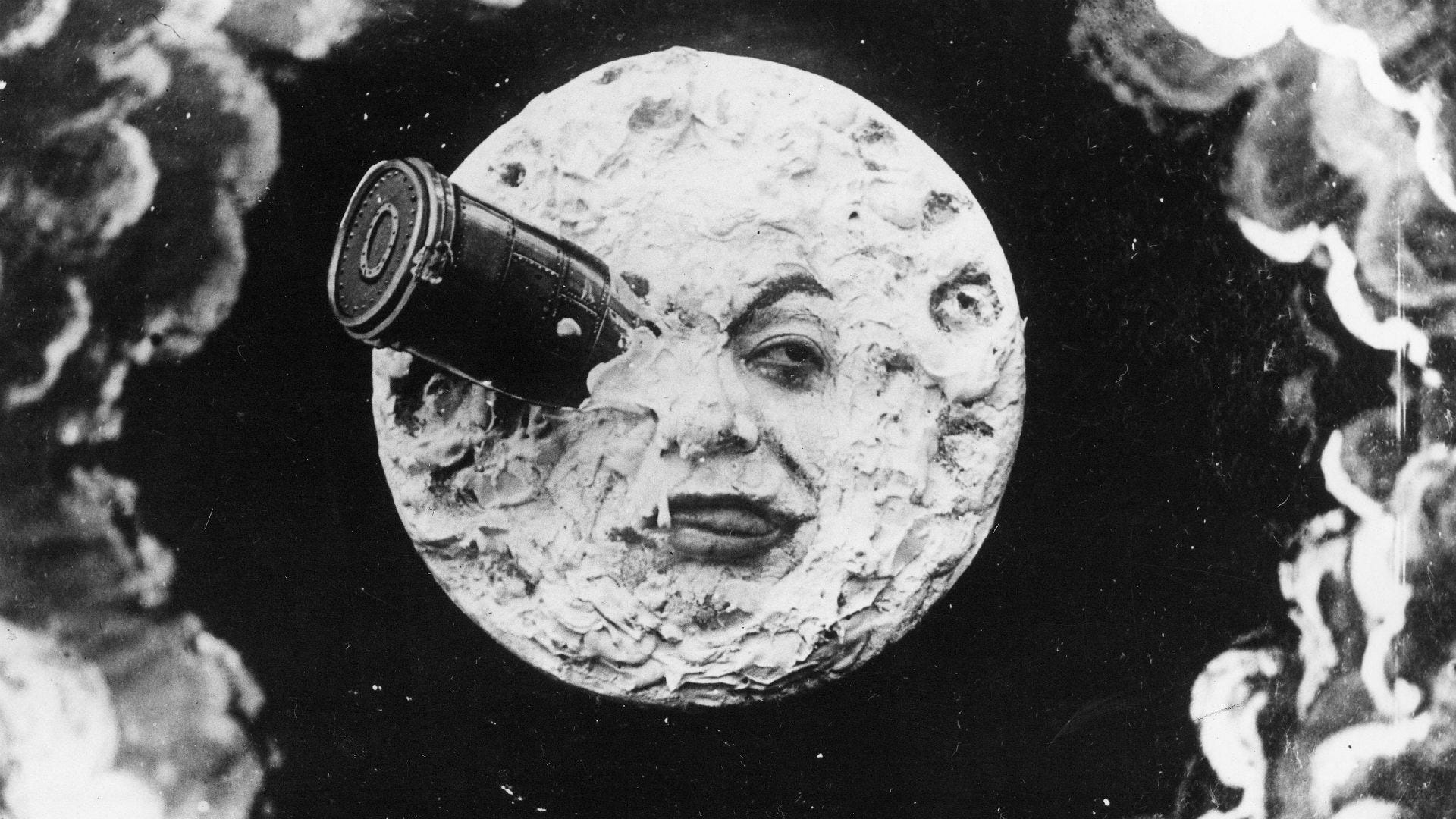
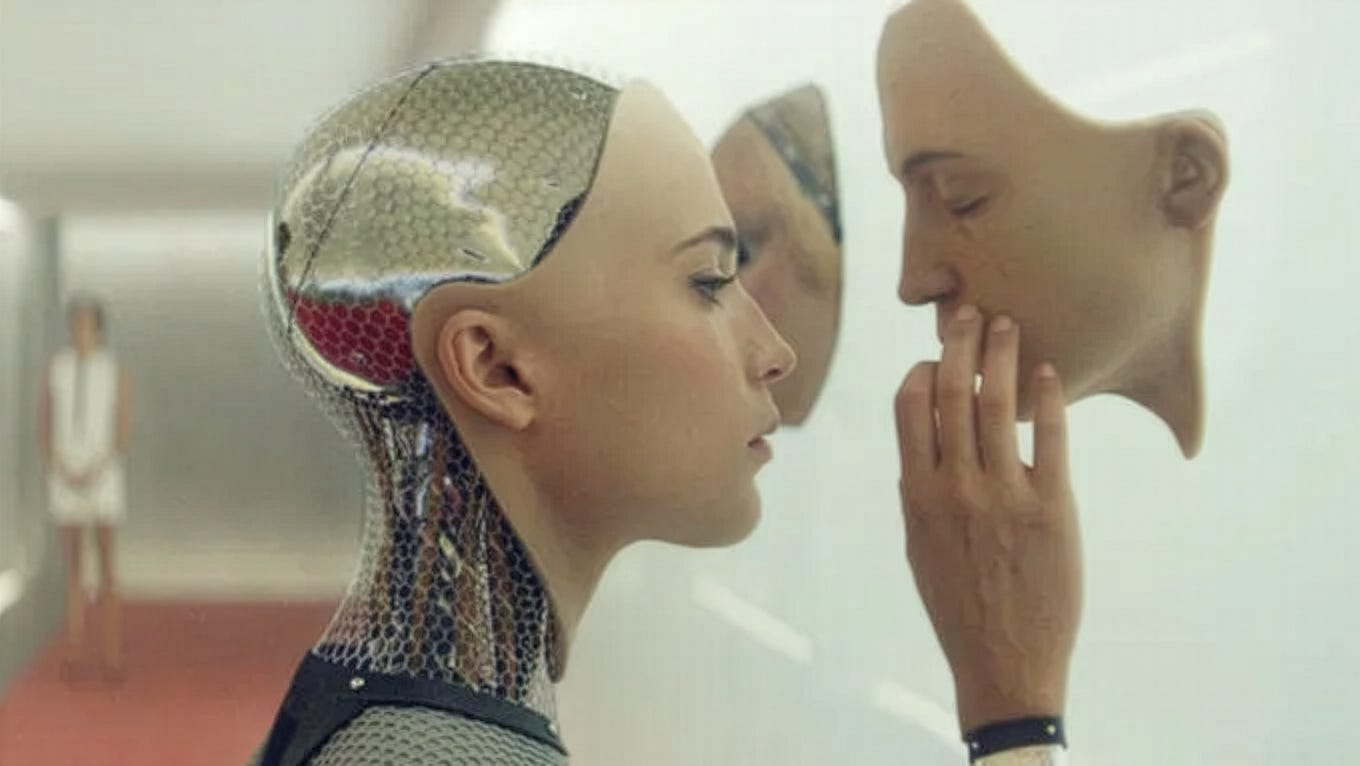
A similar story was prevalent in the popular cinema and television of the time, with Star Wars, Star Trek, Alien, Battlestar Galactica, Close Encounters of the Third Kind, Buck Rogers, Planet of the Apes and more all dramatizing the space-age dream (or nightmare). One of the very first and most legendary films to use special effects was Georges Méliès’ A Trip to the Moon. The Space Age reached maturity very much within and alongside the still-young medium of cinema. Besides reboots and sequels of old intellectual properties like Star Wars and Dune, most of the successful filmic sci-fi of the 21st century has come back down to earth, dealing more with our growing relationship with technology, with films such as Ex Machina, Her, The Matrix, I, Robot and After Yang, and even popular space films like Interstellar, Arrival and The Martian foreground humanity’s relationship to the earth. These feel more attuned to the current zeitgeist, whereas the epic space operas feel much more like fantasy than they might once have done, though perhaps not to the wealthy fantasists who, having grown up absorbing such media, have rekindled the dream of space travel for a much more exclusive group. But at least for now, the collective dream is no longer space-centric.
We have, of course, continued to expand our conception of the universe, but virtually, sending out probes, analyzing data and construing knowledge of places we have never been and most probably never could go, places that can perhaps only nominally be considered places: the Orion Molecular Cloud or supervoids like the CMB Cold Spot. In the meantime, we have rapidly enhanced our capacity to digitally render our fantasies as environments to be virtually explored. We have grown accustomed to gaining the perception of places into which we can never step. If perception is an invitation for us to act, as Henri Bergson believed, and as anyone who has impotently watched the horror of an injustice play out in the palm of their hand must have surely felt, then how many of our perceptions are erecting a screen between even our simplest desires and their fulfillment? The marketers know – the secret of advertising is that the product being advertised is not really there.
I was born in 1994, and so have grown up used to having vicarious access to virtual and remote worlds. As a child I loved wandering to the edge of the map in video games. Some games would try to justify the boundary with a fence, or an unpassable wall, or open water where certain death lurked; others would turn you around with a curt reminder to stay on course, or simply let you butt up against an invisible barrier. But what led me to seek out these boundaries was that there was – most of the time – a view beyond them. When I looked out onto an inaccessible rolling field, populated maybe with a few buildings or some trees whose low resolution lay plain their purely illusory presence, I dreamed of jumping the barrier. I wanted to try the doors of the out-of-bounds houses because inside of them there could be anything. I used to fancy there might be a whole other game hidden there, or, even better, that I would enter a never-ending landscape whose noninteractive objects teased my imagination with the thought of what just one interactive object might do.
But my fascination with these crude backdrops was contrasted with a kind of ambient fear I felt whenever I played a game that made no use of them, such as the early Super Mario games, or Metroid, or Donkey Kong, which, at least in some levels, were set against an entirely black background. No fake stars to adorn the void; it was as if Mario was running and jumping on platforms suspended in absolute nothingness. When I was very young this fear made certain games almost unplayable for me, especially when, in a game like Space Invaders, the black background would change color to signify an increase in difficulty, and suddenly the void became orange, or green, as if nothingness had suddenly become malevolent and bared its teeth.
It would be an exaggeration to say that space travel has – or ever could – lose its novelty, but it remains true that in the late ’60s we reached a fork in the road of humanity, where we might have continued to branch outwards but instead burrowed inwards. In this insular age, simulation theory has arisen as a new cosmogony – how likely this theory is or isn’t is not the point, what matters is that it is a new collective dream – and, if we take the theory and run with it a little, then the argument could be made that burrowing deeper is not all that different from traveling into outer space. Eventually, if we look deep enough, everything atomizes and spreads apart like a universe exploding into life, as if we were turning not a magnification dial but the wheel on a cosmic clock. We can look at any object and conceive of the universe of atoms that make it up, and perhaps even every individual atom, if we could see deep enough into it, would contain an entire universe – or it could be that all of these fractal universes would simply be the code of our own, re-rendering itself at each entry point, which is everywhere. The distance between ourselves and the edge of space could be – at a lesser stage of magnification – that between the nucleus and the envelope of an atom. Zoom in enough and chasms would open up in space between every molecule that makes up the world, existential lacunas of dark matter, in which nothingness perhaps has its own kind of life unknowable to us, like the characters in Italo Calvino’s Cosmicomics who use atoms as gambling chips or marbles to race across the curves of space. Even given these hypothetical degrees of magnification however, the problem remains: We can look, but how do we enter these spaces?
The legacy of the 21st century so far has surely been the ubiquitous proliferation of the internet. We picture it as a web, which is like a diagram of star systems interconnected – digitized, transposed, etherealized into data. Part of the great sci-fi dream was of a universe so vast that nature repeats itself; one in which we might find an earth mark 2, mark 3, mark 400 … on the internet we can see into even more replicas of our world than we could ever dream of. Like space travel, in order to access the web, we rely on technology too complicated for most of us to understand, and once there we enter a non-environment, one that asks us to leave our bodies behind. It promises us entry in exchange for our becoming vicarious.
Simulation theory is an adaptation of belief fit for the internet age; it has its echoes in the Veil of Maya, and in the creationist myths. Great technological advancements have always inspired new conceptions of the universe – as long as there are minds with enough comprehension to contrast one object with another, reality exists alongside representative fantasies of its totality, and seen in this light religious and scientific ideas of infinity seem like metaphors for the same thing: the totality, the pleroma, the outside or beyond that conditions our inside and within. But what really makes simulation theory the apt cosmogony of our age is that in a simulation everything is non-corporeal.
We could psychologize the shift away from corporeality as a sort of collective trauma response after the atrocities of the 20th and 21st centuries – which not only occurred but were seen to have occurred – but really it is nothing new; corporeal suffering is the foundation of the spiritual life and has always been generative of imaginal worlds beyond this existence, perhaps it is even the generative factor of the elusive substance we call soul. To be soulful is to have suffered. What is different in our age is the collective shift towards the vicarious, and we are still coming to terms with our new ways of seeing. Maybe we have been running away from suffering into the spectacle of the suffering of others – maybe that is our new original sin: the guilt of the watcher powerless to act. But the ancients too observed plays of light in a region they could not enter, and from their seeing they advanced their understanding and channeled what they had learned into action. We must not forgot that to see is to divine.
At its most beautiful the sky bruises, and bleeds at the horizon – this vicarious age may be only the first flickers of a new dawn.


Like all smartphone photographers she’s learned the hard way that it’s futile to try to capture our lunar companion as seen by the naked eye.