


What hides beneath your feet? On a grey Parisian street, a passer-by senses play in a loose paving stone. Hands tug the stone out of position, and then in the space of a single cut we’re in someone’s home or studio, that same dirty city stone placed in a sink where years of grime are briskly washed away.
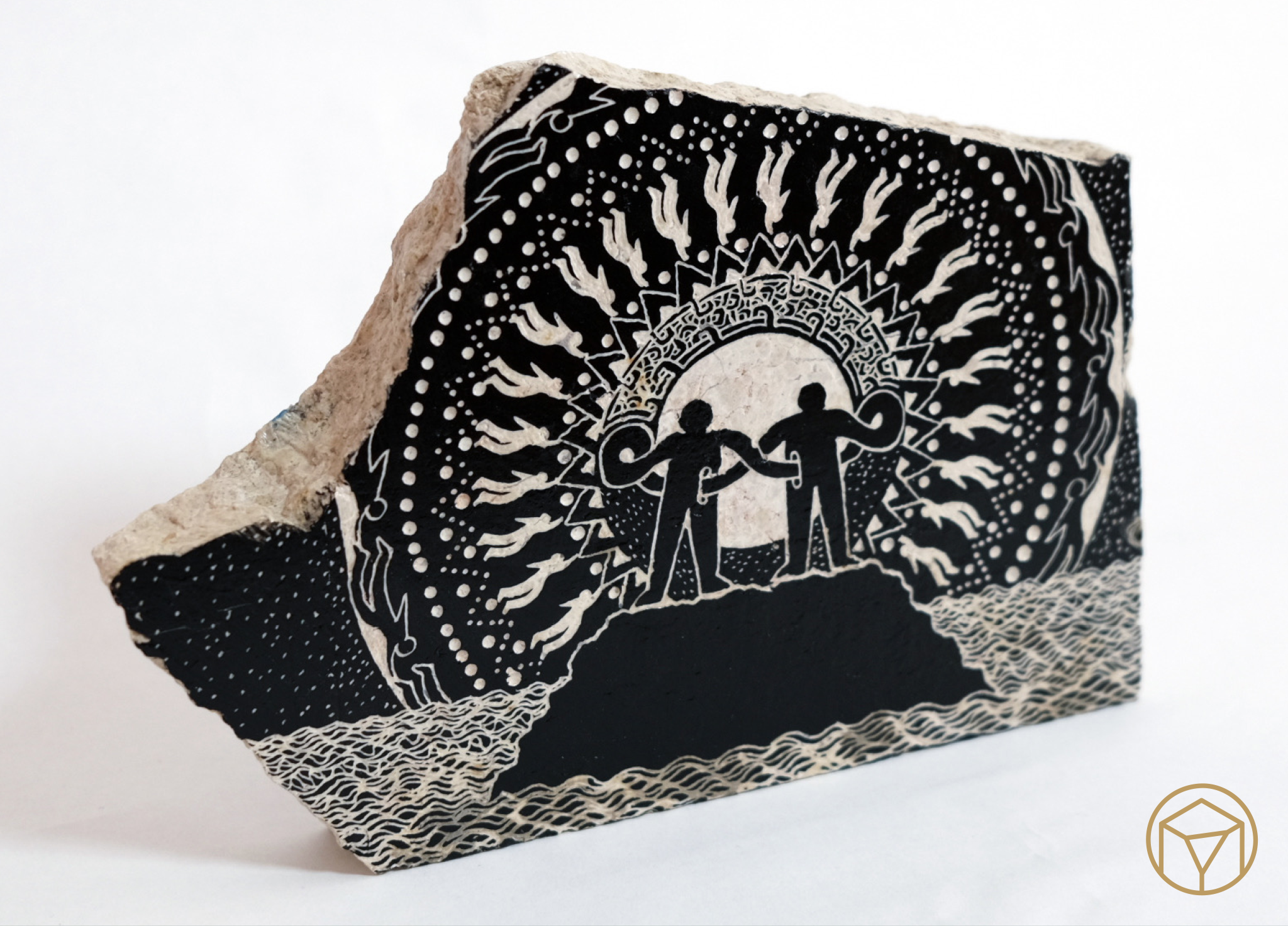
Next comes the blue paint, followed by the whir of an electrical engraving tool. With a gentle hum, an image is all but tattooed upon the stone. Two figures, reaching out for one another, hands joined, arms plaiting together. And then we’re back on the street again and the stone is returned, painted face angled down, the whole thing slotted back into its original spot. Sunlight casts a fleeting silhouette of the artist on the street before him. He raises his hand and gives a quick victory sign before he vanishes. What hides beneath your feet? Wonders.
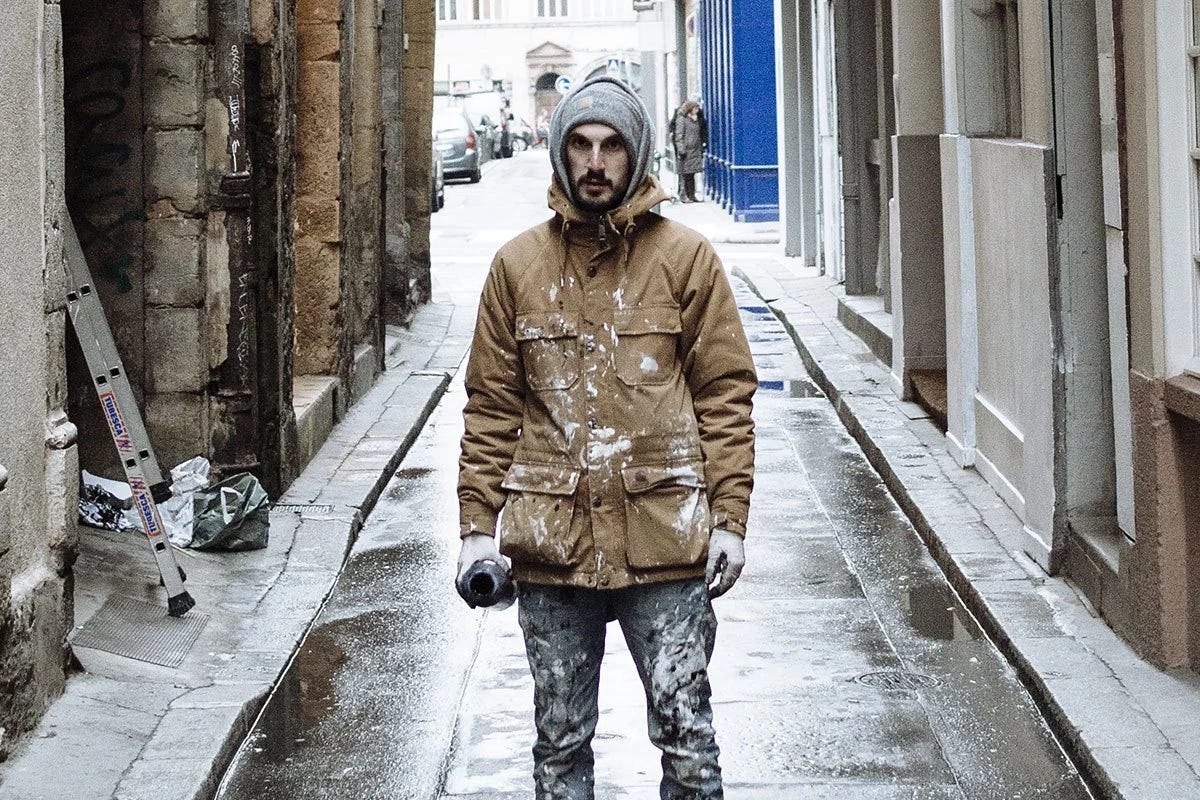
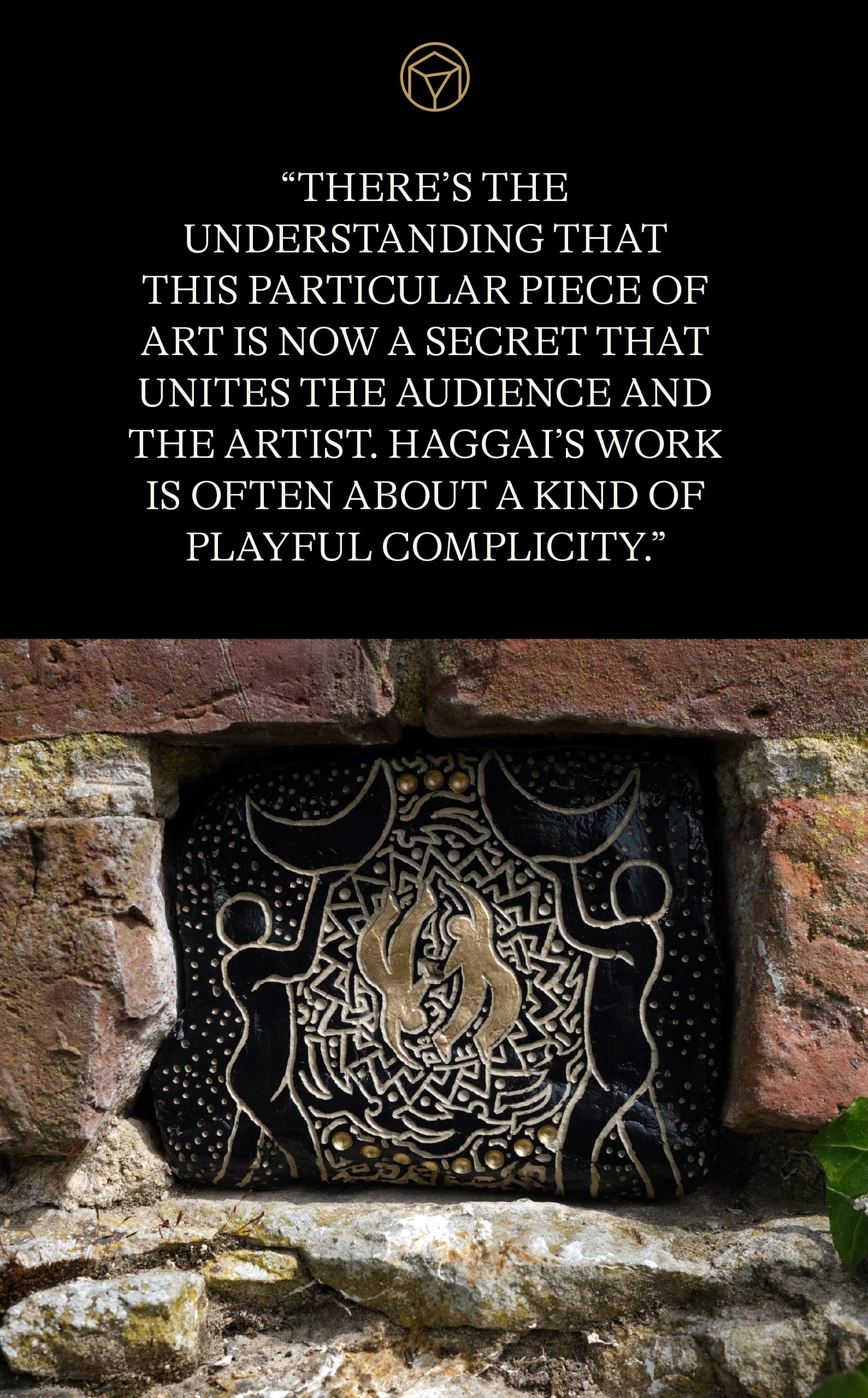
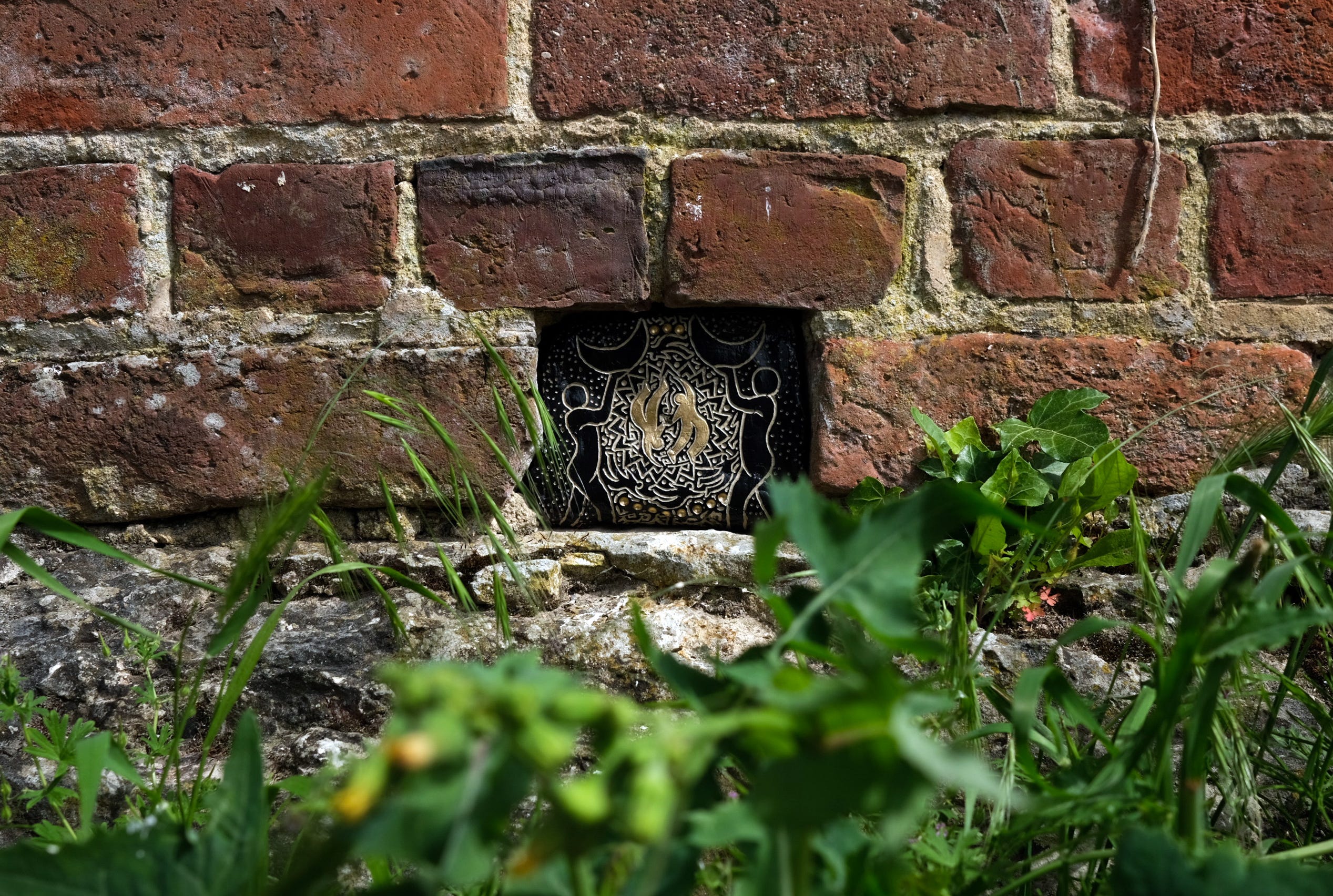
Theo Haggai’s videos often follow this formula. There’s the discovery of potential lurking within the city’s loose masonry. There’s the creation of the art. Then the replacement. It’s a repeated movement, from the speculative to the precise. With it, there’s the understanding that this particular piece of art is now a secret that unites the audience and the artist. Haggai’s work is often about a kind of playful complicity.
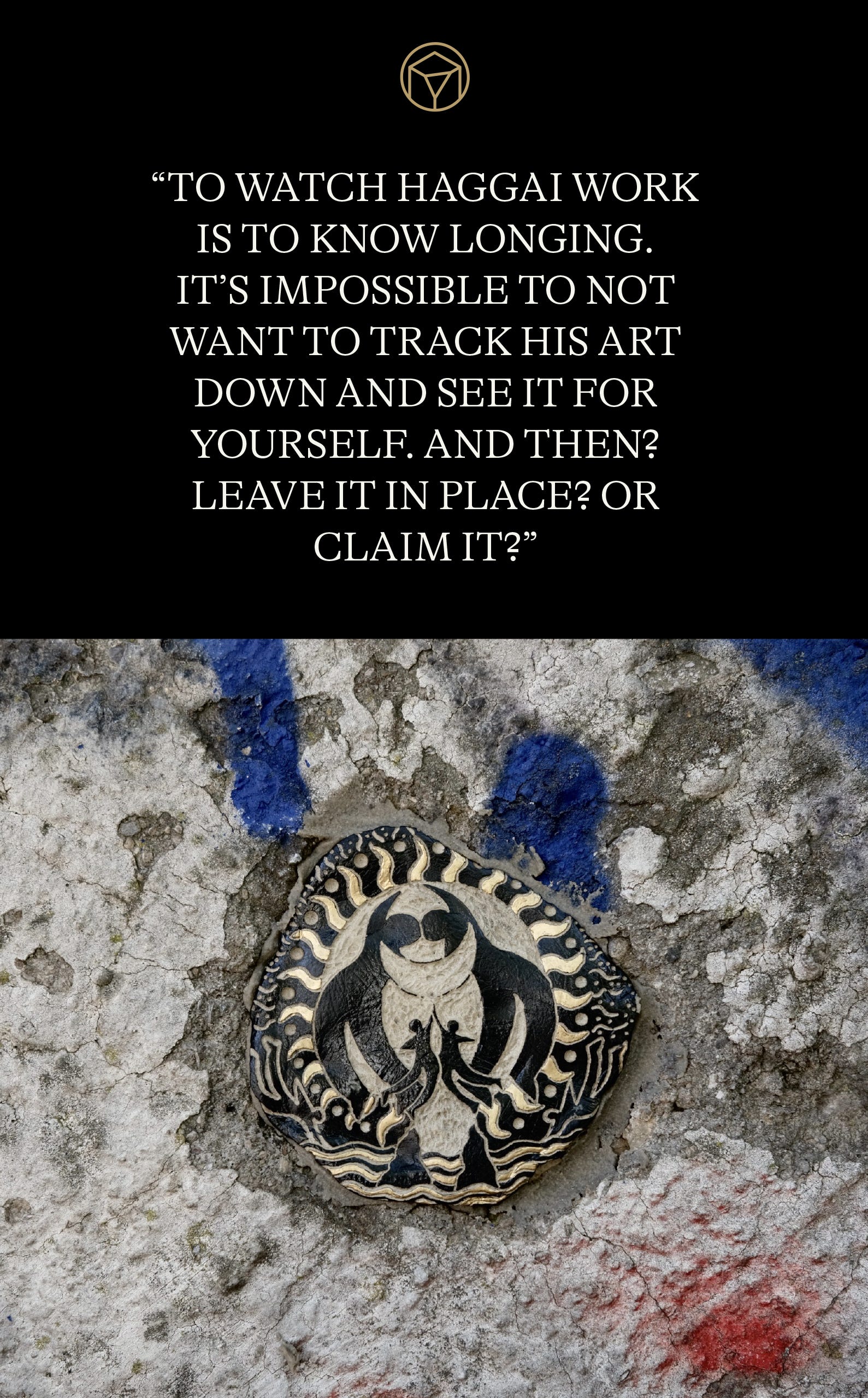
And it’s not just complicity. To watch Haggai work is to know longing. It’s impossible to not want to track his art down and see it for yourself. And then? Leave it in place? Or claim it?
Haggai started out with a camera, emerging from his teenage years with the “somewhat vague” fantasy of becoming a fashion photographer. After high school, he studied visual communication and discovered painting. He lists Pollock, Basquiat and Haring as influences, and with this knowledge, his clear-lined, loose-limbed compositions start to gather an extended family.
“In 2014, in Lyon, I began working in the street,” he says. “First with chalk, drawing large mandalas on the ground, then on walls, to play with contrast.” He arrived in Paris in 2019 and joined a collective workshop where he discovered engraving. ‘Discovered’ is the word he uses for his start with both painting and engraving. Each step is a revelation.
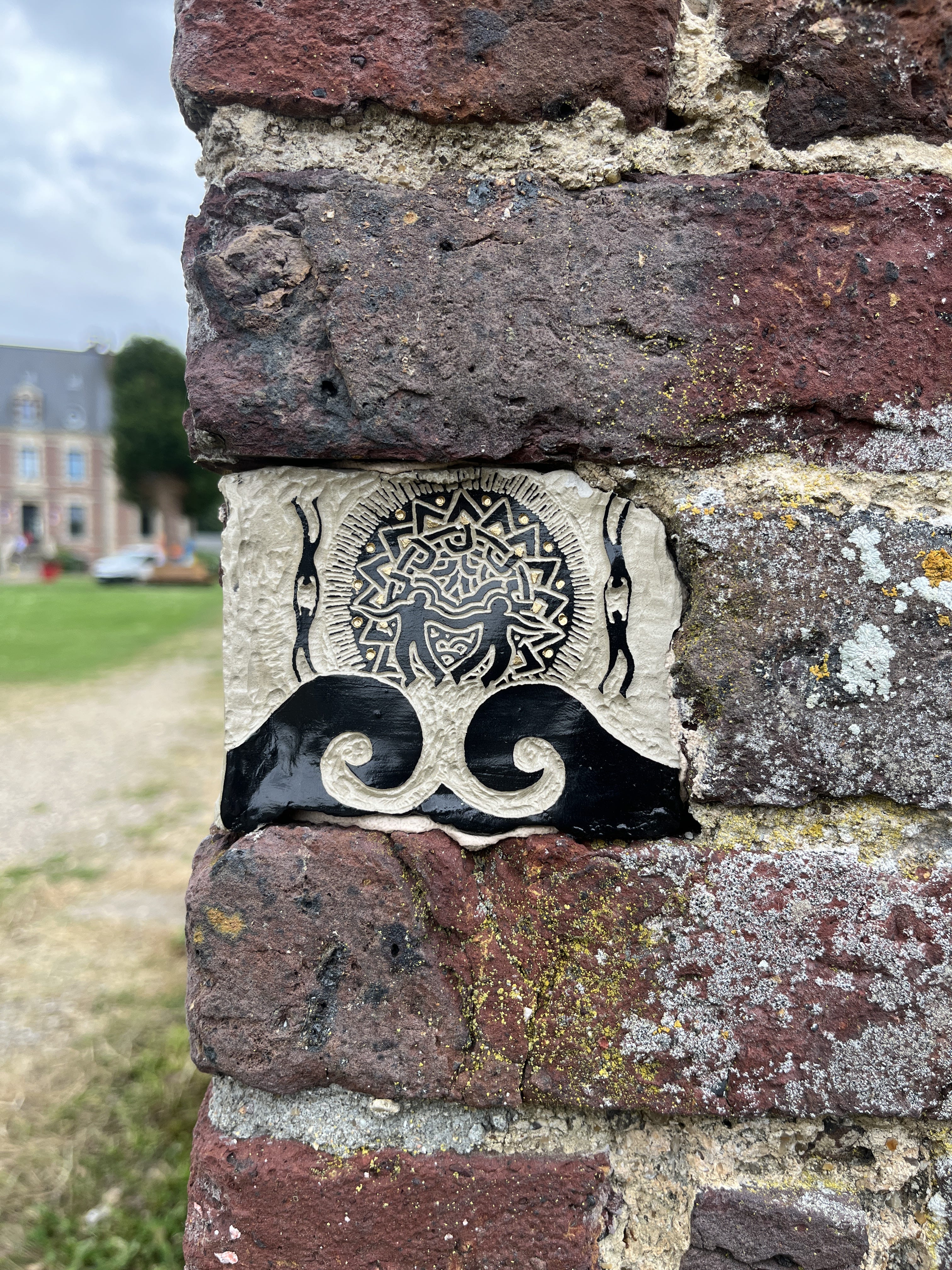
One day, while looking after his child at home, he thought about how to combine engraving and urban interventions. On a bike ride, he stopped at the Porte de Montreuil and picked up a stone. His first.
Haggai’s motifs speak of solidarity and mutual aid. “[My pieces] often feature human silhouettes that I call ‘dreamers’”, he says. “They represent us, connected to one another.” He explains his designs evolve slowly, almost imperceptibly over time.
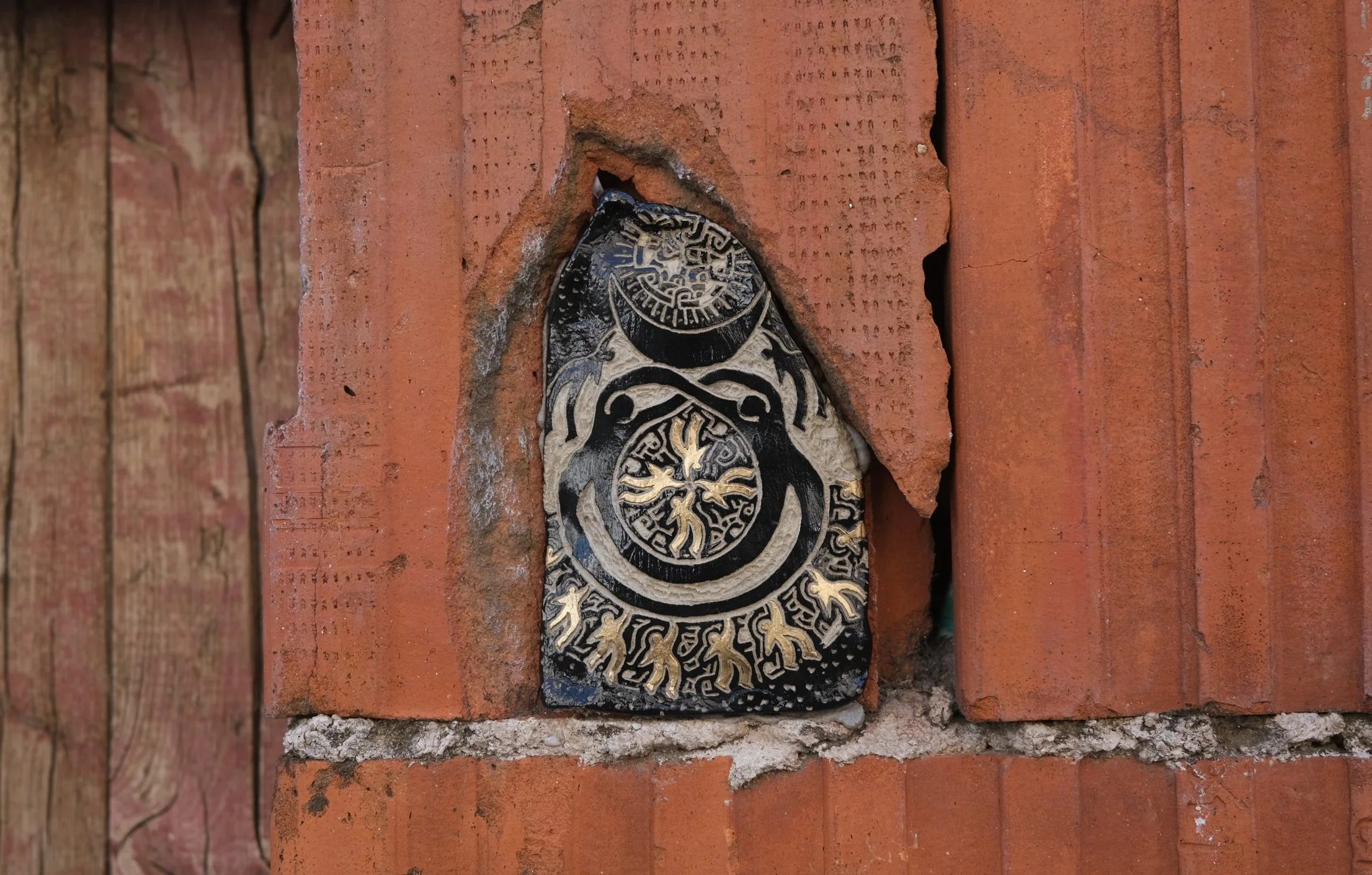
The stone Haggai’s working with influences what he creates. He explains that larger stones mean he can add more narrative elements. But there’s something more, too. The jagged edges of the stones he finds to work with speak to the audience. They suggest that this is just a fragment of some wider, undiscovered culture.
Most of the things I ask Haggai about involve practicalities. How long does a painting take? Does he keep tabs on the stones he replaces? I suspect that I ask these things because his art moves me in a way that I can’t really put into words, let alone questions. I find the textures he uses transporting. I am fascinated by his complex designs with their mandala spokes and pyramids. Wordlessly, he is building a universe from these elements and then hiding it inside our universe.
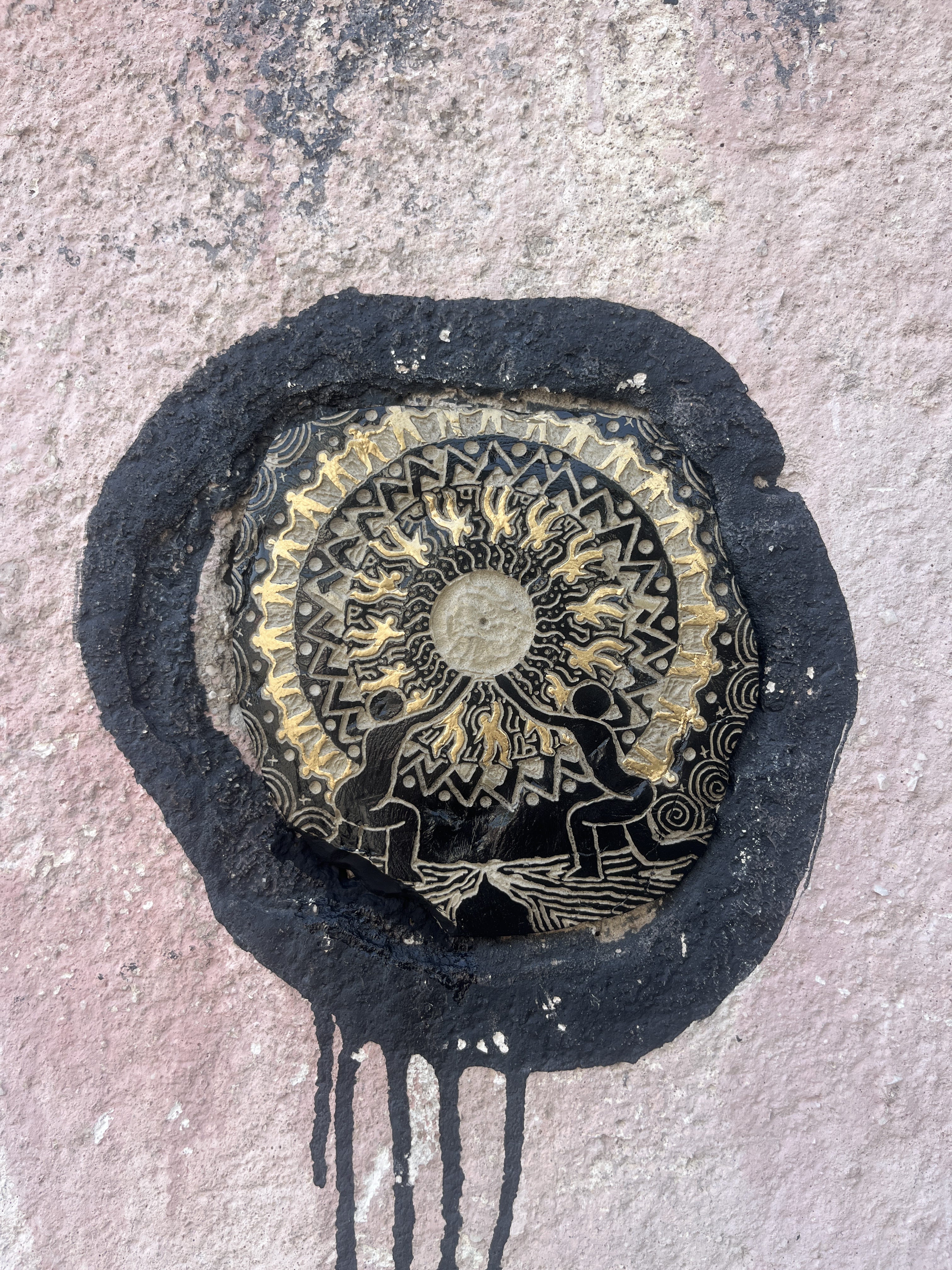
Has the work changed Haggai’s relationship to Paris? “Absolutely,” he says. “And with engraving, it’s more pronounced: I scrutinize the details, the cracks, the small chips. I look ahead less and less; my gaze is always a little sideways, often fixed on the ground. It’s almost a motto: pay attention to details, because they can change everything.”
And that’s what he’s trying to get at really. “I believe this work speaks above all to the attention we pay to details. We tend to place more value on what is large, monumental, impressive.” He pauses to think. “Small things can also arouse strong emotions, and deserve to exist.”
[Thanks to Karine Knox-Humbert for translation.]

