


“Play has a religious origin, to be sure, insofar as it reproduces certain aspects of the sacrificial crisis. The arbitrary nature of the prize makes it clear that the contest has no other objective than itself, but this contest is regulated in such a manner that, in principle at least, it can never degenerate into a brutal fight to the finish.” – René Girard, Violence and the Sacred
One of the central mechanisms for why we don’t constantly devolve into infinite tribal violence is the existence of games.
Our continued need for violence, in other words, is partly sublimated and contained within the rules of games. It is of unspeakable importance. The games, that is, and keeping their rules.
A sentiment that perfectly captures this in miniature: A magician never reveals his secrets. That’s the rule, and performative magic is the game. When you’re doing illusions, your singular goal is to dupe and bamboozle the audience. But as one magician of many, you are duty-bound to keep the methods of your coworker’s bamboozlements a secret.
When a magician successfully performs an illusion, he dominates his audience within the bounded game of his magic show. When another magician reveals the way the trick works, he lets the violence the game was holding back flood into the world. He wins attention, but at the expense of his fellow magician and indeed may threaten the soundness of the entire game, which would be dangerous writ large. It is a profound taboo, such that anyone who breaks it, for any game, risks the consequences of mob justice.
I remember a TV show in the ’90s called Breaking the Magician’s Code: Magic’s Biggest Secrets Finally Revealed, where Val Valentino would reveal how all the magic tricks worked. Of course, he had to wear a creepy mask, presumably so other magicians wouldn’t kill him. Or take Tonya Harding, who (allegedly, I should say) misunderstood the nature of games and assumed that all of life was a competition. Having someone club her competitor’s kneecap is a perfectly natural inclination of a great competitor who doesn’t know that life isn’t always a game.
The walls between games and life are always threatening to come down like this. For one, because the walls are mostly not explicit (and rightly so), and therefore we take them for granted. And two, they are always being redefined and redrawn to deal with the cheaters and the opportunists.
On one side, tearing at the wall, is the person who believes that everything in life is secretly a competition, a bid for power. Even something as sacred as the bond between mother and child. Chipping away at the other side, you have the bleeding hearts, who dislike all competition and think everyone should get a participation trophy. They can’t imagine that there’s a benefit to competitiveness as such.
The truth is, each of us must decide what we take to be a game and what we take to be life. The walls between them are necessary, if not perfect. The best way to deal with them is to refuse ever, on moral principle, to abuse one side for the sake of the other. Don’t cheat in games. Don’t play games in life. This is how I would define a good sportsman. Although we’re not perfect at naming sportsmanship, we intuitively recognize and admire good sportsmen. We venerate them above almost anyone living, in fact.
Some people think games are a frivolous distraction from whatever they deem more important. This is myopic. Games, bound within rules, are the reason that everything is not a fight to the death. Further, all of us must play games. We have some amount of agency in deciding which games we want to play, though. All of us must decide, for ourselves, when to stop playing games and when to start living.
The rules for these two realms are entirely different: In a well-lived life, you should always seek to be last in everything that you do. Empty yourself entirely to elevate others. Games, on the other hand, should be played to win. If you’ve decided on your game, and decided that it’s worthwhile to play it, you’ve also decided, implicitly or explicitly, that you want to win that game. Morally, you should do whatever it takes to win, within the rules of the game. To fail to do that would be to dishonor your competitor.
That’s why the magician always comes to his show prepared to dazzle, to make us unable to properly understand what he is fully capable of, and therefore to psychically dominate us. In and only in the context of his magic show, we accept our submission to him.
Christopher Nolan’s 2006 film The Prestige is about the limit to how you can play these games (spoilers follow). How much you can secretly bring your life into games to be great at them. Remember the magician who walked with an old-man waddle for decades just for the sake of making a fishbowl disappear in his signature trick. In a similar way, the two main magicians sacrifice their personal lives for the sake of their game. You may go down this path if you like, but the movie wants you to know that you will have to sacrifice your personal life in a similarly grotesque way.
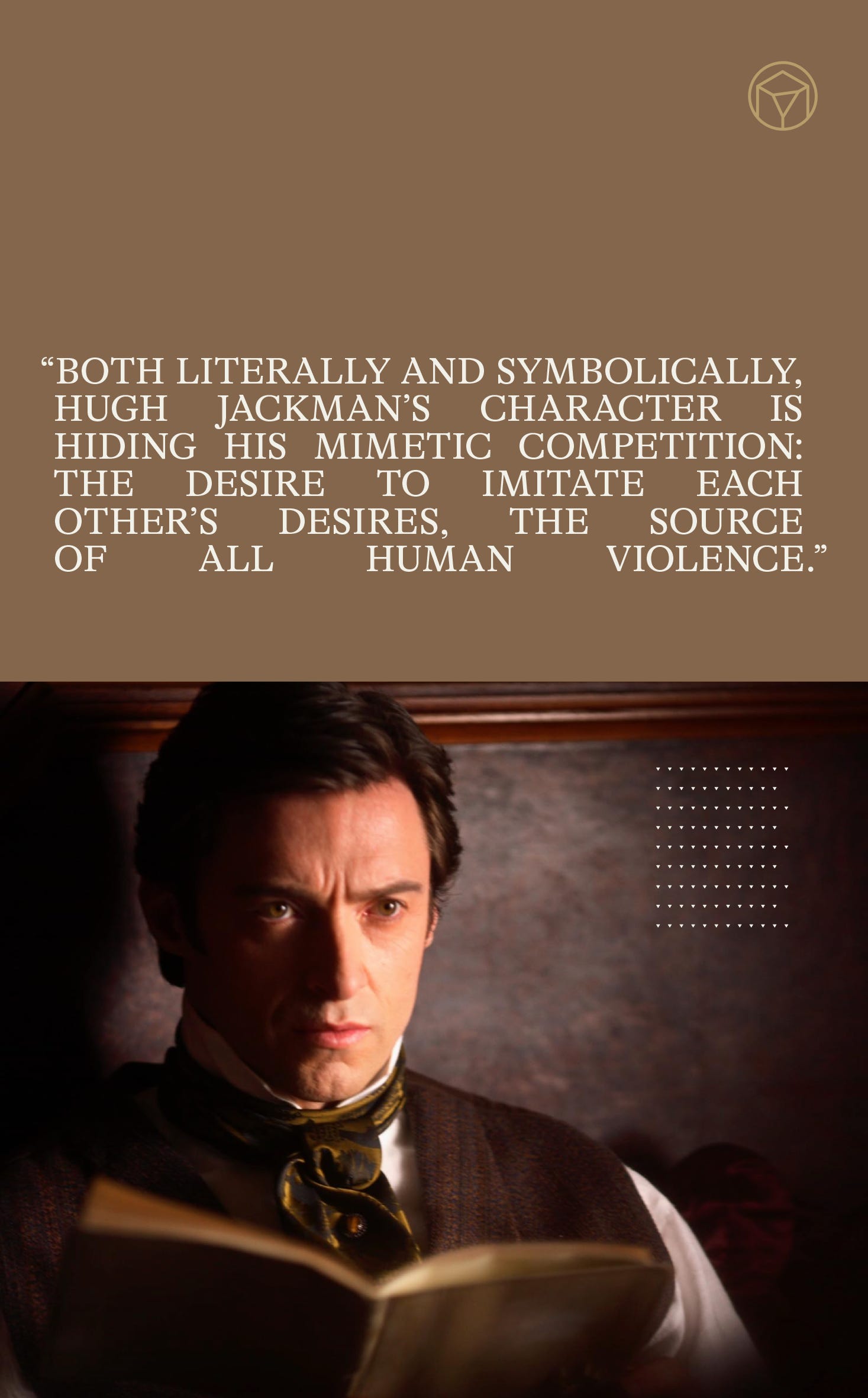
The fact that Hugh Jackman’s character, Robert Angier (The Great Danton), has to secretly kill dozens of his own clones is telling. Both literally and symbolically, he is hiding his mimetic competition: the desire to imitate each other’s desires, the source of all human violence, according to Girard. By making his entire life into a game, he allows this mimetic violence into his personal life, into his very being, which he must keep as deeply secret as the tricks themselves. The tricks become his life, and they increasingly seek vengeance for his domination in the game. You can’t win forever.
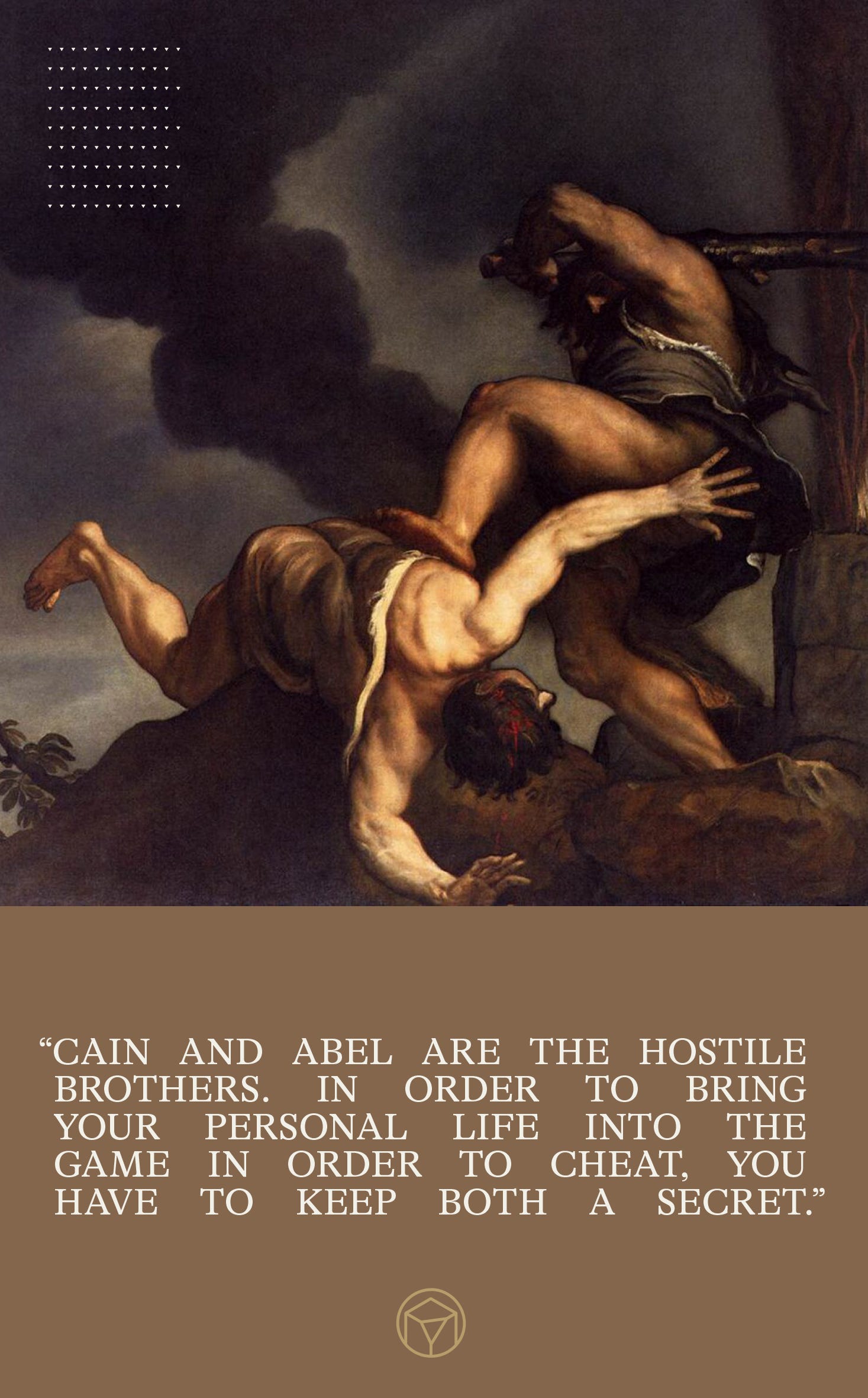
A much more sustainable solution is to play the game when you’re playing the game and live your life when you’re living your life. The Prestige is about men who make an extreme choice that backfires in the end, but at least they make a choice. Most people never consciously make a distinction about when they’re playing games and when they’re living life. Most just lurch from game to life, getting burned by each, doing neither very well.
It’s funny to notice, too, where this line gets drawn. Generally, networking should be a game. Friendship is not a game. Dating and courtship are games. Marriage is not a game. Work is a game. Your coworkers are not your friends in the office, but could be at the bar. Careful with that. Politics shouldn’t be a game, but it is. Dancing should be a game, but mostly it isn’t. Leisure, of which we have too little, is not a game. Worship isn’t a game. Sometimes a game is not a game. For example, if you’re on a date playing mini golf, the aim might be to lose, because you recognize that you’re actually participating in life and not playing a game.
When you’re playing games, you should stay within the rules of those games, for your own sanity and safety. When you cheat, you open yourself up to your life becoming a game to others, and to them attacking you when you don’t want to play a game. It’s best for you to keep those walls up. Cheating is usually not the slick move people think it is. It’s a tactical error. On the other hand, you must never make life into a game. Put your friends and your wife and your kids ahead of you, always.
Within the bounds of your games, though, you must have zero mercy. Make it difficult for your opponent to know the limits of your abilities because of the amount you prepared yourself in secret. Make them think that perhaps you are magic, immortal. Never boast about that, either. Always win by a secret overwhelming force. Then, when the clock runs out and the game is over, graciously accept the result. Instantly go back to life. Remember, there is something rewarding, too, about finding an opponent who can beat you at your most merciless, within the rules of your game. That drives and motivates you to be better next time. Be grateful, not vengeful.
Remember: It is not always what is obviously labeled a game that is a game. Your career is a game. But theater, for the most part, is a game too. Comedy is a game. Art is a game. In fact, some of the most tortured artists are driven to suicide by this confusion. They play the artistic creation game and think it is life. They’ve unbounded their minds dangerously to psychic violence, spending the raw material of their real lives to win the game of public recognition at any cost. It opens up too much psychic territory to endless retribution and warfare, such that they never have peace. Death becomes the only means of escape.
Now, it’s complicated. Perhaps there are certain artists who intentionally sacrifice themselves to create one-of-a-kind art. That may or may not be the only way to go this far.
What I do know, though, is that you and I are probably not operating at the level of these artists. If we were, we would already know it. We would probably benefit from being more careful to bind ourselves to games when we’re playing games, and to life when we’re doing life.
This is a deeply personal choice. I don’t know you, and so I can’t tell you exactly what parts of your life are games and what parts of your life are life. Some people are more game people, and some people are more life people.
What I can say, practically, as advice about how to win much more often than you do, is this: Decide consciously when what you’re doing is a game. Learn and internalize the rules, spoken and unspoken. Never break them. Don’t tell any potential competitors your secrets and preparations. Come prepared to dazzle and to dominate.
This, paradoxically, will make you freer to be self-sacrificing and loving, to expect nothing in return, in your personal relationships.
[Photograph: Magician Passing a Hoop over a Levitated Woman by Nickolas Muray, 1931 (detail).]

