



Nate starts the office tour on the top floor of the building, where he and Andres take in a panoramic view. Andres stares out the window for a good while, squinting in the light. Across the lake, distant spires rise to a pale sky.
“So this is the fruit of ungodly success,” Andres says.
Nate laughs. “It’s pretty crazy. I’m not sure I’ll ever get used to it.”
“Over time, you get used to anything.”
Andres doesn’t seem confrontational about this, but Nate takes a note to be careful. He’s realizing now that he doesn’t know Andres’ feelings on the company Nate joined, or the whole idea of selling out. There was a time when they shared a sense of resentment at an industry that didn’t seem to want to do anything with them, but those days were years ago. Today, many of the people in their loose circle have taken jobs at companies they used to condemn. People were supporting families, they had to eat. That’s how they got you.
Nate takes Andres down through the floors, showing him the design pods, the art pods, the sound studios, the motion capture studio, the kitchen and the gym.
“Does anyone even use all this equipment?” Andres picks up a nearby hand weight and tests it, as though he doesn’t believe it’s real.
“All the time. There’s usually a pretty good number of people working out, especially in the afternoon,” Nate says. He doesn’t know why he feels defensive. Maybe it’s because there’s a growing suspicion Andres is making fun of him somehow, secretly, or making fun of the whole idea of this luxurious office with its glass walls and views and amenities. In reality, this is the bare minimum of what they get for creating and running several of the world’s most successful games. Some of Nate’s coworkers, who’ve been here much longer than him, speak openly about their exotic sports cars, their wine collections, their heli-skiing trips. Nate has the presence of mind not to share with Andres the alienation he still feels when he overhears those conversations.
“Are you one of them?”
It takes Nate a moment to realize Andres is talking about exercise, and to register the playful tone in his voice. He supposes there’s no reason for him to be dishonest.
“Yeah. I’ve started, at least. It’s only been a couple weeks so far, but I decided I needed to get back in shape. Game development isn’t great for the body, as we both know.”
Andres nods, but he looks distant, lost in thought. “Sure. If I were back on the market, I’d do the same.”
Back on the market. So he knows about him and Monica, then. How? It’s not like it was a se - cret, but he hasn’t spoken with Andres directly in over a year. He supposes knowledge like that moves on its own. People get lunch and dinner together, they have game night and developer socials.
“I’m not in a rush or anything,” Nate says.
“Of course not. How is Liam?”
“He’s good. He’s at the age where he’s starting to become interesting. He’s like a little man. He fixates on weird things.”
“Fixates? Like on what?”
Nate shrugs. “He’ll pick something, and then he’ll only want that. Like just that specific thing, over and over. Right now he’s on a big phase with Virginia Seele. Do you know who that is?”
“The pop star? I don’t keep up with any of that.”
Nate nods. He wants to say he wishes Liam would stop listening to Virginia Seele. Not that he hates herthe songs were fine, the melodies perfectly catchy – but there’s something about his son being a fan of hers that doesn’t sit well with him as a father. He was taken aback when he discovered that Liam had Virginia Seele in his earbuds on the way to and from school. In some sense she was another vapid modern musical act among many, but Virginia Seele made that emptiness the point. I’m becoming who you want me to be, she’d sing. Was that really the best you could hope for? Couldn’t the kids have something a little more full-hearted than this cynical, nihilistic stuff? At least before they became teenagers …

Andres seems to pick up on his thoughts in spite of his effort to hide them. “Kids don’t really start to have taste until they’re 13 or 14,” he says. “Everything until then is just whatever’s in front of them.”
Nate nods, but wonders how Andres would know. Unlike most of the other people in their circle of friends who came up together making indie games, Andres stayed the same. He stayed making experimental interactive fiction for tiny audiences. He stayed single. He stayed stuck in the scraggly-beard-and-cargo-shorts phase of life. Nate, clean-shaven and wearing a dark green Henley shirt he recently bought at a price he would have balked at just a year ago, feels like he is speaking to someone from the past.
“Anyway,” Andres says, “I’ve been meaning to ask. How much money do you make here?”
Nate takes a deep breath, blows air through his mouth, looks at the ceiling, looks pained. Finally, he mentions a number.
“Wow,” Andres says.
Nate shrugs and laughs. “Yeah, it’s crazy. It’s too much, honestly.”
“That’s like four times what I made last year, between sales of my games and contracting. Or more like five times.”
“Well, maybe you could come work here.”
“They don’t need anything I do.”
Nate shrugs. “You would be surprised. They need all kinds of people.”
“They don’t need someone who prototypes shitty little games and makes dinky synth music.”
Now it’s starting to frustrate Nate, the way Andres refuses to accept the possibility that he could find himself in some kind of relation to this company. In fact, throughout the tour, Andres hasn’t said anything in the way of expressing approval or disapproval of what he’s seen. Having some kind of reaction would be the polite thing to do. Nate even would’ve liked it better if he got upset, saying this company and its fancy office stood for everything he was against. Something like that.
“If you say so.” Nate decides to try a different tack. “Look, I understand. At the end of the day, you still have your artistic independence.”
This gets Andres’ attention. “I guess? Too bad artistic independence doesn’t pay the rent.”
“No, but it’s worth something, isn’t it? When I got here I had to learn a whole new language. My boss is always talking about being ‘accountable to the fans.’ And what that means is, we basically have to do whatever they want.”
“There’s nothing new about being in conversation with the audience. That still requires judgment.”
“But that’s the thing, in our case, it kind of doesn’t. Just the other day we announced we were going to make a minor change to the movement system and all these players yelled at us. So a couple days later we pulled back. We gave up. We’re at their whim.” Nate lets out a sigh, realizing how real his disappointment is. “I hardly think of myself as a game designer anymore.”
“You’re a conduit for the will of the people,” Andres says, and Nate finally catches the sharpness in his voice that he’d been anticipating.
“I could put that on my business card.”
“You should. It’s funny.”
Nate thinks there’s something strange about the way he says this, almost like Andres looks down on him. What if he does, though? What if Andres has every right to look down on him? After all, he sold out, leaving behind his money worries, his artistic integrity and his old crew. He went to work for the man and now he’s whining about it.

The conversation with Andres is still on Nate’s mind as he pulls into the parking lot at Liam’s school that afternoon. He thinks that maybe in the future he could help Andres in some way. If not a job, he could fund one of the games, or help put on an exhibition. He could show that there’s something good to come out of his working where he is now, despite the way it looks.
Liam clambers into the car and pulls the door shut without looking at him or saying anything. He’s staring at his phone, earbuds in. It occurs to Nate to wonder if that’s normal for a child about to turn 10. Why does he even have them in the first place? He could ask Monica why. On second thought, maybe he shouldn’t. There’s a thin stream of sound leaking from them. It’s Virginia Seele.
Nate starts driving his son to his mother’s house. He tells himself that Liam will grow out of it. Or even if he doesn’t, what’s the problem, exactly? Can he point to a real reason?
“Hey.” Nate waves to Liam in the back seat, finally overcoming his fear that his kid hates him.
Liam doesn’t seem bothered at all. He pops the earbuds out. “What’s up?”
“I’ve been listening to some Virginia Seele too, you know.”
Nate can’t see Liam’s reaction well in the back of the car. He’s hoping it’s not too cringe for your dad to listen to your music. Unfortunately, he’s pretty sure he would’ve been upset if his own father did that to him.
“Yeah? What do you think?”
“It’s fun. It reminds me of some of that stuff we had in the ’90s.” Nate feels himself sounding ridiculous, but he can’t seem to find the path to a less embarrassing set of words.
“I like the lyrics,” Liam says.
The lyrics? Nate suppresses a laugh. That’s the kind of thing that surprises people about having kids: just how unpredictable they can be. He wouldn’t have expected Liam to be engaging with, much less appreciating, the lyrics to songs like these at his age. Was he already seeing himself in meta-commentary about conforming yourself to the ideals of others? Was that because of social media? Maybe Liam is getting too much screen time. He could talk to Monica about that.
At the same time, Liam wasn’t wrong. The lyrics were what struck Nate, too. To be a pop star, you have to be a strange being, both more than human and less than human at the same time. Virginia Seele existed to fulfill her contract as an avatar. It was strange, because she kept basing her songs on real-life things, even though at the same time she wanted you to know that she had anything but a normal life. Just when you thought you related to her she reminded you that she was different.
“You know, Virginia Seele and I have something in common,” Nate says.
“Yeah?”
“We’re both defined by others, in a way.”
Liam is quiet, and Nate can’t help himself.
“You know when she sings about becoming the person you want her to be, it’s a bit like my job now. I used to be the kind of game designer who decided what I wanted to make players experience. Maybe there’s a long corridor to kind of lull you into a sense of safety, and I put a surprise in at the end to make you jump. Or I want you to think about the relationship between two values, so I design a system where they’re intertwined … but the players of the games I work on now think they know everything about the game already, before I can even put anything new in there. So we just listen to what the players are saying, look at how they behave, and then we do the thing that seems best. It’s no different than if they just told me what to do. So what does that make me, right? The part where Virginia Seele says she’s only who she is because the fans made her into that – I feel like I’m in the same place. Less visible, but the role is the same.”
Liam stays silent.
“When you’ve got this crowd chanting at you to do something, and you do it … who’s in control, really?”
“I don’t think you’re like Virginia Seele.”
Nate laughs. This time he couldn’t stop himself beforehand, but he hopes Liam doesn’t take it the wrong way.
“No, you’re right. We’re different. Very, very different. I don’t sing or dance. And she’s much richer than I am. That’s for sure.”
Liam goes back to being quiet again.
“And Virginia Seele has something to say. I had something to say once, maybe, but I said goodbye to all that.”
Nate is late again. This time Monica doesn’t bother to mention it, but he knows it’ll be going into her database. Her ammunition stores. She’ll reference it later when she again accuses Nate of being absorbed in his work to the detriment of his personal life. Which is funny, because it’s only now that he started the new job that he’s really pushing himself.
“Is he listening to Virginia Seele again?” Monica frowns as Liam runs past her to his room.
“You don’t like him listening to her?”
“I don’t like the example she sets. Why?”
“When did he get the earbuds?”
“All the kids at school have them.”
“Virginia Seele is pretty interesting, actually.” Nate doesn’t know why he’s saying this. He feels like he’s being driven by a motor in his back. “Have you listened to any of it? It’s about how you have to turn yourself into something in response to others. To be a successful artist or entertainer, you’ve got to think about that. But if you go that route, then what’s left of you? If you reduce yourself into nothing but a machine for responding to other people, do you really have any kind of independent existence?”
Monica gives him a withering look. “Does this have something to do with your new company?”
“Maybe it does.”
“Wouldn’t that require knowing how to listen to people?”
There it is. He was waiting for that.
“I guess. I mean, there’s listening, which is what I was talking about, and there’s blindly molding yourself to be what other people want you to be, which is what I think some people mean when they say they want you to listen to them.”
On the drive home, Nate puts on Virginia Seele as loud as he wants. It’s funny, he thinks. He had such big ideas after the separation. He would get in shape, he would find someone new, he would rededicate himself to his craft. The new job initially seemed to be the first of a number of steps he would take to be the person he imagined he could become. But it wasn’t long before his transformation seemed to have stalled out. The chains of reality yanked him back to the sad truth: that he was a divorced dad who would set off alarm bells in everyone he knew if he opened his mouth about Virginia Seele again, no matter how much he thought there was something real in her work. He would keep his head down and go back to the office tomorrow morning, and if he did his job well, he would rinse himself out of the game he worked on completely. No room for any kind of individual taste in what amounted to a pure product, the perfect expression of its customers’ wishes.
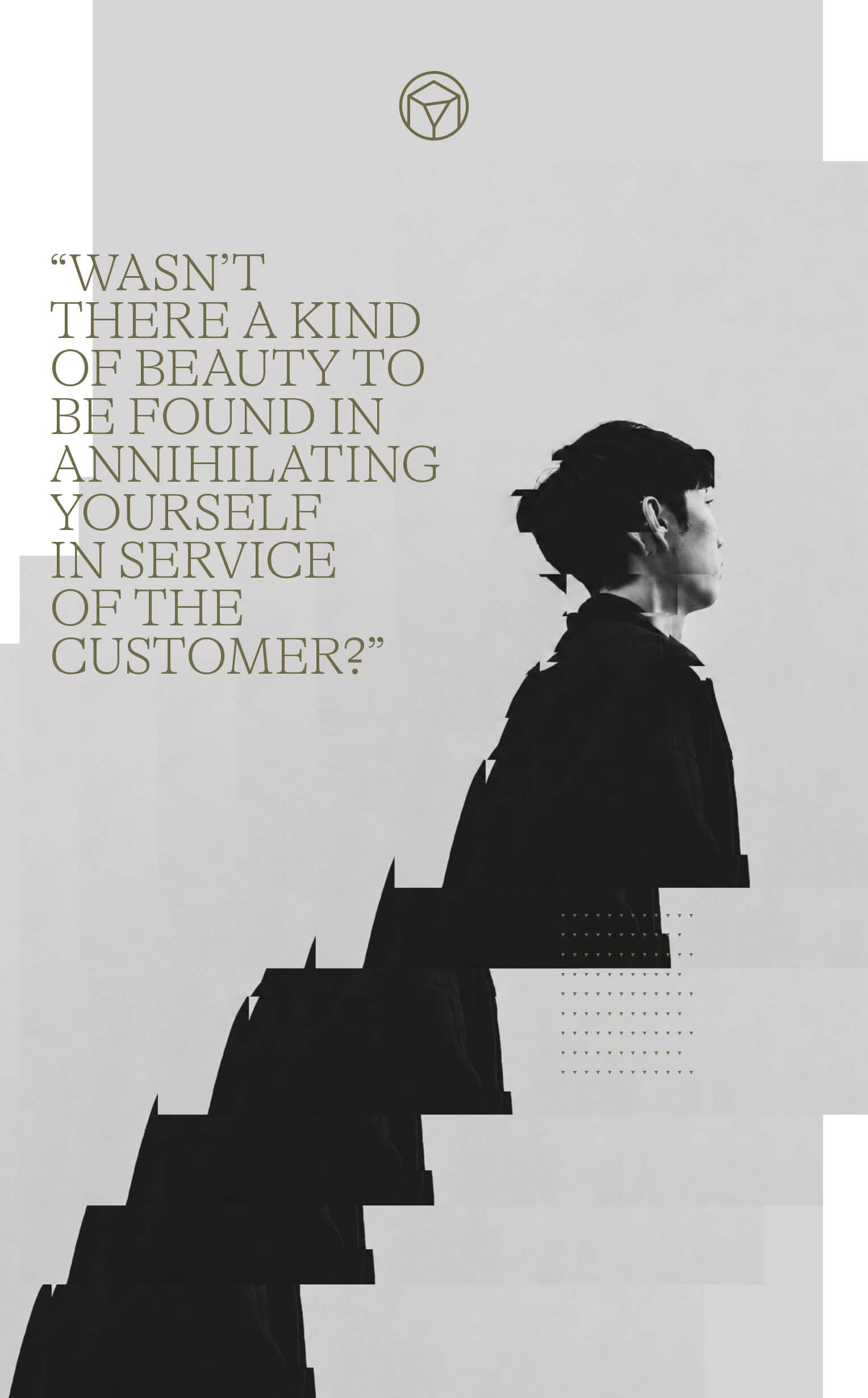
Maybe that’s fine. Maybe the worldview of people like Andres is wrongheaded. Wasn’t there a kind of beauty to be found in annihilating yourself in service of the customer? In a total vacuum of artistic intent, you could achieve a kind of synchronization with your players that someone like Andres, who often thought of his audience in antagonistic terms, could never find. Nate was in the business of fulfilling wishes, the same as anyone who worked in an entertainment field. It was time to give up the pretense that he had something to say, something to broadcast to the world. Throughout history, some artists didn’t shape clay to create forms – they were the clay, beaten and distorted by the forces around them.
Nate realizes now that he was on this path before he knew it. He was farther down it than he’d let on to anyone, farther even than he could admit to himself outside of the house. All alone in a cavernous space he originally purchased with the idea he would raise a family, he might gradually lose hold of his mind, let it fall into fragments, let it be replaced by the noise of things.
One night he finds himself scrolling through Virginia Seele’s social accounts. He doesn’t remember the events that led him there, but now he taps “like” on every single post, as though it were a reflex. Is this sad? It’s certainly not a matter of hoping the artist herself would notice or care. There was simply a point where the gravity of her ideal became too powerful. It got him, that was all. Something is lost when that happens, but something is gained, too. Something important. In that heightened moment he can forget the fact that he is him, that he is pathetic. He sheds his neutral poise and starts to believe in something. From there, everything tumbles along at great speed. He only needs to follow the contract he makes with his audience, after all. It’s an ancient, inviolable compact, the same agreement that binds his employer to its fans, the same one that collapses the space between people and turns them into self-reinforcing entities with their own collective minds and memories.
Right now, Virginia Seele is becoming who you want her to be.


