


Editor’s Note: Print issues of Chisel Volume 001 are shipping out soon! If you’re a paid annual subscriber to Chisel, be sure to check your inbox for an email requesting your delivery address.
If you aren’t yet a print subscriber, upgrade to our annual plan today.
Mike Flanagan, the visionary director behind horror films like Doctor Sleep and Oculus, has also become known for dropping the darkest horror miniseries each October. Netflix is home to a number of his passion projects, like the jump-scare-filled The Haunting of Hill House (2018) and the demonically delicious The Fall of the House of Usher (2023). His adaptation of Stephen King’s Carrie, which just finished airing on Amazon Prime and has already been greenlit for a second season.
But, in a filmography which is heavy with adapting works of literature for horror fans (including Shirley Jackson, Henry James, Edgar Allan Poe, Christopher Pike and, of course, Stephen King), many people forget that he was also behind an original project, 2021’s religious horror series Midnight Mass, a deeply Catholic-coded spin on the vampire mythos in small-town (well, small island) America.
Flanagan, who recently celebrated eight years of sobriety on Instagram and grew up a Catholic, teased the series in his prior works Hush and Gerald’s Game. One of his earliest ideas, long before he became the household name he is now, Midnight Mass was originally envisioned as a novel before he turned it into a 155-page screenplay for a feature film. It is a meditation on faith, on religion, on addiction and on how humanity can be quickly corrupted by these things, even if they started out with the best of intentions.
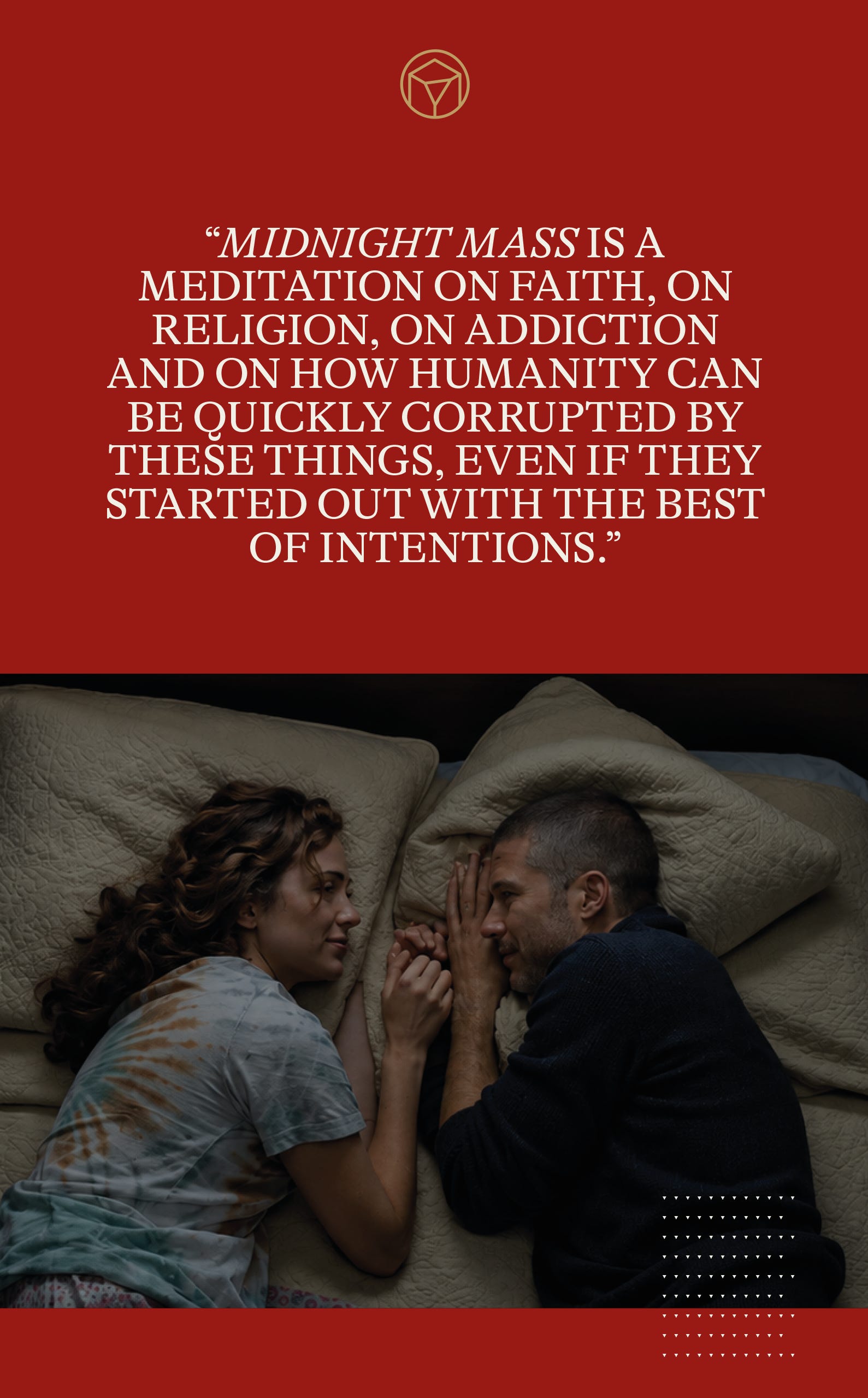
Riley Flynn (Zach Gilford) returns home to the deeply Catholic community of Crockett Island after serving a prison sentence for killing a girl on the mainland while drunk driving. The island is quietly dying, with many of the community selling up, and the remaining inhabitants hoping for a change in their fortunes. Their lives revolve around Mass at St. Patrick’s Church, led by the elderly priest, Monsignor John Pruitt, who has recently gone on pilgrimage to the Holy Land but doesn’t appear to have returned. This leads to the arrival of the much younger and charismatic Father Paul Hill (Hamish Linklater), whose faith begins to revitalize the town, even as mysterious events – which the Catholic residents see as miracles – begin to take place on the island.
The island’s peace is quickly disrupted as these miracles affect the residents and begin to cause religious tension, most notably between the overzealous Bev Keene (Samantha Sloyan) and both the homeless alcoholic Joe Collie (Robert Longstreet) and the town’s Muslim sheriff, Hassan (Rahul Kohli).
Bev also becomes the driving force behind fanaticism after she sees Pruitt/Paul resurrect from a gunshot. Incapable of serving as an official member of the clergy due to her gender, despite being an expert in Catholic theology and Christian scripture, Bev instead becomes self-righteous and arrogant, but even her warped ideas around her faith quickly evolve into madness. She believes this is the first event in the prophesied Book of Revelation and does everything she can, even murdering fellow members of the congregation, if it means forcing the Second Coming, where Jesus will return and judge the people of the world.
Each of the seven episodes is named after a book of the Bible and the story serves as a meditation on faith, but also on obsession and addiction. Father Hill, actually the younger version of Monsignor Pruitt, is engineering the “miracles.”
While in the Holy Land, the dementia-ridden priest got lost and found a cave where a frightening, winged creature – which he calls an “Angel” (Quinton Boisclair) and we would best liken to a vampire – drinks his blood and then has him consume its. This begins to de-age the priest and restore his faculties. Believing the creature, this Angel, to be miraculous, he arranges for the creature to be shipped back to the island. Then Pruitt begins to dose the residents by adding the creature’s blood to the communion wine taken during the Eucharist at Mass. He also takes an interest in Riley, coaching him through Alcoholics Anonymous meetings in the island’s community center and eventually revealing what he’s been doing and the creature as well, turning the now-atheist Riley into a vampire...
But by balancing Riley’s recovery and sobriety, Pruitt/Paul also leads the congregation of the island to become blood drunk, metaphorically but also literally. Riley eventually commits suicide by sunlight to convince Erin Greene (Kate Siegel), his childhood friend and love interest, who recently lost her child because of the Angel’s blood, that he’s not just making this up. Horrified by his ashes floating in the dawn light, she resolves to prevent the Angel, and its infection, from leaving the island.
Catholic theology teaches that Christians should meet to remember Jesus, his sacrifice, and partake in his body and blood, based on John 6:51-58. This has become the foundation of the ritual called “Mass,” the heart of Catholic worship and liturgy. The series’ title comes from the fact that, once he resurrects, Pruitt/Paul can only hold Mass at night, with the penultimate episode seeing him and the townsfolk meeting after dark and holding a kind of vigil, culminating in the arrival of the Angel, wearing clerical robes, and calmly standing in front of the terrified congregation. While initial consumption of the Angel’s blood heals wounds, reverts the elderly to their youthful forms and restores mental awareness, if someone who has drunk the blood dies, they then become locked to darkness. They have become, as the world understands it, very traditional vampires with the hunger that state induces, and the dawn is now racing toward the island.
In the New Testament, Jesus and his disciples came together for the Last Supper the night before Jesus was arrested and crucified. During the meal, he commanded them to eat of the bread and drink of the wine, as if it were his body and blood. Catholic theology teaches that the Eucharist literally becomes this during the Catholic Mass through a spiritual process called “transubstantiation.” This ritual, during earlier times, also led to the mistaken belief that Christians were cannibals who were literally consuming blood and flesh as part of their apparently arcane ritual, rather than doing it in the memory of the Last Supper.
When coded for religion, eternal life is a reward for belief. For partaking in a sacred sacrament which remembers a great and terrible sacrifice. But when you strip that away, we speak of words like “cannibalism,” “forbidden” and “damned.” It’s the same power, the same outcome, but coded for good and bad, light and dark or as spiritual reward or punishment.
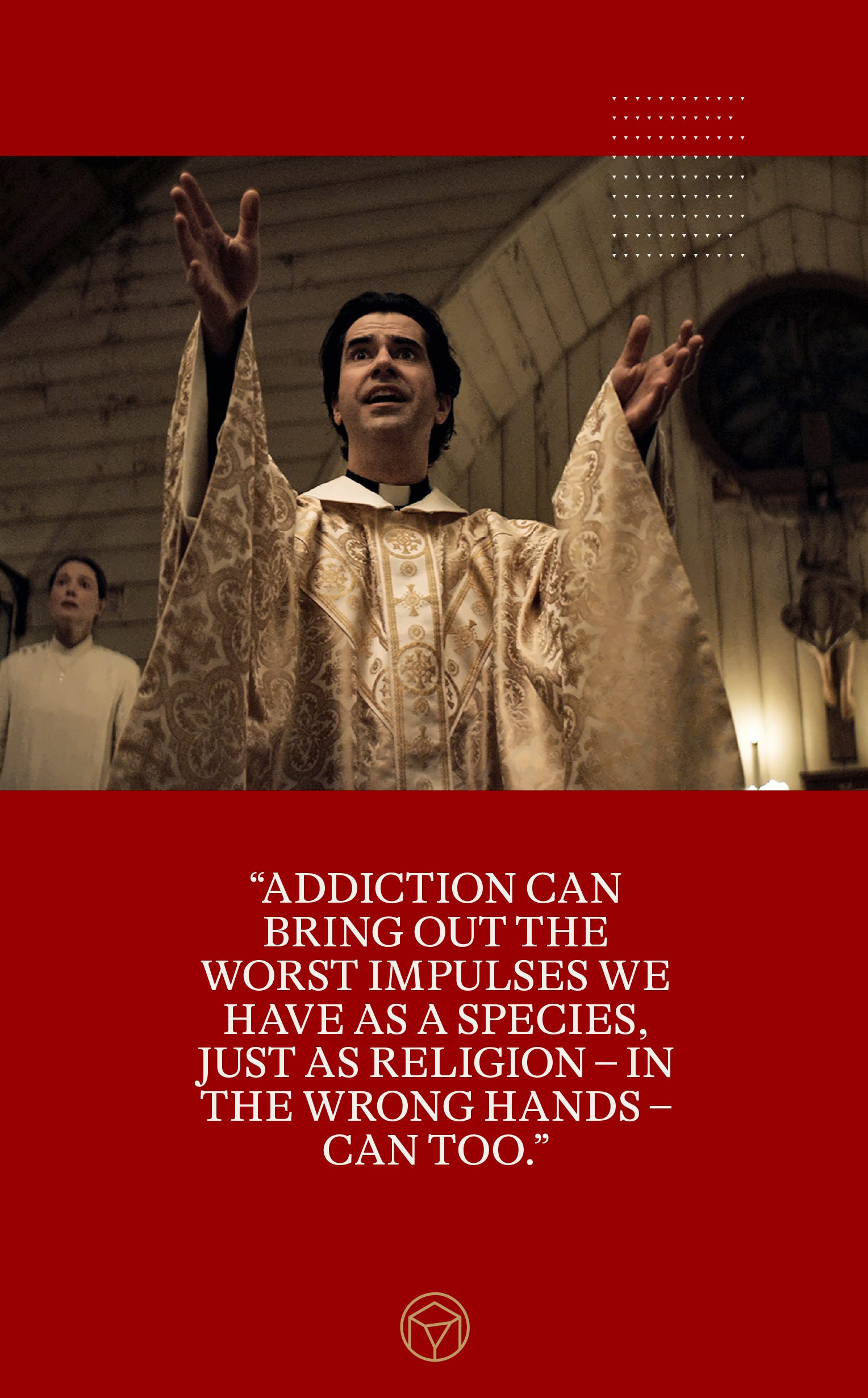
When Pruitt/Paul finally introduces the Angel to the townspeople, who are justifiably terrified at witnessing this passive but demonically coded creature, he reminds them of Luke 2:10: “Be not afraid; for behold, I bring you good news of a great joy which will come to all the people.” This is the tipping point as the islandfolk drink poison en masse, with parents forcing their children to drink. They resurrect minutes later and massacre anyone still alive in the church in their blood-drunk state, causing them to rise as well. This includes Hassan’s son, Ali (Rahul Abburi), who is beginning to feel the peer pressure from his Catholic friends over his Islamic faith, especially as the miracles seem much more real than the abstractness of his own faith.
The final episode sees the newly converted vampires feeding on the townspeople, as the boats are burned by a small cohort of survivors, trapping them on the island. Erin gives up her life to slice the creature’s wings, preventing it from being able to reach the mainland.
All the turned, and the creature, then perish as the dawn sun rises, combusting as the sun’s rays hit them. In their last moments, some turn to family, others to their faith and begin singing the hymn “Nearer, My God, to Thee,” while the self-righteous Bev turns to desperation, not wanting to die given her actions in the last few episodes where she has become the villain even while quoting scripture. Meanwhile, the dying Hassan and his turned son begin to make the fajr, the Islamic dawn prayer, even as both know this will be the last time they pray together.
The only survivors are Riley’s younger brother, Warren, and the formerly paraplegic Leeza, who escape in the last boat, only for her to realize, as the sun rises, that she can no longer walk. This suggests that the Angel has died, and its “miraculous” blood has been neutralized. As they leave, Leeza offers a prayer, knowing she cannot save them and, instead, asking God for her parents to find peace, proving once and for all that the children, innocent and untainted, will indeed inherit the Earth.
Religion is a vital part of what it is to be human, to look for a higher power, to live by morals and to come together as a community. But Midnight Mass, in its seven-hour runtime, shows how this faith, this piety can quickly be corrupted into something much darker. We see the gamut from the sincerely honest like Riley’s parents, to Pruitt/Paul, who genuinely means well, even if he is very misguided, to the zealous and self-righteous Bev, who embodies the worst aspects of a fanatic. And when Pruitt tries to admit he’s mistaken – that it should be about God, not about him – it’s too little, too late. Bev calls him a hypocrite, and Pruitt/Paul prepares himself to die a third, and final, time.
Religion can be healthy, or it can be harmful. Just like alcohol, just like certain drugs. A little bit will help you but a lot can do incredible harm. This is something we see today all too often in the real world. But the series also shows how quickly this can happen – albeit thanks to mystical means – as much of the acceleration that happens on Crockett Island is caused not by the Angel but by the humans, like Pruitt/Paul, Bev and Sturge (Matt Biedel), the church handyman. Because humans are the real evil here, not some vampiric Angel. Because addiction can bring out the worst impulses we have as a species, just as religion – in the wrong hands – can too.

