


How much of life do we spend waiting? Waiting for buses, queuing for tills, lining up to get on a plane, rushing down to the door every morning in the hope that a certain letter or parcel has arrived? I have very early memories of waiting – waiting really does kick in early – and oddly enough most of these memories involve games.
What they involve for the most part is waiting to get a turn to play. With two older brothers, both of whom had a brighter claim to the Commodore 64 that itself waited, creating the unmistakable fragrance of too-warm plastic, in the basement, I would spend so much time waiting for my go on a new game that I got very used to just watching games. Games were a thing that I would take in, quietly and politely, spectating with no kind of agency whatsoever. In truth, I still love “playing” them this way.
But then there were games that you actually played and then found you were waiting, too. Ghostbusters on the Commodore 64 was a case in point. You get your franchise running and you swoop around Manhattan bagging ghosts, but really when you play the game, you’re waiting for the moment that the Keymaster and the Gatekeeper converge at Spook Central and the energy in the game goes through the roof.
Somehow, Tetris, a game in which players are busy doing something critical for every second of play, is another game about waiting. And unlike a lot of games, it mints great substance and thought from this part of the design. Waiting, if you ask me, is where Tetris swoops upwards from the plane of brilliant, world-beating design and becomes, what? Something philosophically and morally challenging.
(This may sound like a reach, and I almost agree – but I thought this all up when I was in-game, and waiting, and I felt utterly convinced by the end of it.)
To tackle this in a slightly different manner, once I’d played Tetris for a few years I started to realize that the game I was seeing was only one half of the deal. Approached in a certain way, Tetris is all about negative space. It’s about what isn’t there – or crucially, what isn’t there yet.
So you build the wall and there are gaps that stop you from clearing it and moving on. Maybe the gaps are perfect for a certain block, and while you could fudge it with other blocks, you decide: No, I’m going to play this the right way. I’m going to wait for the block I am after.
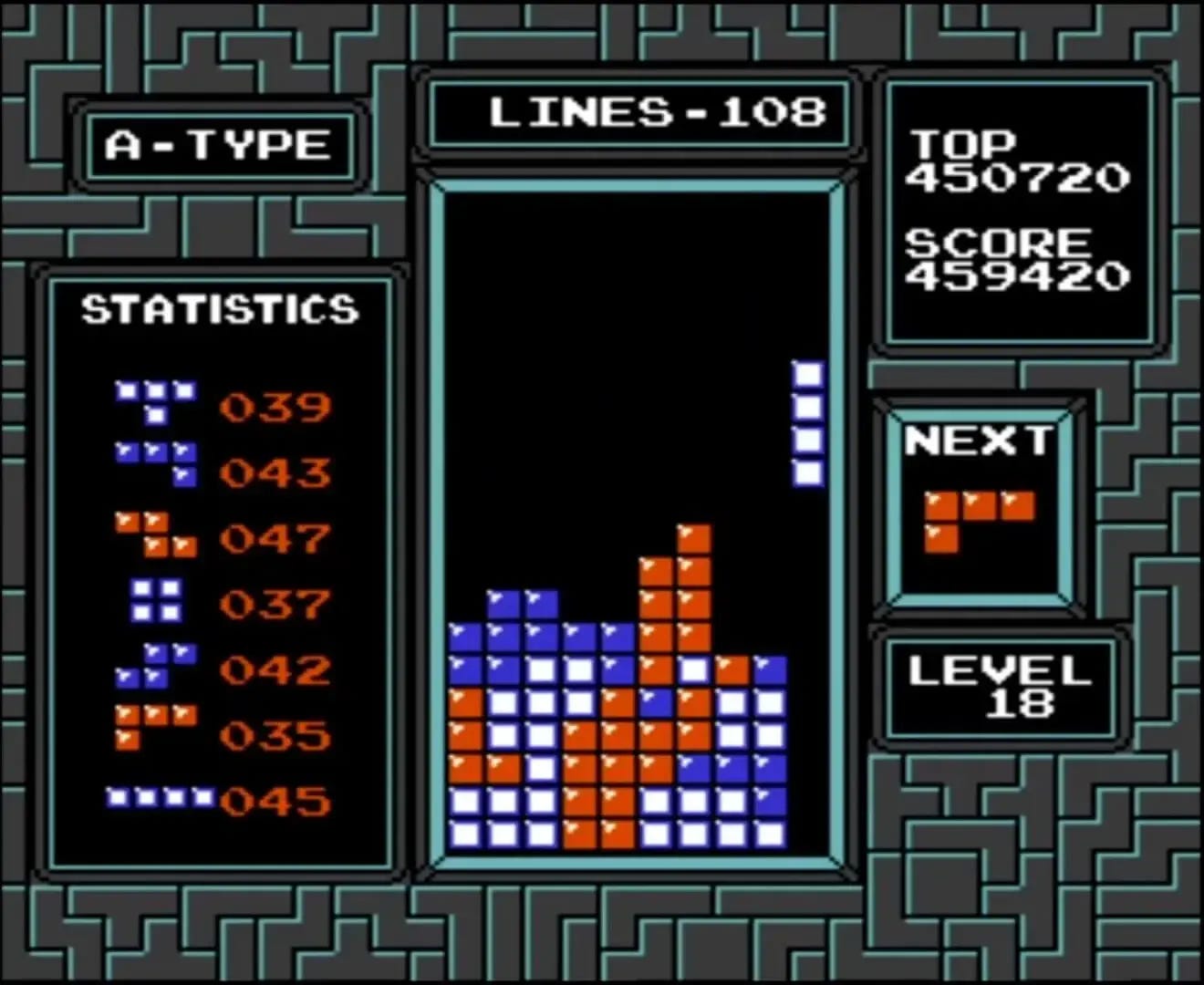
This is never more true than when it comes to the most devilish of all Tetris pieces, the I. The long block. The Hero. The long block is just perfect for clearing the board and giving you a Tetris. And so inevitably I find myself playing just for these moments, making sections of wall that are perfectly shaped for the long block to arrive and drop in and clear everything. And solve everything.
The problem with this is that Tetris bucks and resists. It seems to know when you’re playing in a non-pragmatic way. It sees your idealism for what it is: inflexibility. And so you wait and wait and wait for the long block, and then things get out of hand, and then you make a mess of things, and then your plans are in ruins, the wall is a gappy disaster and then – then! – just when you can’t use a long block anymore, it finally arrives. And then, generally, it’s a fast slide towards game over, with no one but yourself to blame.
This is the moral dimension of Tetris, the point at which this simple puzzle game almost becomes a parable. You wait and wait and wait for the long block, and yet so much beauty and potential is presenting itself all the while, and you simply refuse to see it. Because beautiful as all this other stuff is, it isn’t quite as beautiful to you as a long block.
When I find myself among people who love Tetris, I often tentatively broach the subject of the long block, and how it seems dialed into the worst elements of human nature. I think I’m hoping that someone will tell me I’m deluded, or that I’ve thought about it too much, or that I need to get more sleep.
Often, though, the people I’m talking to agree. Even worse, they start to ruminate on the long blocks that crop up in their own lives, far outside of Tetris and its well. The long blocks are the fixations they have, the shot at a perfect moment that blinds them from all the loveliness that’s going on everywhere around them. When I get that big payday! When the roof is finally fixed. When people finally understand how brilliant I am at work.
Regardless of how we play Tetris, I’ve started to believe that we’re all waiting for our long block – and the best thing we can do is simply identify what it is and then try to see the world beyond it. I’m still trying, frankly. Mixed results so far.
[This essay is an extract from the forthcoming book All the Pieces Matter: The Purpose and Meaning of Tetris by Christian Donlan, coming in 2027 from publisher Tune & Fairweather.]

