


The internet is dying. The 2025 “Bad Bot Report” from cybersecurity firm Imperva claims that there is now more bot than human activity on the Web. The online world has become increasingly homogenous and filled with AI-generated content. Even, and especially, websites that prided themselves on crowdsourcing human knowledge have become tarnished by this. Wikipedia now has a “WikiProject AI Cleanup” to combat the inclusion of unsourced and poorly written AI-generated text. With the old internet long dead, it’s hard not to be nostalgic for what once was, or to dream of what it could be, in a parallel world.
“While I believe Wikipedia to be a modern (and exceedingly rare) marvel of community collaboration that I consult regularly, I never set out with the intention to use it as the narrative medium of Neurocracy.” Joannes Truyens is the creator of a sci-fi murder mystery told through an alternate Wikipedia, called Omnipedia, in the year 2049. A “run” of the game is told over 10 episodes, each being a snapshot of a single day, which allows players to trace how older articles have been edited and new ones added over time. With a new episode released weekly, this enables Joannes and his team of writers and designers to adapt updates according to emerging theories and discussions on the game’s community forum. They explain, “The earliest conceptual version of Neurocracy in its current form was a story bible filled with world-building details that I had written and formatted to resemble Wikipedia articles for the sheer fun of it. Eventually I realized that the ideal format for Neurocracy was staring me right in the face.”
Neurocracy isn’t the only alternative Wikipedia that started out as a world-building exercise. Stanley Baxton’s The Shaman, the Outsider, and the Diet of Worms is an experimental piece of interactive fiction including the autobiography of an anthropologist visiting a remote village in a fantasy world, and the accompanying wiki about the autobiography 400 years after it was originally written. “The format was to showcase a world not through an objective lens or the author telling you the exact specifics, but instead through in-universe texts and materials, where they come with their own biases you have to consider.” Stanley has written a postmortem about Diet of Worms in which he advocates for “world-building through negative space,” allowing room for player speculation. “I wanted the player to feel like an active participant in the world, rather than a passive observer, much like they were reading an actual Wikipedia article on a topic they may have been completely unaware of until now.”
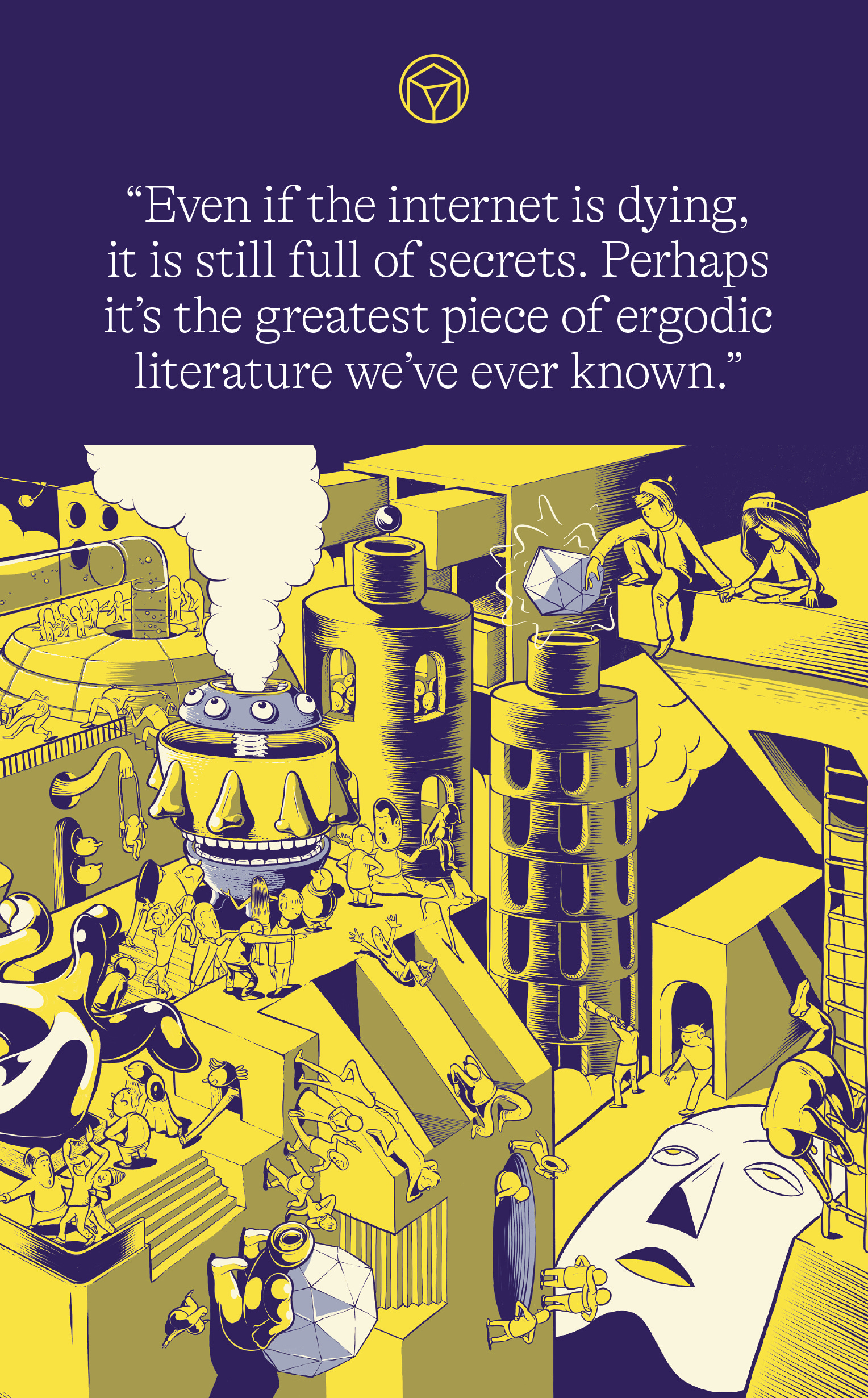
Back in 1997, Espen Aarseth coined the term “ergodic literature” to refer to a genre in which it takes a reader a nontrivial amount of effort to traverse the text. He gives a range of examples of ergodic literature across different media, including wall inscriptions on ancient Egyptian tombs with nonlinear arrangement of religious texts, the I Ching, and Raymond Queneau’s Cent mille milliards de poèmes, a “sonnet machine book” that can technically produce 10^14 sonnets. The vague nature of the concept has drawn some criticism, but the wiki forms of both Neurocracy and The Shaman, the Outsider, and the Diet of Worms arguably lends them to this definition. As Joannes puts it: “My hope was that players would be intrigued enough by the sci-fi story world of Neurocracy, and the way it’s dispassionately presented through Omnipedia, to dive in and start hunting for clues and basically do research for fun.”
Kitty Ess also sought to design her game, Pink Website, with a particular player experience in mind. “I wanted a feeling of exploration, like you’re uncovering something hidden and being a little nosy. This is why some of the links to the pages aren’t super obvious.” Rather than Wikipedia, Pink Website takes its aesthetic cues from contemporary nostalgia for the internet of the 2000s. You navigate the blog of a young woman in an alternate 2025 where everyone has discovered that the world is going to end in approximately 15 years. Through navigating this blog, you can discover the 2004 webpage of the creator of a cartoon rabbit called Lulu Bunny, complete with era-appropriate graphics.
Pink Website was a solo project, with Kitty herself even appearing as the fictional influencer protagonist in pictures. Stan collaborated with an artist, Reyn, for the 3D modeling and wiki design of Diet of Worms. Neurocracy has more of an anthology format, which allowed for Joannes to bring on multiple writers. “The unifying encyclopedic tone and presentation of Omnipedia meant that writers could cover the most outlandish subjects … expanding the roster of potential suspects in the murder mystery to include an 11,000-year-old humongous fungus and a Fall Out Boy cover band.” Emulating the format of an encyclopedia written by countless people enabled the organic growth of Neurocracy’s intertwined narratives.
I wanted to know what personal experience these creators had with the sites that they’ve drawn inspiration from. For Stan, he was also interested in the community dynamics of Wikipedia: “I’m curious about their motivations for adding, removing or amending text, and what political, social and personal effects influence them to do so.” He remembers watching edits being made to the Higgs boson page in real time as a kid. In Kitty’s case, she didn’t have firsthand experience of the millennial internet. “Since I didn’t experience the ’90s and 2000s web first-hand, for the page from 2004 I studied archived Geocities pages and emulated them to get the look I wanted.” She’s particularly interested in amateur web design and how personal websites have evolved over time, and Pink Website is an exploration of this.
One of the most striking elements of Pink Website for me, however, was how closely it was able to mimic the aesthetics of contemporary web pages filled with advertisements. At one point you are directed to a website called TechVibe, which Kitty based on CNET and The Verge. “I normally browse the Web with an ad blocker, so I deliberately turned it off and studied the way modern news sites are laid out. I then took screenshots of ads I found interesting and recreated them in Photoshop. During my research I was reminded that modern news websites are basically impossible to navigate without an ad blocker.”
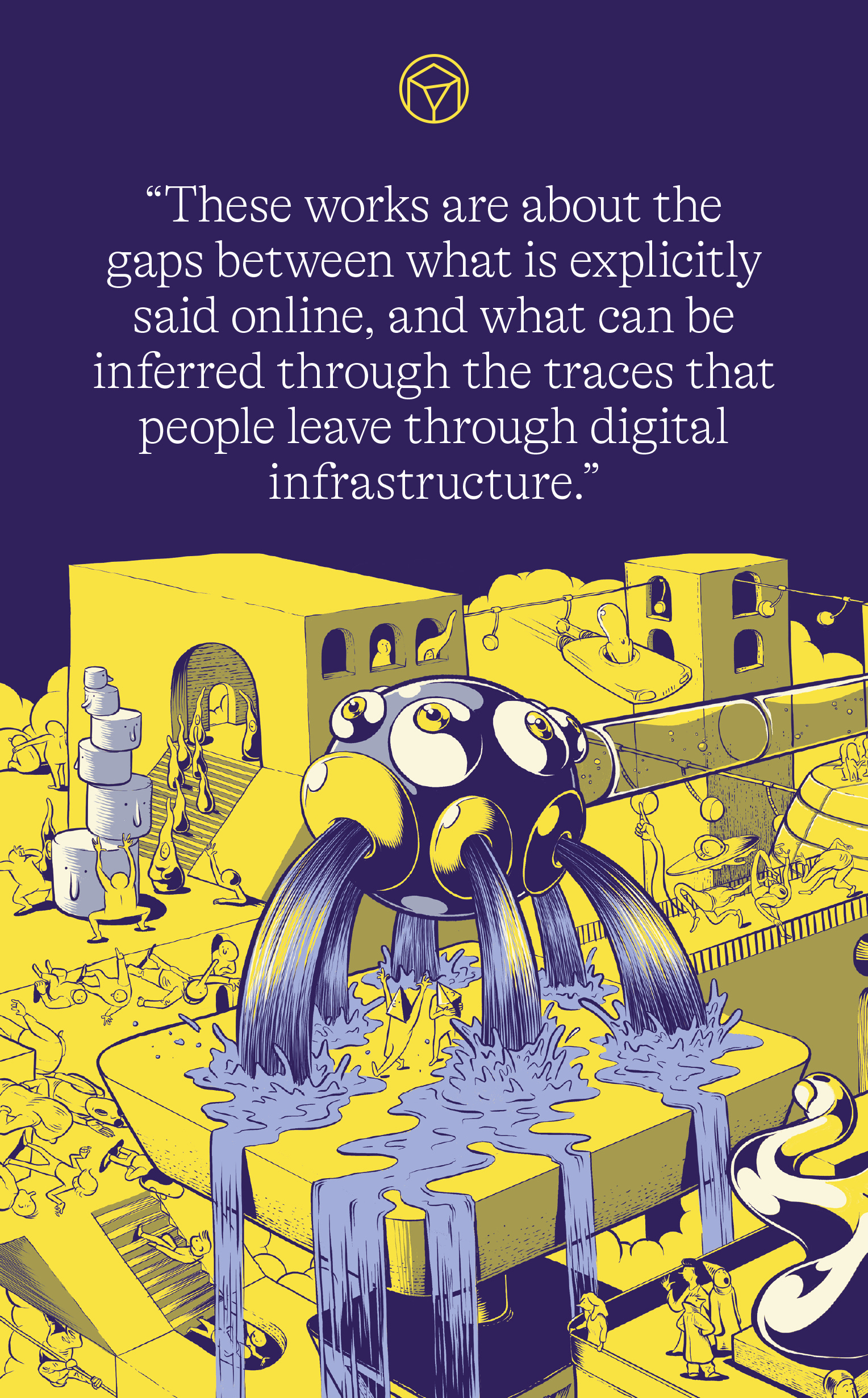
All three of these projects used the idiosyncrasies of the internet, past contemporary and future, for narrative purposes. Here we find an alternative online world, though perhaps not one that is any less dystopic. These three works are also about the gaps between what is explicitly said online, and what can be inferred through the traces that people leave through digital infrastructure.
Kitty was specifically inspired to include hidden links by Martine Neddam’s Net art, mouchette.org. Following that thread led me down my own strange internet rabbit hole. Mouchette is a distinctly unsettling experience, especially given that it is based on a 1937 novel about a teenager committing suicide. Exploring that art piece, I found my way to Martine’s About Me section, where she comments: “Available information can be found in the Wikipedia entry about Mouchette.org. The nice thing is: I didn’t make this entry at all. I really don’t know who did.”
Even if the internet is dying, it is still full of secrets. Perhaps it’s the greatest piece of ergodic literature we’ve ever known.

