



Wastelands retreating into mist. Empty rooms filled with sickly dawn light. The nearly urban world seen from above, photographed from some chilly and uninquisitive perspective. Over the years I have watched Denis Villeneuve’s films, often in a state of admiration, frequently pleasantly frustrated, and always with a growing sense that I am watching a filmmaker exploring the same narrative again and again. And exploration is exactly the word for it. The writers would change, as would the cinematographer and the actors, along with the hooks and the specific details of the plot. Even so, Villeneuve would always find a way back. He would always find a way back to a restaging of the same essential scenario, as if there was always more in there to discover, or to disinter.
When his name came up in conversations, I would tell people that I thought Villeneuve always made the same story over and over, and I didn’t mean that as a slight. If anything, it’s the opposite, surely. Here is a creative person who is willing to set aside the panorama of the changing world and everything in it, to give themselves utterly to the specific thing that compels them. Here is a person drawn back, again and again, to investigating and understanding … what? Some central aspect of their own identity perhaps. Or maybe a deeply set fear. How could anyone know? And would the answer really matter?
As for this story Villeneuve would restage over and over, for a long time, I think I actually had it slightly wrong. I had spotted, I told myself, that Sicario and Blade Runner 2049, the two Villeneuves I knew the best, have what seems like similar, specific and distinctly uncommon central trajectories for their unfortunate protagonists. For starters, the apparent heroes: FBI agents and android bounty hunters by turn. There’s a quest and, for all the melancholy detailing, the promise of something that feels like adventure in both films. But then, over the course of the almost-adventure, these protagonists discover that they are not truly the protagonists. They discover that they are ultimately bit players in a wider story whose focus is somewhere else, and on someone else.
So in Sicario, FBI Agent Kate Macer is invited to join a shadowy, and perhaps quietly illegal, interagency task force combating drug traffic across the border between the U.S. and Mexico. But as events become more chaotic and deadly, Kate starts to question her role, before being told – and in a film filled with torture and executions, this feels like a peculiarly cruel blow – that her actual role is, in effect, purely bureaucratic. The CIA requires the involvement of the FBI if they’re allowed to operate within U.S. borders. She’s not an asset to the team so much as she’s a piece of box-ticking and rubber-stamping, an annoying quirk of complex checks and balances. In truth, everyone else thinks she’s in the way.
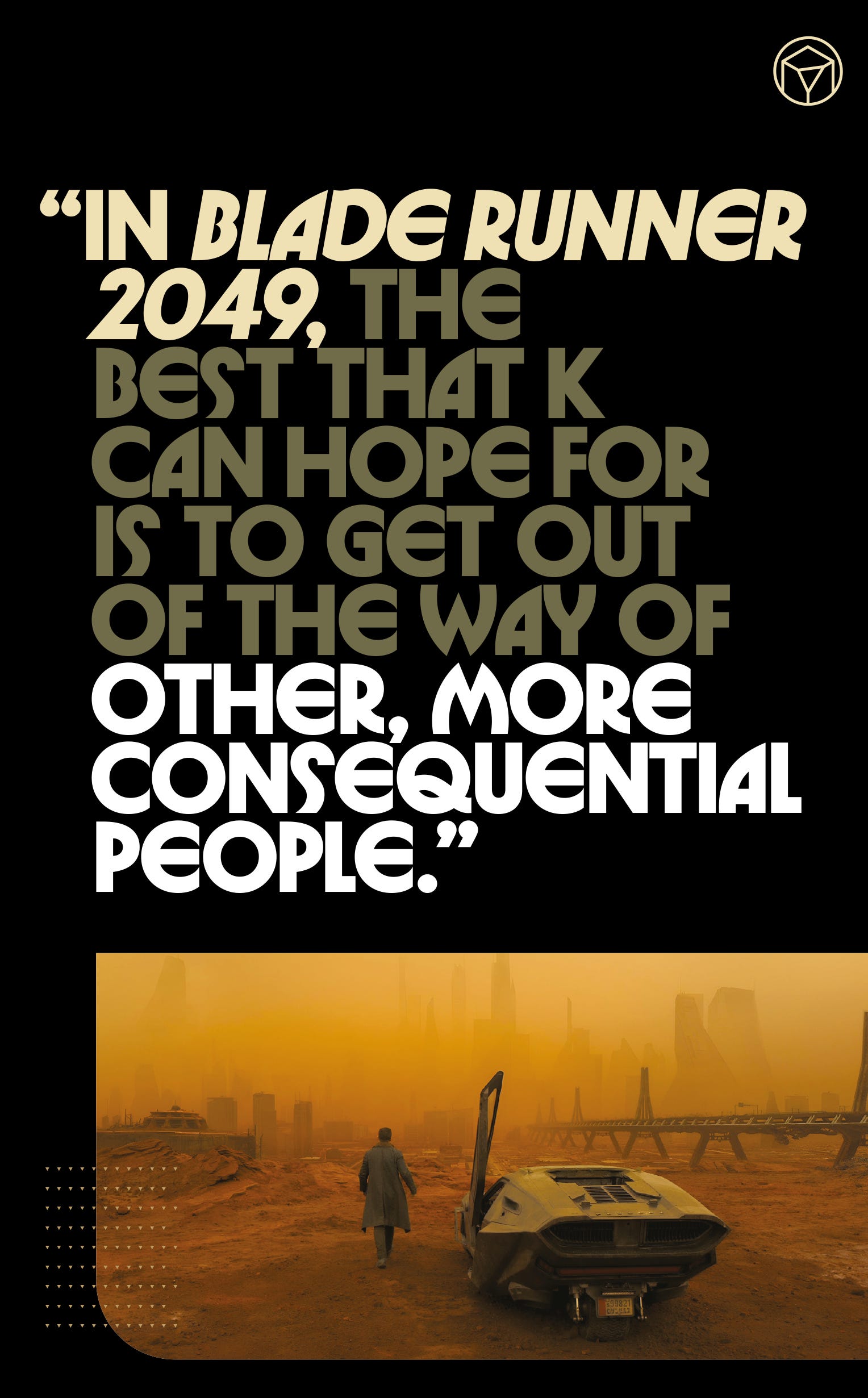
Meanwhile, in Blade Runner 2049, K, an android who hunts down other androids, uncovers historical evidence for something this future world has long believed was impossible: an android who was able to conceive and give birth. Navigating by his own seemingly implanted childhood memories, K starts to suspect that he is the child who was born in this unique scenario, which would mean that the memories he cherishes are actually real. Eventually, however, his dreams of singularity are crushed by an offhand comment from an ally. He learns that the child in question was a girl. And she grew up to be the creator of artificial memories for androids. It’s her memory that she gave to K, and the best he can hope for with the remainder of his artificial life is to create the opportunity for a meeting between father and daughter. The best he can hope for is to get out of the way of other, more consequential people.
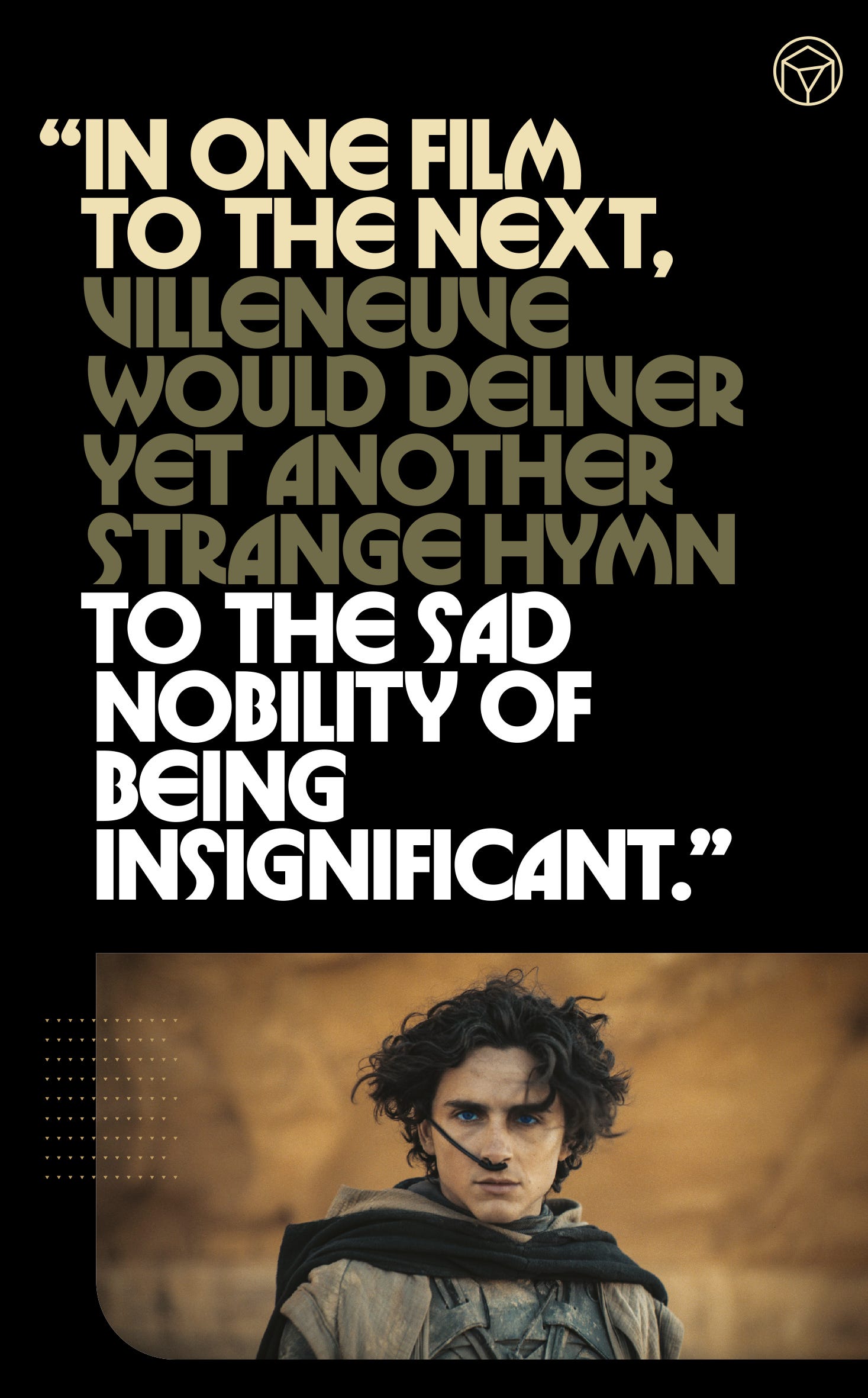
There is a thrill to pattern-spotting in art, and for a while I was sure I had found one. In one film to the next, Villeneuve would pick his projects and arrange his material to deliver yet another strange hymn to the sad nobility of being insignificant. Villeneuve seemed fascinated by those cognitive biases in which we place ourselves, against all odds, at the center of events.
But then I watched more of his films, and the picture deepened a little. I watched Arrival and Prisoners and a movie called Enemy that I had utterly missed on its initial release. I mused on his work on Dune. I still felt Villeneuve was restaging some crucial repeating narrative in each, but the narrative itself became broader. I see now that in Sicario and Blade Runner 2049 I had found a subcategory of his compulsions. His wider theme, I think, is much simpler and much more universal. Villeneuve is fascinated by misperception.
And as themes go, misperception can creep up on you. I should know. I was three-quarters of a way through writing my first book, a memoir, when I discovered that the story I was telling was not what I thought it was. That’s something to realize when you’re writing your own life story. Rather, the real story the book was telling was exactly the fact that nothing was what I had thought it was. This wasn’t the hero’s journey: It was a minor repetition of Don Quixote, the supreme work of misperception, in which the hero’s role is to mis-see, misunderstand, misinterpret, for our delight and education.
And returning to Sicario and Blade Runner 2049, this is now very clear from the off. Both films concern investigators who are ultimately wrong-footed by the mysteries that are unfolding about them. And both have only tentative holds on the real world in the first place. Sicario’s Kate Macer is a contained and quietly nomadic presence within the film: She’s happy to switch departments to pursue justice, happy to disappear back and forth between the U.S. and Mexico, and what little we see of her apartment and her friendships suggests she has little purchase on the world, little to provide her with the wider context a person surely needs to see things as they are.
K from Blade Runner 2049 is an even flimsier presence: an ersatz human with an ersatz girlfriend whom he is unable to touch, because she is nothing more than a light projection. Her name is Joi, and one of the film’s antagonists is named Luv. So K is surrounded by knockoff emotions in the same way that his head is filled with copies of someone else’s memories. How can he make sense of anything at the center of such an artificial scenario?
Both protagonists move somnambulantly through films that take a surprisingly long time to tell sparse if not entirely simple stories. They both get away with their twists, which are based on the central characters’ misreading of things, because they dovetail their heroes’ delusions with the audiences’ prejudice about the way things should surely unfold. “You imagined it was you?” K is asked when he learns that he is not remarkable. We all imagine it was us. We all wish it was us.
Moving outward from these two films, it’s not hard to see Villeneuve’s protagonists as witnesses as much as dynamic forces in their own rights – witnesses who consistently struggle to understand what they have seen. Even when they act, they probably shouldn’t have. Dover, from Prisoners, is a man whose daughter has gone missing, so he leaps into action, making a prisoner of a person who clearly didn’t take her, a man with learning disabilities, and then torturing him for most of the film’s length.
“Why are you making me do this?” Dover asks of his own prisoner, suggesting that he sees himself as a prisoner, fated to do the bizarre thing that he has done. But he is a prisoner of misperception, which may be worryingly similar to fate in this particular universe. “What if you’re wrong?” another grieving father asks him at one point. But Dover can’t even imagine such a thing. Just as he probably couldn’t explain why his own religious belief must work double-duty for him, as a means of achieving total certainty and a source of unknowable life-giving mystery.
Total certainty. Yet even from about 15 minutes into his plan, it’s clear that Dover has made a mistake. Over time it becomes yet clearer that he is, perhaps unwittingly, putting his victim through the same sorts of things he must fear that his daughter is being put through elsewhere.
And in the end of the film, he has a singular moment of insight into the true identity of the killer, who turns out to be the mother figure of the man he has kidnapped. But when he rushes to her house, instead of launching a heroic third-act rescue, he finds himself kidnapped and imprisoned in turn. It’s a terrifying fate, but also an entirely fitting one: He reaps what he has sown, perhaps. But it’s also thrillingly ridiculous. A man who understands nothing may go to his grave because he finally got something right.
(Prisoners’ story is ultimately wrapped up by a police officer who makes almost as many mistakes as Dover does, incidentally, and who solves the case, such as it is, by something that feels queasily similar to luck.)
I’m tempted to see two of the three Villeneuve films I saw most recently as opening out the question of misperception a little, unmooring it from their protagonists’ perspectives and letting it float around the world and settle elsewhere.
In Arrival, aliens come to earth and humanity must try to interpret their intentions, which means learning their peculiar language. It’s a beautiful film, and also a daringly inert one. If Villeneuve’s protagonists are often witnesses, in Arrival, they’re part of an actual audience. Aliens bring them into their ship and essentially stand them in front of a movie screen on which they then try to make themselves understood. While the hero, a linguist, eventually cracks the code, the wider world takes every opportunity to misunderstand it, bringing the planet close to the brink of a new world war.
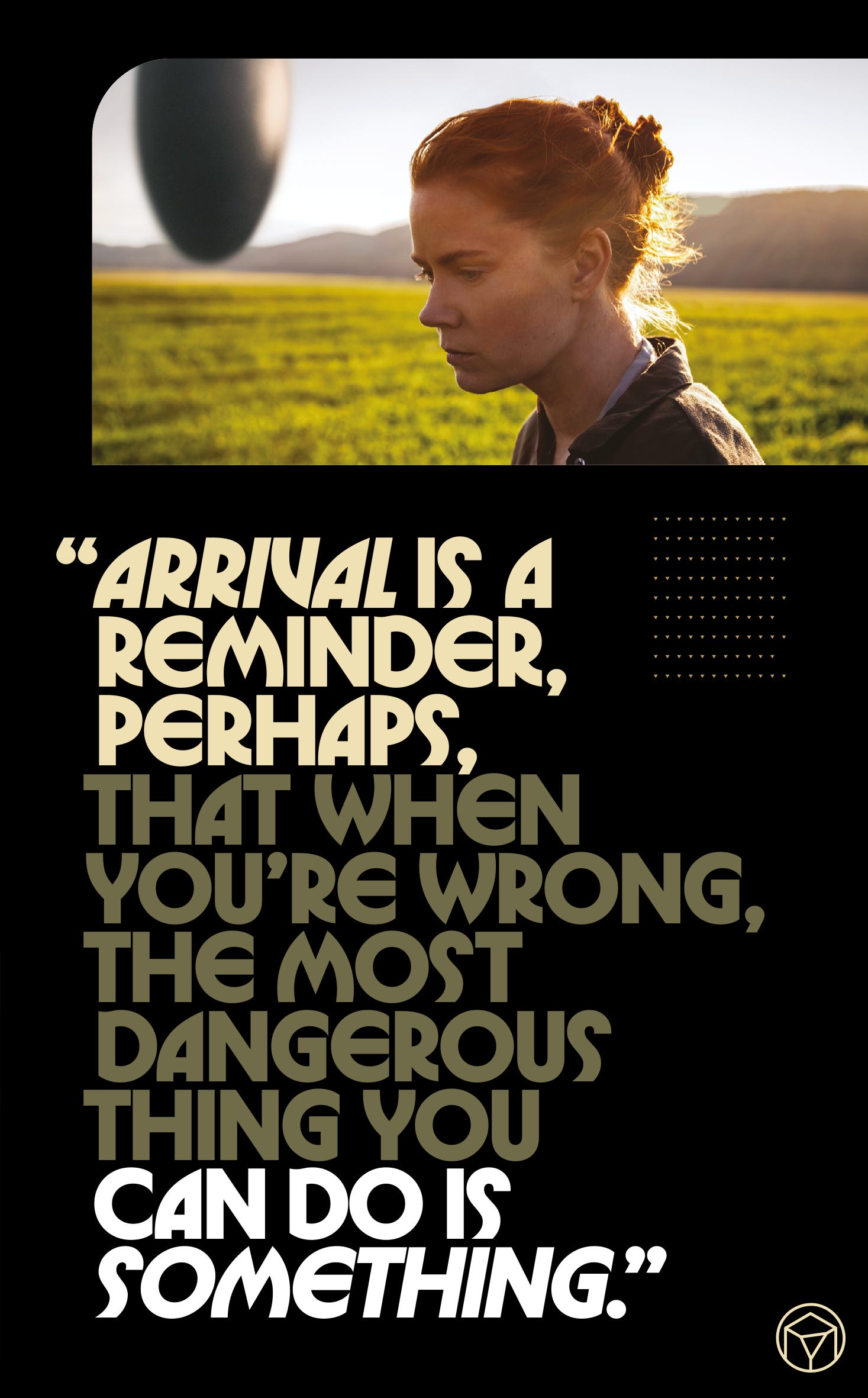
It’s a reminder, perhaps, that when you’re wrong, the most dangerous thing you can do is something. All roads seem to lead to war for the global military in Arrival, just as most of the actions taken by Dover and the police officer in Prisoners tend to make things worse rather than better. The real monsters in Villeneuve’s films don’t come from space. They’re normal people who have picked up the deadly notion that they can be certain about the way things are.
Compared to Arrival – compared to all the other films I’ve discussed here – Enemy is a far smaller story. It’s about a man who discovers he shares his town with a doppelgänger. Then they meet. And things get steadily worse from there.
Even though Enemy is a relatively early Villeneuve – it’s from 2013, putting it after Prisoners but before Sicario, Arrival and Blade Runner 2049 – it feels like the director, cribbing loosely from a José Saramago novel, has found a way to explore misperception in the most open-ended of all ways. Every conceivable thing in Enemy could be the result of misperception. Are the two protagonists truly identical? Is there actually two of them, or is this some kind of psychic break or fugue we are witnessing?
As the film unfolds, the people around them become confused: the wives and girlfriends and mothers. By the end of the film, the audience themselves may have lost track of which is which, as both men seek to infiltrate each other’s opposing lives, perhaps sensing that they have found the negative space of their own choices and temperament.
Enough of this muddling. Whatever the specifics of the story, and whatever treatment of misperception Villeneuve is offering, he does provide an unusual number of ways for the audience to orient themselves – at least with the knowledge that this is all the work of the same creator. Time and again his films offer delicate visuals paired with scripts of surprising bluntness. Arrival is a sensitive film despite the fact that its characters completely forgo subtext and chat about huge ideas – maths, language, love, time – with little attendance to the rhythms of genuine human speech. It’s a movie about the way that language works, and yet to hear it is to hear language of total falsity. And somehow, despite this, it’s gloriously affecting.
He’s also fond of treating everything as if it’s science fiction, showing how easily our perceptions can be muddled. In Sicario, Roger Deakins’ camera silently ghosts over Mexico before framing an Arizona suburb from high above, rendering it as precarious as a Martian outpost. He also likes to visualize his characters’ misunderstandings in neat ways. Circular labyrinths abound, from the recurring spiral motif of Prisoners to the protein farms of Blade Runner 2049 and the alien writing system of Arrival. Enemy’s city is perhaps the true villain of its story: endless mazes of identical concrete where people must somehow live and work, all of it pulled together with a spider’s web of tramlines. It’s a reminder that the best protagonist for these kinds of worlds is always lost, wrong-footed and looking for direction. Villeneuve should be making The Odyssey.
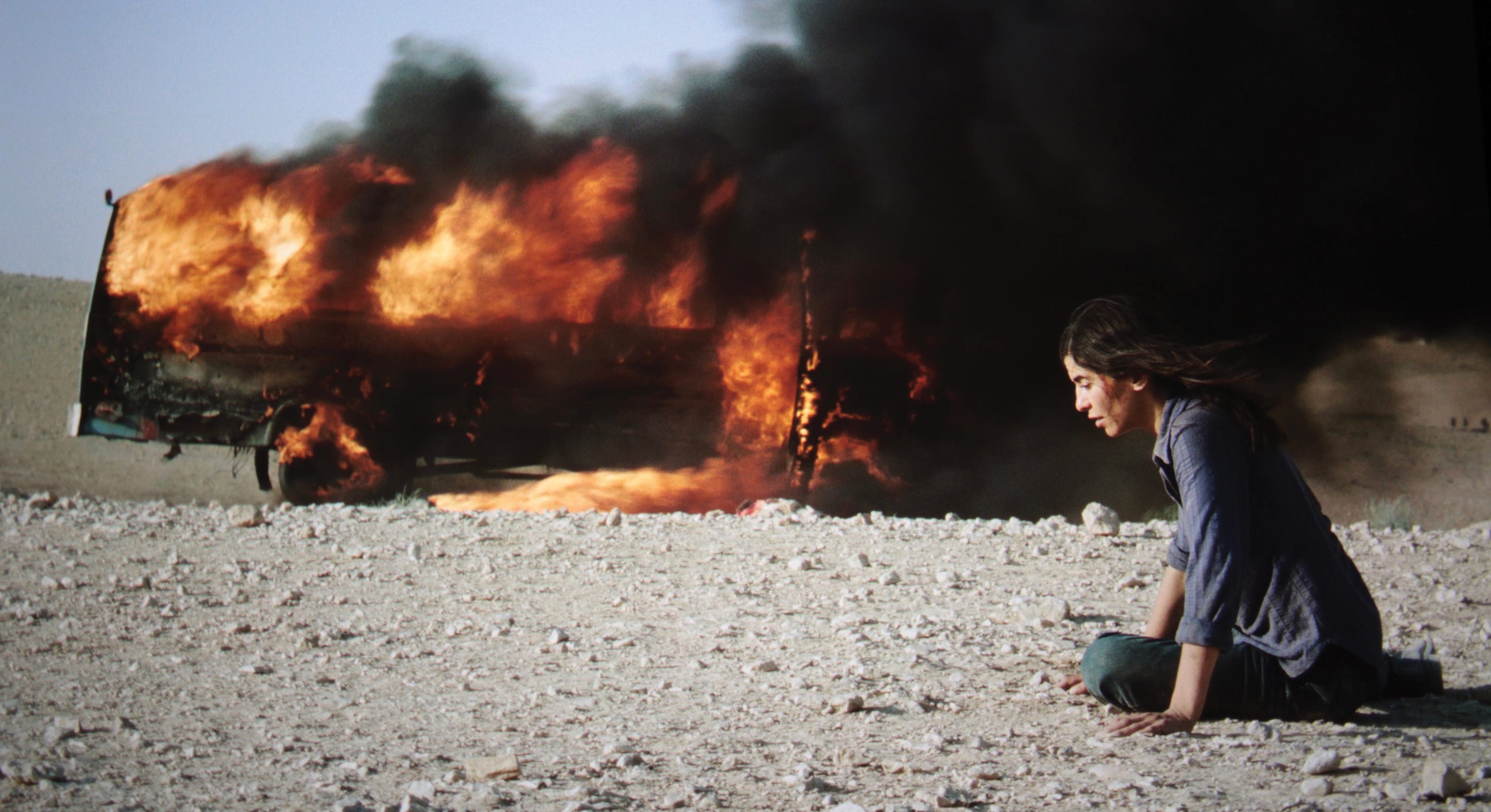
Perhaps he has already made it, in a manner of speaking. What would a Villeneuve film about trying to get home look like? It might look a lot like Incendies, the film of his I’ve watched most recently but which, having come out in 2010, predates Prisoners. Incendies is based on Wajdi Mouawad’s play of the same name, and focuses on a brother and sister. Upon their mother’s death these two siblings are dispatched by the instructions in her will to deliver two letters to people they have never met. One is to their true father and the second is to their brother, whom they were entirely unaware of while their mother was alive.
Through the course of the film, we uncover the mother’s story alongside them, from her youth in the Levant, where a bitter civil war is raging, through the birth of a son who had to be given away for adoption and into the heart of an uprising movement. She is sent to prison for assassinating a local politician, and in prison she is raped by a torturer and becomes pregnant. At the end of the film, the siblings learn that, through circuitous twists of fate, the man who raped their mother is also the son she had to give up for adoption. Their missing brother is their missing father, and both letters are for the same man.
It’s an astonishing film, switching seamlessly from one era to the next and soundtracked, for the most part, by little more than footsteps or car tires crunching on gravel. Its central coincidences feel less like implausibilities and more like profound verdicts on the forces of war that toss people around in wild eddies in their wakes. And even here, in the script for a play that Villeneuve helped adapt, misperceptions abound. But we also get the removal of misperceptions. By the end, we get the truth.
And so the mother and son do not recognize one another when they meet in prison. The siblings, however, slowly come to untangle their mother’s hidden life and strip the fog of history back until the truth of their own lives becomes horribly apparent. In one central scene, which may be among Villeneuve’s very best, the sister finds herself in a house filled with friendly women whose language she cannot speak. Once they find out who she is, the friendliness disappears and she’s confused by the enmity and rejection she suddenly faces.
She’s come to the house in search of her father, but her journey is muddled in ways she does not yet understand. “You’re looking for your father, but you don’t know who your mother is,” she’s told before she leaves. To add to the stacked tiers of confusion, the man she is looking for at the time will eventually turn out to be her father’s father rather than her own.
But Incendies ends on a note of hope, or something very like hope. And it’s perhaps the Villeneuve film where we get the clearest message about why the fight against misperception matters, despite the brutal costs involved. The siblings’ mother wants her children – all of them – to understand who they are and how their lives are connected. This is necessary to “break the chain of anger,” as she puts it. It’s a chain that extends beyond the Greek tragedy of the central family and out into the wider world with its civil wars and prisons and torturers.
The siblings eventually make it home, in the sense that by the end of the film they know who they are and how they got to this point. This is The Odyssey seen at an extreme angle: through hardship and the occasional kindness of strangers, a chance at some kind of peace.
As for Villeneuve, instead of adapting Homer after completing Dune – a series that famously builds up a singular hero purely to prove how dangerous and wrongheaded singular heroes are – he’s off to make James Bond. It’s a strangely tantalizing prospect. Bond the action hero is fine, but Bond the spy feels perfectly placed to allow Villeneuve to continue muddying truth and expectation. After all, in films like Sicario and Blade Runner 2049, if you stare long enough at the patterns, you’ll see that their protagonists’ misperceptions do not completely diminish them, but make their eventual revelations more powerful. Their lives are deepened by the act of understanding that misperception allows for. If that isn’t the best possible thing to take from the shadow world of espionage, what is?


Excellent piece. I’ve spent all this time trying to imagine what Villeneuve will do with Bond on a visual level, and now you’ve made me excited for what he could do on a philosophical level.