


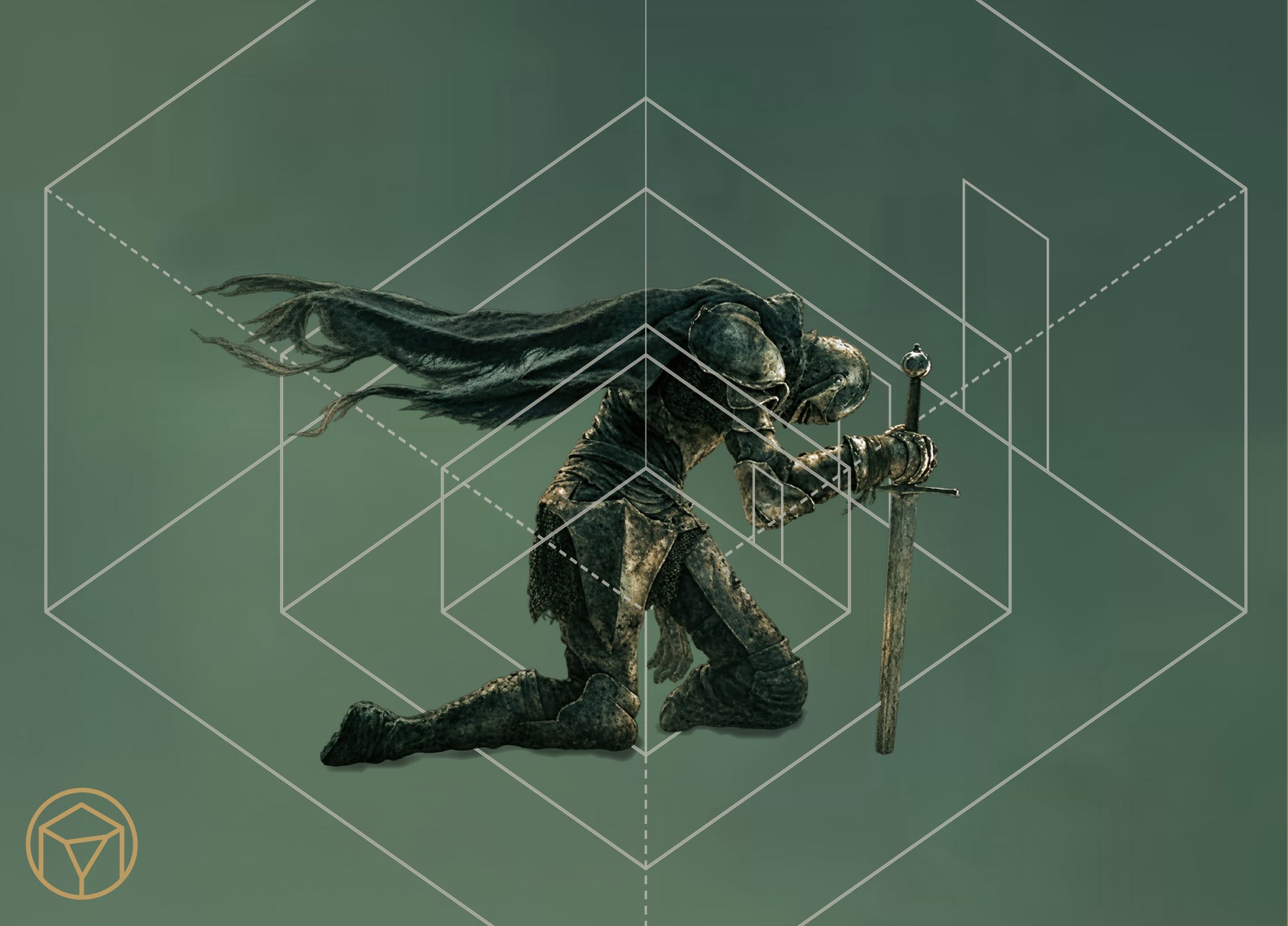
Sometimes getting lost means ending up in a place you already know. This familiar principle, equally known to hikers and video-game players alike, makes an unexpected appearance in Sigmund Freud’s classic essay “The Uncanny” (1919). Among several better-known examples of the titular feeling, including dolls, automatons and doubles, Freud tells a personal anecdote about getting badly turned around while on a trip to Italy. Walking through a provincial town, he finds himself in a questionable neighborhood – presumably a red-light district – and hastens to leave. But trying to get away only leads him back to the same place:
“[A]fter wandering about for some time without asking the way, I suddenly found myself back in the same street ... Once more I hurried away, only to return there again by a different route. I was now seized by a feeling that I can only describe as uncanny, and I was glad to find my way back to the piazza that I had recently left and refrain from any further voyages of discovery.” (Translation by David McLintock)
There is perhaps something overly familiar in this passage: in Freud, it would seem, all roads really do lead to sex. But just as emblematic is the role of familiarity itself, which forms the paradoxical heart of the uncanny as a concept. On the one hand, the German word unheimlich (“uncanny”) is the opposite of heimisch, meaning “familiar” or “belonging to the home.” (“Uncanny” can be translated literally as “unhomely.”) The uncanny is thus precisely what’s unfamiliar. On the other hand, Freud defines the uncanny as “that species of the frightening that goes back to what was once well known and had long been familiar.” So, strictly speaking, the uncanny is an unfamiliar return of what is itself deeply known.
What might this look like in practice? Imagine you are an astronaut traversing an alien planet. You step out of your landing pod into a thick mist and feel soft reeds underfoot. Before you lies a frozen pond ringed by bare trees, and beyond it, your childhood home. The family dog bounds toward you across the grass. You stand at the window and watch your father moving around his study.

Freud’s essay helps us express why such a scenario – vividly realized in the closing sequence of Andrei Tarkovsky’s film Solaris (1972), about which I’ll say more shortly – represents the height of uncanniness. But it also gives us a framework for examining how space functions in certain video games, and especially FromSoftware’s blockbuster fantasy RPG Elden Ring (2022).
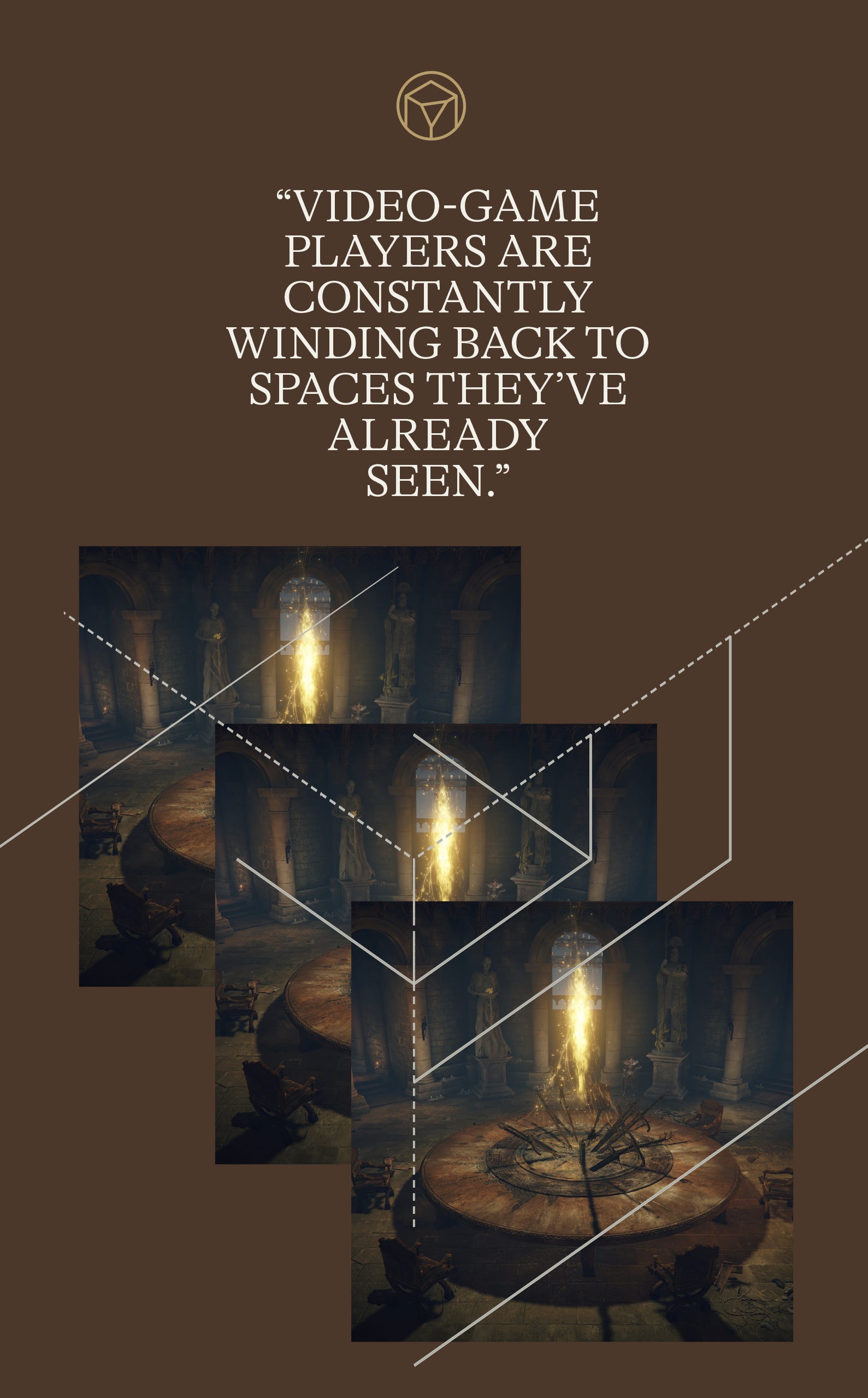
Video games, after all, make the return of the familiar a structural norm. Despite the staggering size and graphical detail of modern 3D gameworlds, technical as well as development restrictions dictate that such worlds are often built from a limited pool of environmental assets – trees, rocks, windows, walls, doors, bookshelves – repeated and recombined ad infinitum. Think of the endless maze of indistinguishable hallways in the original Doom (1993), or the identikit thatch-roof structures that compose each of the villages in The Elder Scrolls V: Skyrim (2011), each building itself furnished with the same cabinets, beds, tables, candlesticks, bread loaves and fruit bowls that you’ll find all over the gameworld, including in your very own house. Like Freud in his anecdote, video-game players are constantly winding back to spaces they’ve already seen (even when, as in Solaris, those spaces are actually new). Granted, the very familiarity of this ontological distortion has largely desensitized us to it. Gamers today feel at home in virtual worlds in which everything looks the same. But in a few key sequences, Elden Ring reactivates the uncanny force of the spatial repetition endemic to its medium.
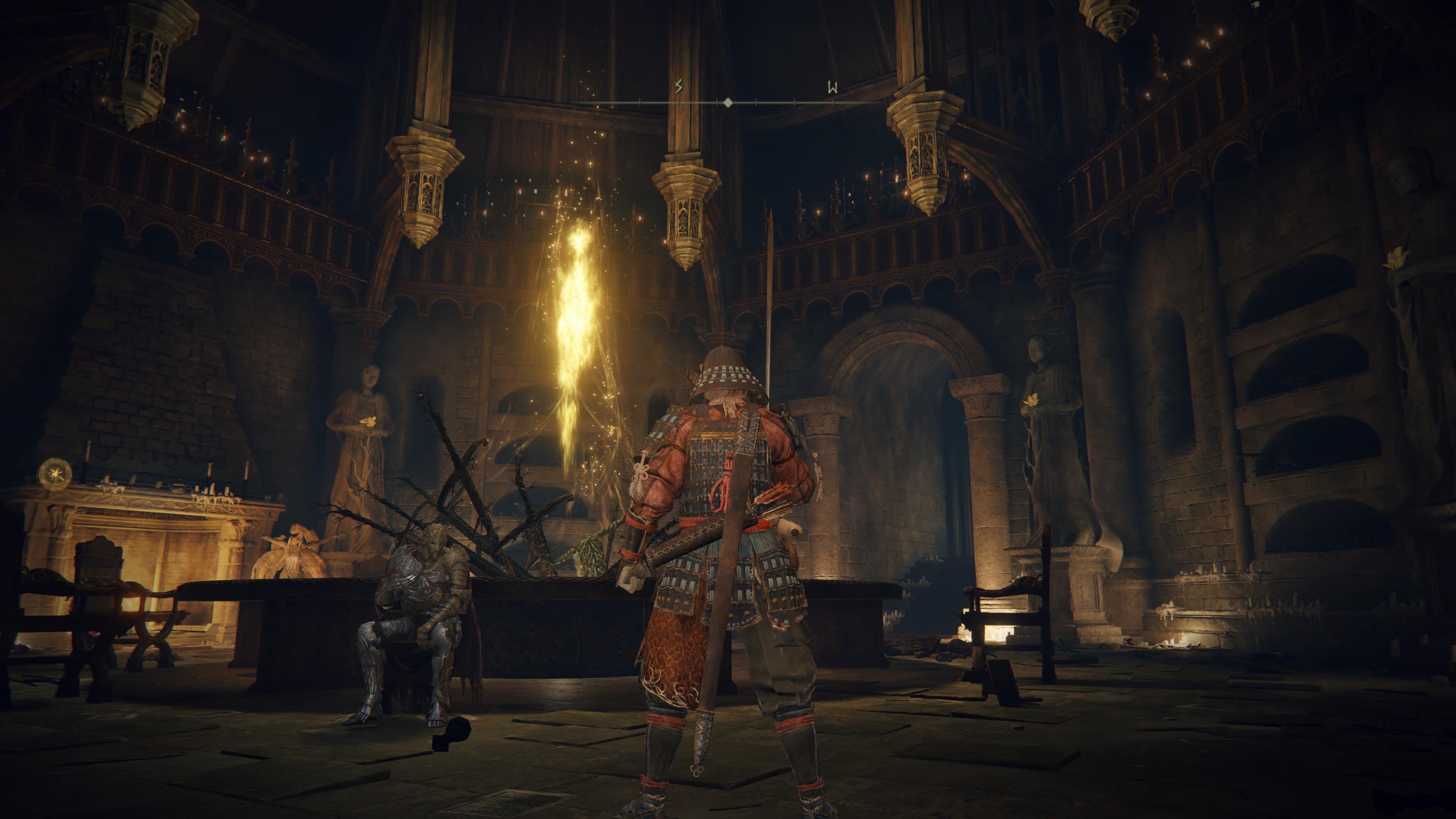
Consider the Roundtable Hold. At an early point in Elden Ring, your avatar is whisked away from the game’s open world – a spatially continuous landmass of mountains, forests, lakes and ruined cities that can be traversed seamlessly from end to end – to a castle hall populated by friendly non-playable characters (NPCs). Accessible instantly from anywhere, but only by teleportation, this sanctum seems at first uniquely disconnected from the rest of the gameworld. It also presents a stark change in vibe, trading the game’s brutal difficulty and oppressive atmosphere for a cozy hub where you can chat with fellow adventurers, purchase helpful items and upgrade your gear. Amid the unforgiving combat gauntlet of Elden Ring – whose dark fantasy world is populated by grotesque monsters that can kill your avatar in just two or three hits – the Roundtable Hold quickly becomes the closest thing the player has to a home.
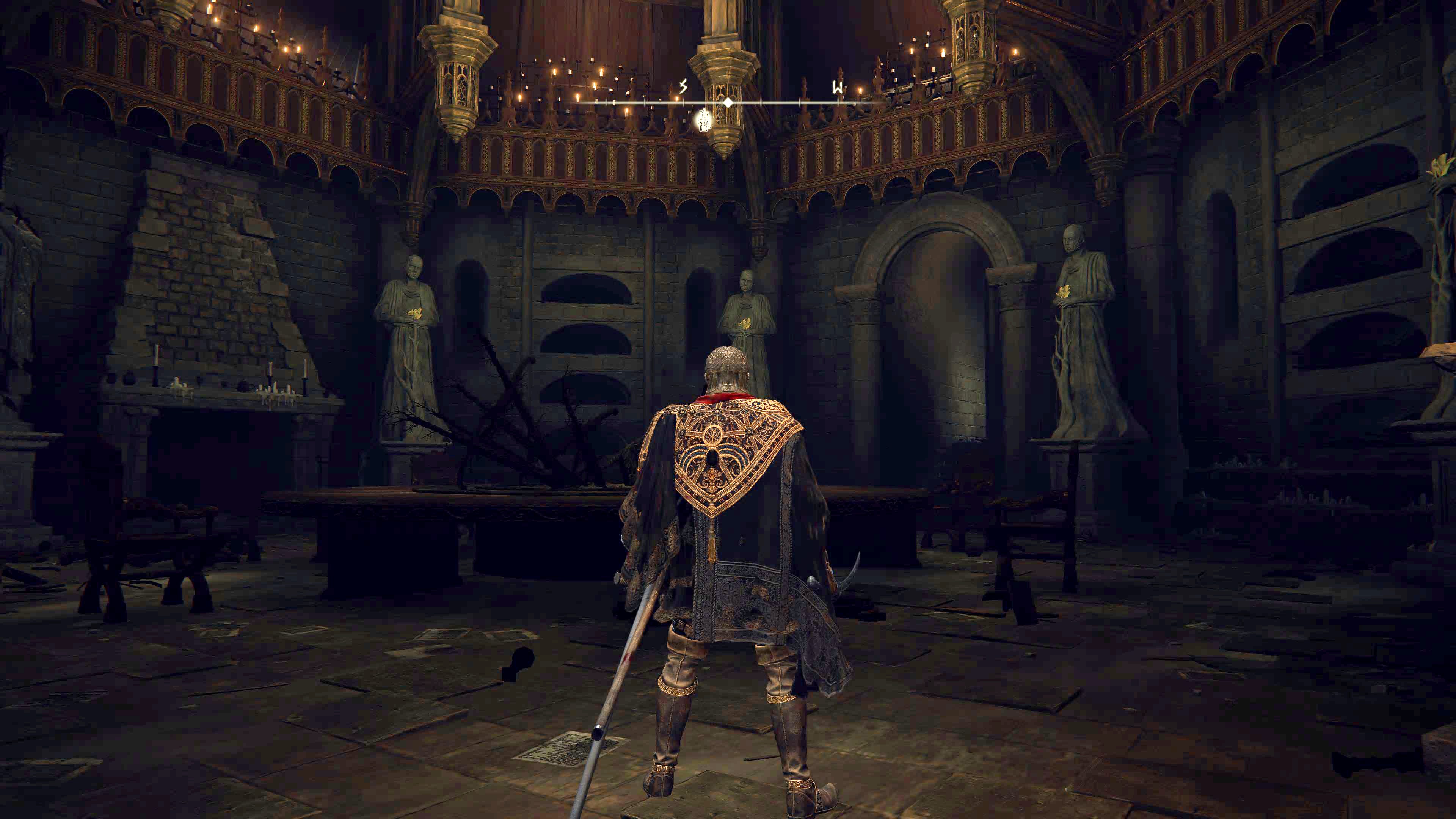
Dozens of hours later, however, Elden Ring’s more intrepid explorers will discover that this home has an uncanny double. In an abandoned quarter of Leyndell, the holy capital, one can find a rather drab-looking fort in the shadow of a titanic petrified dragon. Those who venture inside seeking arms or treasure, however, are in for a shock: this building is none other than the Roundtable Hold. Or rather, it’s the Roundtable Hold as it exists – or once existed – within Elden Ring’s actual physical world. The dawning familiarity as you wander its deserted hallways thus coincides with a powerful feeling of alienation. In this version of the game’s most intimately known space, the lights are out, the fires are dead and nobody is home.
The implications are disturbing. When Kris Kelvin, the protagonist of Solaris, touches down on the titular planet at the film’s end, he finds a simulacrum of his family house occupied by copies of his father and dog. We know they’re copies because his father acts a lot like a video-game NPC. As Kelvin peers into the house through the window, we see his father wander into a stream of water pouring inexplicably from the ceiling without giving the slightest reaction, exactly like those background automatons in Fallout 3 or Cyberpunk 2077 whose broken AI leads them obliviously into fire, water or poison mist while they calmly go about their daily tasks. (In the film’s opening scene, set at the “real” version of this same house, a summer shower breaks out while the father is standing in a doorway, and we watch him step instinctively into cover, mid-conversation, just as the rain begins to fall – an act of pure reflex that only becomes significant, as a telling sign of authenticity, on subsequent viewings.) Such inhuman behavior, especially in someone “well known” and “long familiar,” is certainly uncanny. Yet as the camera zooms out in the film’s final shot to reveal that all of this is taking place on Solaris, we are at least secure in the knowledge that the simulacrum of Kelvin’s home is exactly that: an ingenious act of communication, and perhaps even empathy, from the sentient planet itself.
Elden Ring’s Roundtable Hold, by contrast, jarringly reverses the usual hierarchy of copy and original. No doubt, the emptiness of the dilapidated hall is creepy in itself – as if we had unwittingly traveled into the future to witness the desolation of our most cherished living spaces. But far more unsettling is what this all-too-real ruin implies about the place we’ve been calling home. In an inversion of Solaris, here the familiar turns out to be the copy. The very decay of the abandoned Hold attests precisely to its physical reality, and hence, to the comparative unreality of the place we’ve been inhabiting this whole time. It would be like if Kelvin traveled to Solaris only to discover that his terrestrial home and family were never more than hallucinatory projections of the distant planet’s original will.
In Elden Ring this jarring effect is further heightened by context. As in the rest of the unofficial “Soulsborne” series from which it hails, individual locations in the game are often structured as loops, thoughtfully built around unexpected returns to already-traversed spaces. If one trademark of the series, famous for its imposing challenge, is the blunt message “You Died” that appears on the screen whenever your avatar falls in battle (or simply falls), just as representative is the small moment of relief and wonder when you open a door to find yourself back at a known safe haven, now furnished with a convenient shortcut to a deeper part of the level. (I discuss this level-design trope in Grant Us Eyes: The Art of Paradox in Bloodborne, my book on an earlier entry in the same series.) The surprise discovery of the “real” Roundtable Hold thus plays on precisely this expectation of return, goading us not just with the likeness of a familiar space but also with the knowledge that we could very well stumble upon an indirect path to our Roundtable Hold somewhere in Elden Ring’s open world. Just as the final sequence in Solaris initially primes us to read Kelvin’s landing on the alien planet as a genuine return (“I guess it’s time for you to return to Earth,” Kelvin’s friend Snaut tells him just before we see him arrive at the house), the discovery of the abandoned Roundtable Hold is likely experienced first as a real homecoming and only belatedly as an uncanny repetition. I want to call such moments “fake returns.”

Fittingly, fans of the Soulsborne series have been here before. The two preceding games – Bloodborne (2015) and Dark Souls III (2016) – each contain a similar moment wherein the player, exploring off the beaten path, finds a deserted replica of their home base that turns out to be the original from which the more familiar space is derived. In Elden Ring the fake return on the level of content is thus an actual return on the level of form. The trope of repetition itself repeats.
For Freud, the phenomenon of repetition is just as ambiguous as the uncanniness it can evoke. In “The Uncanny,” Freud suggests that repetition is unsettling because it reminds us of the repetition-compulsion that characterizes infant psychology, a primitive instinct we’ve supposedly long since repressed. In Beyond the Pleasure Principle (1920), however, he also describes the repetition-compulsion as a technique for mastering unpleasant experiences. Repetition thus at once disorients and orients, both awakens disturbing memories and allows us to manage them. Accordingly, although Elden Ring’s fake return to the Roundtable Hold may unnerve us when experienced in isolation, its larger repetition as a world-design trope arguably works contrariwise in this latter, more positive sense. Once the initial disorientation wears off, for some players this redux of a celebrated moment from the previous two games might feel almost cozy. By affirming a pattern across the series, here the fake return’s estrangement of our familiar domestic space also domesticates – in the true sense of the word – the uncanny itself.
Yet Elden Ring still has an ace up its sleeve. Not far from the abandoned Roundtable Hold, in a destroyed residential neighborhood of the same city, one can descend a well to find a sprawling sewer system that itself hides yet another secret location. This is the Leyndell Catacombs, a “dungeon” – or tightly designed space with a bespoke sequence of challenges and rewards – inside a dungeon (the Leyndell sewers) inside another dungeon (the capital city itself). This nested structure mirrors the location’s own design, which seeks to confuse the player by putting them through not one but two fake returns. As you explore the catacombs, killing enemies and avoiding traps just as you do in all the other catacomb dungeons in Elden Ring, you eventually reach the second floor of the dungeon’s entrance hall. With no other pathways available, one has no choice but to drop back down to the first floor and begin retreading the linear series of rooms you just cleared, now populated by the bodies of your fallen foes. But completing this loop only leads you back to the upper level of the same hall, whereupon you must drop down and double back once more.